

The Conversation
NYU Law is a place where people come to talk about ideas that matter. Every year, the Law School hosts a rich variety of speakers—scholars, experts, and leaders from government and business—who share knowledge, examine vital issues, and join faculty and students in robust intellectual debate. These conversations spark new ideas, expand perspectives, and help drive change throughout the world.

“Interpreting the Constitution…cannot be undertaken without humility, courage, and a commitment to the public interest over time, because rights are not frozen in time or in text.”
In the James Madison Lecture, retired Canadian Supreme Court Justice and Distinguished Judicial Fellow Rosalie Silberman Abella argued for taking changing social realities into account when deciding constitutional questions. Read more about the Madison Lecture.
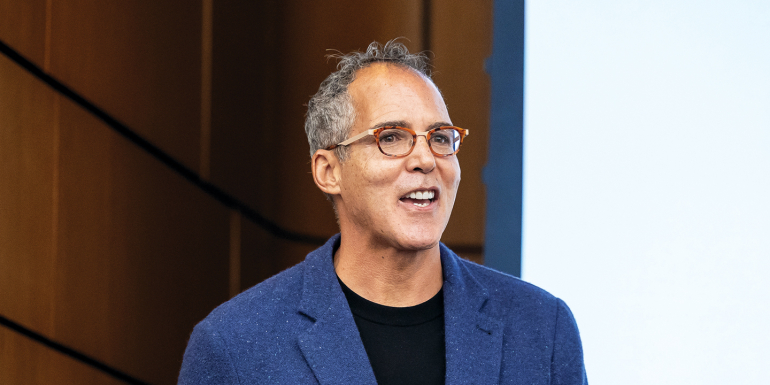
“I want to talk for a minute right now about class as well—and socioeconomic status—which [have] been left out of the conversation for too long, and about what it means when we say expand access to law, expand access to other professions.”
In the Derrick Bell Lecture on Race in American Society, Professor James Forman Jr. of Yale Law School argued that pipeline-to-law-school programs are still needed to open opportunities for a broader spectrum of students. Read more about the Derrick Bell Lecture.

“Words are written for a reason…. ‘We the people do ordain this Constitution’—that’s why the words have an authority, and to interpret the Constitution as meaning something other than what [the founders] meant when they wrote those words just to my mind doesn’t make a lot of sense.”
In a Respectfully Dissent dialogue, visiting professor Michael McConnell, former judge on the US Court of Appeals for the Tenth Circuit, called originalism the most sensible way to interpret a constitution. Read more about the Respectfully Dissent discussion series.

“Some of the most powerful advocacy can come from showing respect to the other side, acknowledging the force of some of their better points, and using the force of persuasion and legal analysis to demonstrate why, nevertheless, you should prevail.”
Robust courtroom argument doesn’t mean sacrificing collegiality, said former US Solicitor General Elizabeth Prelogar during an NYU Law Forum sponsored by Latham & Watkins. Read more about the Forum.

“If you care about equality, if you care about dignity, if you care about freedom, then our institutions, including the rule of law, are essential pieces of the puzzle.”
Delivering the Fred T. Korematsu Lecture, US District Court Judge Dale Ho emphasized that public trust in legal institutions—despite their inherent flaws—is crucial to safeguard rights. Read more about the Korematsu Lecture.

“At what stage do you say this is a question of interpretation, and in what case do you think, ‘Well, no, it’s a case of amendment and a decision by the people’?”
During the Emile Noël Lecture on the State of the European Union, Donal O’Donnell, Ireland’s chief justice, discussed the role of the courts in a constitutional order. Read more about the Emile Noël Lecture.

“Inevitably, constitutional theory bows to constraint, because the justices and judges will ignore it when it doesn’t get to the results that they want to come to.”
In the Jorde Symposium, Erwin Chemerinsky, dean of UC Berkeley School of Law, disputed the idea that constitutional theory offers an objective method to decide cases. Read more about the Jorde Symposium.

“[We] need more folks with compassion, empathy, a sense of excellence, real skill, and substance in these roles [in the legal profession].…We need more folks who used to be poor and know what that feels like.”
Delivering the Attorney General Robert Abrams Public Service Lecture, Massachusetts AG Andrea Joy Campbell offered advice to law students. Read more about the Abrams Lecture.
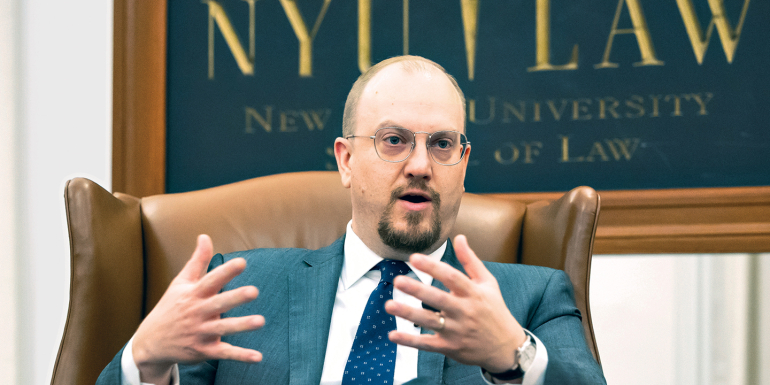
“[Tech companies] are the largest corporations in our economy, in the world, in the history of man.… And it is precisely when you have that much aggregation of economic power that you have to be on heightened alert for its abuse.”
During an NYU Law Forum sponsored by Latham & Watkins, Federal Trade Commissioner Mark Meador discussed antitrust enforcement in the technology sector. Read more about the Forum.

“The challenges we face can’t be solved through legislation alone. We don’t live in a time where there is politics as usual. I believe we need to build a movement, an anti-corruption movement, that will help fight against the apathy, against the helplessness, against the antibodies of the status quo.”
US Senator Andy Kim of New Jersey explored the costs of political corruption and proposed remedies as he delivered the Robert A. Katzmann Lecture. Read more about the Katzmann Lecture.
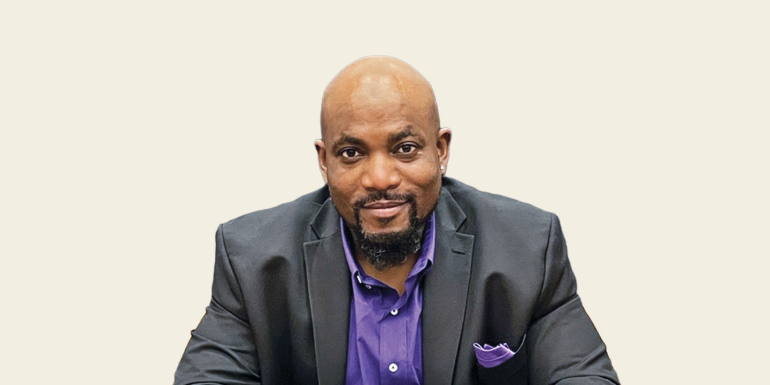
“What if I didn’t do something to reform myself? What if I tried—and there just wasn’t nothing there? And these people [are] coming out here with no education, with nothing, you understand?”
Kevin Haynes, who served 26 years in federal prison after being convicted of bank robbery, described the lack of resources available for rehabilitation in prison during a panel discussion in the Kenneth P. Thompson ’92 Lecture on Race and Criminal Justice Reform. Read more about the Thompson Lecture.
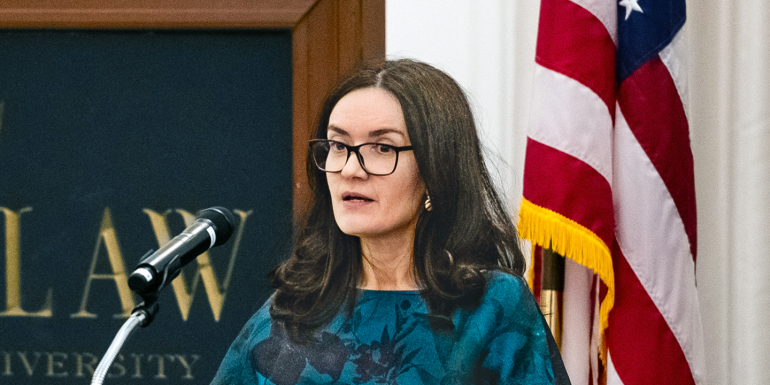
“That in a nutshell is the problem facing tax state aid enforcement today—not even experts can state with confidence what it is supposed to accomplish.”
In the David R. Tillinghast Lecture on International Taxation, Professor Ruth Mason of the University of Virginia School of Law critiqued ambiguities in the European Union’s regulation of state support to businesses. Read more about the Tillinghast Lecture.

“A robust dialogue between the branches of government and the people makes for greater governmental legitimacy, quite apart from stare decisis.”
In the IJA Brennan Lecture on State Courts and Social Justice, Chief Judge Rowan Wilson of the New York State Court of Appeals argued for amending state constitutions more frequently. Read more about the Brennan Lecture.