

Two former Solicitors General talk about myths and realities of the SG’s Office
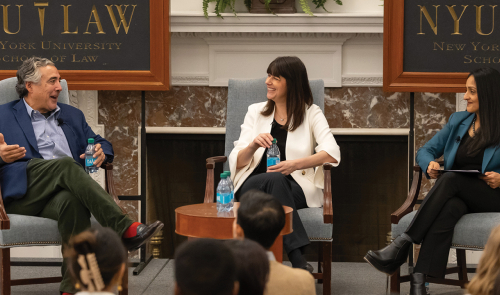
Noel Francisco, Elizabeth Prelogar, and Vanita Gupta ’01
The US Solicitor General is sometimes called the “10th justice” of the US Supreme Court—but two former solicitors general took issue with that notion during an NYU Law Forum, sponsored by Latham & Watkins, on January 28. Former SGs Elizabeth Prelogar and Noel Francisco emphasized that the solicitor general serves as a litigator and strategist for the presidential administration in which they serve. “The solicitor general is an advocate. You are advocating on behalf of the interests of the executive branch,” said Francisco.
Still, a recurring theme in the discussion was the balance that SGs must strike between vigorously advocating for the federal government and taking positions that maintain the credibility of their office. “The Solicitor General’s Office is the quintessential repeat player in the Supreme Court,” Prelogar said, adding that the “10th justice” idea stems from the special institutional familiarity between the office and the Court. Preserving the trust of the Court requires an extra duty of candor and exactitude from the SG’s Office, she said.
Watch the Forum featuring Noel Francisco and Elizabeth Prelogar :
The January 28 Forum, “A Conversation with Solicitors General,” brought the two former SGs to the Law School to discuss the unique role of the solicitor general. Francisco is now partner-in-charge of Jones Day’s Washington, DC, office, and Prelogar is a partner at Cooley. Distinguished Scholar in Residence Vanita Gupta ’01, former US associate attorney general, moderated the conversation.
Although the mission of the SG’s Office is to represent the federal government in the Supreme Court, that often means getting involved in litigation well before it moves to the high court, the panelists said. “Even today my favorite part of the job is not the actual argument in the case,” Francisco said. “[It’s] where you've got a client that’s got an objective and there’s a thicket of legal woods in between where they’re sitting and what their objective is, and you need to help guide them through those woods to achieve their objective. And that is what the solicitor general is often called upon [to do] when you’re defending the administration’s most important issues.”
Gupta asked Francisco and Prelogar how each handled already-pending cases when taking the reins at the start of a new presidential administration. What if, she posited, “there’s a policy that is getting defended that is totally anathema to the current president”? In most cases, Francisco responded, the correct approach is for the new administration to change the policy.
But sometimes, he added, the policy change isn’t possible or the SG’s Office might be defending a statute. “And so you are put in a position of deciding whether or not to flip the administration’s position in active litigation,” he said. “I generally approach that with…a three-part test. Is the issue important? Are we right? And are we likely to win? And generally all three of the factors would have to line up if I was even going to consider flipping the position.”
Prelogar agreed that the decision to reverse positions in pending litigation isn’t taken lightly. “I approached that set of decisions with a strong thumb on the scale of maintaining consistency, because it does potentially use up credibility or suggest to the Court that the United States is not always being super-thoughtful in articulating its positions,” she said.
At the close of the discussion, Gupta cited concern in the legal profession about strains on the rule of law, including recent attacks on judges and public questioning of the legitimacy of the courts. “What responsibility do you think that institutional actors such as the Solicitor General’s Office have, if any, in reinforcing public confidence in the law and the judiciary?” she asked.
“I think it’s our job and our obligation to model…civil discussion and civil debate,” Francisco said. “[As SG,] when I argued some very controversial cases on hot issues, I always spent a lot of time thinking about how I wanted to describe the issues in a way that would take down the temperature.”
“There’s this tradition in the Court of calling opposing counsel ‘my friend,’” Prelogar said, “And I always kind of chuckle at this, because usually when I would refer to ‘my friend,’ it’s because I was gearing up to set out to utterly destroy his point of view.…But I think it gets to the heart of what Noel was saying, which is that we’re litigators and so we’re by definition oppositional.… Yet that doesn’t mean that you have to sacrifice collegiality or assume bad motives or use ad hominem attacks or take the temperature up with rhetoric. I think that some of the most powerful advocacy can come from showing respect to the other side, acknowledging the force of some of their better points, and using the force of persuasion and legal analysis to demonstrate why, nevertheless, you should prevail.”