In the Katzmann Lecture, Senator Andy Kim takes aim at political corruption
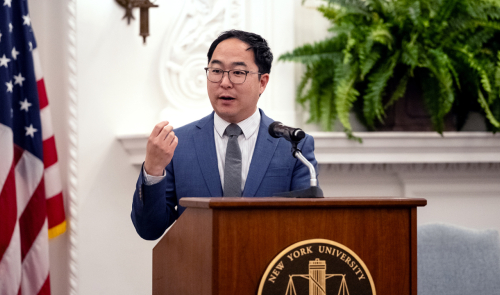
Last year’s edition of Transparency International’s Corruption Perceptions Index, which gauges countries’ perceived resistance to corruption, gave the United States its lowest score since the index’s current scale debuted in 2012. That result likely would not surprise US Senator Andy Kim of New Jersey, who focused on corruption in politics when he delivered the fifth annual Robert A. Katzmann Lecture on April 6. The event honors the career and impact of the late Judge Katzmann of the US Court of Appeals for the Second Circuit, a professor of practice at NYU Law.
Corruption has seldom been far from Kim’s mind over the course of his political career. “I’m in the Senate by virtue of a corruption scandal in New Jersey,” said Kim, referring to the Senate seat vacated by former Senator Bob Menendez, who resigned after being convicted of conspiracy to act as a foreign agent. Shortly before Menendez’s indictment, Kim added, a survey had found that 84 percent of New Jerseyans surveyed thought their elected officials were corrupt.
Kim said he aims his anti-corruption efforts at his own party, the Democratic Party, as well as at the Republican Party. During his Senate campaign, Kim successfully sued to change a design that placed candidates endorsed by party leadership in a preferential position on primary ballots.
“I was not supposed to be a senator,” said Kim, a 43-year-old Korean American. “I didn’t put in the work to kiss the rings. I’m from the wrong part of the state, I’m the wrong age, I’m the wrong ethnicity. I heard it all. But politics shouldn’t be just some exclusive club for the well-off and the well-connected.”
Having grappled with state-level corruption during his campaign, Kim said, he found political corruption at the national level to be even worse than he had expected. He had seen the consequences of such corruption play out earlier in his career, when he worked for the US Department of State as a civilian advisor to four-star generals David Petraeus and John Allen in Afghanistan. Later, at the White House National Security Council, he advised President Barack Obama as Iraq director.
“In Iraq, we saw corruption lead to a country that was not only less prosperous, but less secure,” said Kim. “I saw prime ministers and the highest-level officials grabbing as much as they could, running the work as if it was Tony Soprano’s waste management business. It was in part the corruption that made the Iraqi government weaker when they faced the rise of the terrorist group ISIS. In Afghanistan, corruption undercut the legitimacy of the government. It cost the government billions of dollars and ultimately the faith of the Afghan people.”
Referring to President Donald Trump’s refusal to divest from his own businesses while in office, Kim said, “I’ll be honest—corruption was deeply rooted in our politics well before Trump. And we may not have seen it as industrialized as we do today, but for years, we’ve seen corporate money flooding into our politics, the conflicts of interest, the voice of everyday people repeatedly silenced.”
Kim noted that his firsthand observations of corruption have been instructive: “I have come to see that the problems of corruption and broken politics affect my ability to get things done in every other policy issue that I want to work on. It is so core and fundamental.”
He went on to propose a range of anti-corruption measures. In the realm of elections, Kim argued for implementing national nonpartisan commissions to end partisan gerrymandering. He advocated for reforming campaign finance by overturning Citizens United v. Federal Election Commission and limiting certain kinds of donations.
Kim also recommended various measures to prevent corrupt acts by public officials. These included banning stock trading across all three branches of the federal government; reforming the pardon power; and protecting independent watchdog agencies from being disempowered by the politicians they monitor. He proposed closing loopholes in bribery statutes that were created by rulings such as Snyder v. United States, in which the Supreme Court held that “gratuities”—gifts given to officials after an official act—are permissible. Finally, Kim asserted the need for greater public service opportunities to counter citizens’ apathy and disillusionment with the current system.
“If you are worried about the trajectory of our democracy, what are you willing to do about it?” asked Kim. “The challenges we face can’t be solved through legislation alone. We don’t live in a time where there is politics as usual. I believe we need to build a movement, an anti-corruption movement, that will help fight against the apathy, against the helplessness, against the antibodies of the status quo.”