Rosalie Silberman Abella, retired Canadian justice, contrasts American and Canadian constitutional rights in Madison Lecture
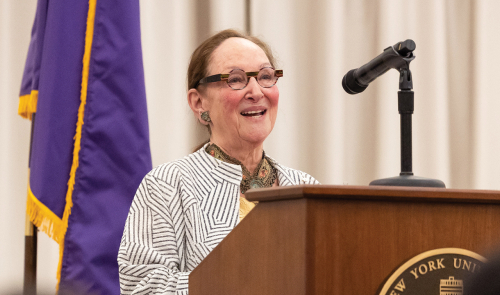
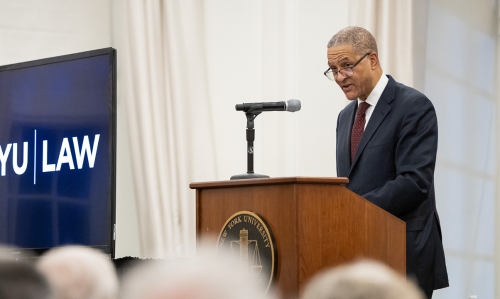
Rosalie Silberman Abella, a former justice of the Supreme Court of Canada, offered a wide-ranging exploration of the differences between American and Canadian constitutional jurisprudence when she delivered the 2026 James Madison Lecture on February 19 at NYU Law. Hosted by the Arthur Garfield Hays Civil Liberties Program, the Madison Lecture series was founded in 1960 to promote the understanding and appreciation of civil liberties. Abella led with a joking reference to the recent US victories against Canada in Olympic hockey—“I’m not very bitter. I’m going to give my lecture anyway”—and then promised remarks focused on “constitutional interpretation, democratic theory, literature, and even some law.”
Watch the 2026 Madison Lecture on video:
Abella began by comparing US and Canadian ideas about equality. In the United States, Abella said, the notion of the “melting pot” promoted cultural assimilation within the context of formal equality—i.e., equal freedom from government intervention or regulation for individuals. By contrast, she said, Canada believed that “differences were to be taken into account based on the recognition that if people were all treated the same or equally, inequality could result”: one size may not fit all. She extolled the ability of literature to foster empathy by exposing readers to experiences outside their own: “Most of us have probably never experienced the desperation of the central characters in Crime and Punishment, their crushing poverty in Joyce Carol Oates’s Them…. But through great writing, we can experience what the world looks and feels like to others.”
Abella also distinguished between the free speech ideals of the two nations. While freedom of speech is considered virtually absolute in the US, she said, in Canada, “the lessons of history show us that sometimes hateful and vitriolic speech can silence debate, especially if those it targets are vulnerable.”
The human rights atrocities of World War II, or what Abella called “the horrifying spectacle of group destruction,” persuaded the world—the US included—of the value of human rights and multiculturalism, leading to the civil rights movement and the sweeping decisions of the Warren Court. But the creation of a more level playing field in the US—thus shifting who is rewarded—resulted in changes that some found hard to tolerate, she said. Their reaction was to declare that sufficient progress had occurred and that a difference-based approach to equality was no longer useful, the justice said.
Abella explained that in Canada, a 1929 ruling that characterized the Canadian constitution as “a living tree capable of growth and expansion within its natural limits” effectively ended constitutional originalism in that country.
The rest of the world has diverged from the US in its approach to constitutional rights, Abella said. Nations outside of the US, she said, “rejected the view that interpreting constitutional rights in a way that recognizes changing social realities is legislative trespass, or a violation of neutrality, or judicial activism—a phrase that only seems to be aimed when rights are expanded, not restricted.” Abella suggested that the current US Supreme Court seems to have adopted a rights-restricting approach to constitutional rights not unlike that in the infamous Dred Scott v. Sandford case that denied citizenship to Black people, when Chief Justice Roger Taney wrote, “It is not the province of the court to decide upon the justice or injustice, the policy or impolicy, of these laws. The decision of that question belongs to the political or law-making power....”
Abella offered this interrogation: “If the courts cannot decide upon the justice or injustice of a law, who can?”
“There’s a difference between stability and stagnation,” she said, “and the constitutional interpretation that ignores the social realities of vulnerable minorities in favor of majoritarian impulses to protect the status quo turns a constitution from a safeguard into a straitjacket…. Justice is the application of law to life. It is not a science…. With knowledge comes understanding, with understanding comes wisdom, and with wisdom comes the capacity for justice. And justice, after all, is what law is for.”