Ireland’s Chief Justice Donal O’Donnell examines what courts can and cannot do in Emile Noël Lecture
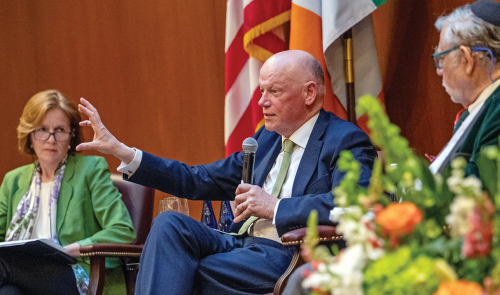
Síofra O’Leary (left), Donal O’Donnell, and J.H.H. Weiler
Donal O’Donnell, chief justice of Ireland, explored the role of courts in a constitutional order during the 17th annual Emile Nöel Lecture on the State of the (European) Union, looking back at how Ireland legalized abortion and same-sex marriage and considering whether law can address political polarization in Europe.
Entitled “Reflections in a Friendly Mirror: A View From a National Court,” the April 13 event was moderated by J.H.H. Weiler, University Professor and director of the Jean Monnet Center for International and Regional Economic Law and Justice, and by the former president of the European Court of Human Rights, Síofra O’Leary, who is now a Hauser/Remarque global fellow at NYU Law.
The discussion began with O’Donnell recalling his experiences growing up in West Belfast in Northern Ireland, in the 1960s and 1970s during the era of sectarian violence and social unrest known as “the Troubles.” He said: “I have a memory of playing records on a record player and then hearing gunfire outside the window and seeing a man running across with a rifle. It was this sort of normal life and very abnormal.”
The turbulent period, O’Donnell added, influenced his decision to pursue a career in law. In 1971, his father was appointed a justice of the High Court of Northern Ireland; he later served as a lord justice of appeal. O’Donnell decided to study law in the Republic of Ireland, entering University College Dublin in 1976. He later advanced his studies at the King’s Inn, the oldest law school in Ireland, and earned an LLM from the University of Virginia School of Law in 1983. As barrister-at-law, O’Donnell handled cases involving commercial law, employment law, intellectual property, defamation, and constitutional law. In 1995, he was named senior counsel, appearing in all courts in Ireland and Northern Ireland as well as the European Court of Justice and the European Court of Human Rights. After being appointed to the Supreme Court of Ireland, he became chief justice in 2021.
Both abortion and same-sex marriage were legalized in Ireland in 2018 and 2015 respectively, following historic referendums that repealed constitutional amendments. O’Donnell saluted the fact that—following protracted legal battles—the laws were enacted after being put to a vote. “It was a great thing that people were asked to make the decision themselves. This isn’t something that only the lawyer understands. Anybody was capable of sitting down and saying, ‘What are the reasons to pass this amendment or not?’” he said. “Again, that leads back into the question of, ‘What is the correct role of court in a constitutional order?’” At what stage do you say this is a question of interpretation and in what case do you say, ‘Well, no, this is a case of amendment and a decision by the people’?”
Another subject on the agenda was what O’Donnell called “the delicate balance” of negotiating the complex constitutional tensions that periodically emerge between Ireland’s courts and the European Union. While the Supreme Court serves as the ultimate arbiter in the legal system of Ireland, the Court of Justice of the European Union holds the highest authority on matters of European law. But, O’Donnell added, the sheer number of judicial bodies and varied legal decrees raise the risk of stalemate and uncertainty. In human rights cases, for example, “you have the national constitution, you have the European Convention on Human Rights, and you now have the Charter of Fundamental Rights of the European Union, all jostling, but causing problems of interpretation,” he said. “And that delays the process of decisions. And that then calls into question the whole effectiveness of the process.… It's really important to the whole concept of judicial review that courts are acting as courts.”
The discussion turned to the rising tide of political and social polarization across Europe—what O’Donnell described as “the question” currently facing society as a whole. “It is driven by a sense that the Western capitalist, democratic model isn’t performing for people; some people are losing out,” he said. The issue is one that transcends the legal system, he added. “I think it’s a mistake to think the courts are the institution that are going to stop developments that we disapprove of. There’s a whole range of things that have to happen within society,” he said. “It’s important, in my view, to get the jurisprudence right. But it is a little bit above my pay grade to sort out all the problems of Europe.”
Throughout the dialogue, O’Donnell routinely invoked the words of Irish writer Seamus Heaney, whose poetry on the resilience of the human spirit during the Troubles later earned him a Nobel Prize in Literature. To the students in the audience, O’Donnell sought to convey a similar message of fortitude in the face of upheaval and uncertainty.
“In a curious way, a bit like in Northern Ireland [during the Troubles], we’re living in very dangerous times. But in a way, it clarifies what our course is and that the human reason is invincible. Now, that may be in the sense that that’s what we must believe in…. that even when the pendulum is swinging in the opposite direction, holding yourself to that [belief in reason] is really important.”
“I would say to the students,” O’Donnell continued, “there’s no more important time to be studying law than today. There’s no more important time to be advancing the belief in human reason and [in] the reasoned resolution of disputes by interaction between people of different views, but of good will, whether in universities or in courts.”