Constitutional theory should be retired, Erwin Chemerinsky argues in Jorde Symposium

Erwin Chemerinsky
“I want to suggest this afternoon that it’s time to put constitutional theory as it has been done for over 60 years to rest,” constitutional scholar Erwin Chemerinsky announced as he delivered remarks titled “Against Constitutional Theory” during the Brennan Center Jorde Symposium on February 5. For decades, he said, constitutional law has been on “a futile quest that has misdirected constitutional scholarship and judicial decision-making.” In particular, Chemerinsky, the dean of the University of California, Berkeley, School of Law, critiqued the approach known as originalism.
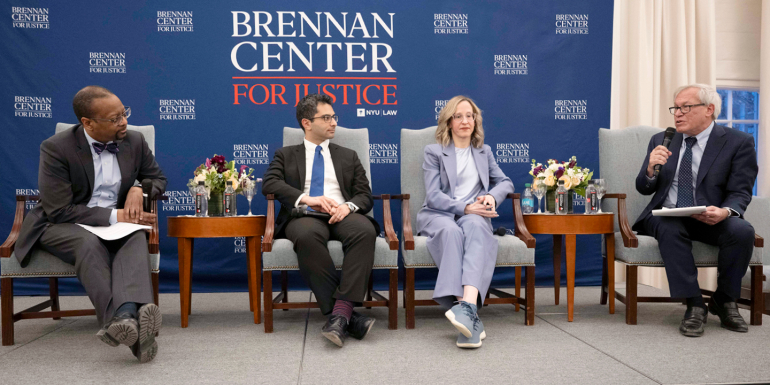
The event marked the 30th anniversary of the annual Jorde Symposium, which focuses on issues integral to the legacy of Justice William Brennan Jr. The symposium’s format is distinctive in that the Jorde lecturer delivers the same remarks twice—at Berkeley Law and at NYU Law—with different commentators at each presentation. Sherif Girgis, professor of law at the University of Notre Dame, and Leah Litman, professor of law at the University of Michigan, provided commentary at NYU Law. Dean Troy McKenzie ’00 introduced all three of the speakers.
Chemerinsky began by tracing the influence of 20th-century legal theorists such as Alexander Bickel and Robert Bork. They highlighted the tension between judicial review and democracy: unelected judges can overturn the decisions of elected officials. Bork contended that the only way to reconcile judicial review and democracy “would be for the Supreme Court to remain true to the original intent [of the Constitution],” Chemerinsky said.
Chemerinsky disputed Bork’s premise, however. It’s impossible, he said, to reconcile judicial review in the United States with democracy defined as majority rule. “There’s a simple reason why it’s impossible,” he said. “The Constitution is inherently antidemocratic.… Framers of the Constitution were deeply distrustful of majorities.”
Constitutional theory—such as originalism—seems to offer a method for judges to decide cases apart from their own values or ideology, Chemerinsky said, but the reality is different. He cited several major Supreme Court decisions, including the 2024 ruling in Trump v. United States, in which the Court held that the US president has absolute immunity from criminal liability for any official acts in office. “I challenge anyone to make a plausible argument that the framers of the Constitution, who distrusted executive power, meant to bestow such immunity upon the president,” he said.
“Whatever the constitutional theory, justices will ignore it in key cases [when it] doesn’t get them what they want it to be,” Chemerinsky said.
Constitutional theory also misleads the public about what judges do, he argued. Justices John Roberts and Brett Kavanaugh have both compared the work of a justice to being a baseball umpire. But umpires don’t make the rules, Chemerinsky said, and they have relatively little discretion—unlike Supreme Court justices. “John Roberts and Brett Kavanaugh saying this is what judging is about, it gives to the people a very false sense of how courts actually operate,” he said.
In his response to Chemerinsky’s remarks, Girgis said that Chemerinsky himself—in citing the founders’ views of executive power, for example—has demonstrated that originalism offers some useful guidance. “That doesn’t mean it’s utterly determinate in every case, but it does…give us something to sink our teeth into,” he said.
Litman expressed reservations about the idea of abandoning constitutional theory entirely, pointing to the very success of originalism. “[Constitutional theory] can be useful for advancing a political agenda, it can be useful for actually mobilizing the public and creating a political community, and it can be useful for legitimating exercises of political power,” she said.
When the speakers took questions from the audience, another reaction came from an attendee who identified herself as Canadian. “As someone from a common-law jurisdiction,…I agree with just about every single thing that Dean Chemerinsky said,” she said. “…When you have a roller coaster of constitutional theory, it makes us on the outside question what the purpose of the constitutional theory is, instead of thinking about what’s the purpose of a constitution in a democracy?” It was left to Dean McKenzie to make one more introduction. “That was retired Justice of the Supreme Court of Canada [Rosalie] Abella,” he said.