James Forman Jr. tackles law school access gap in 30th Derrick Bell Lecture
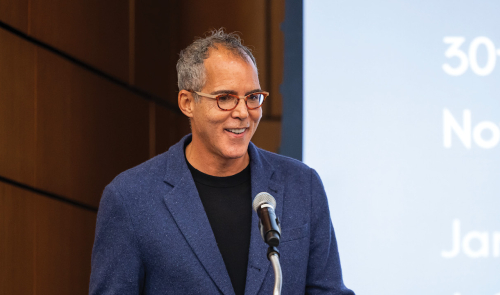
This year, the Derrick Bell Lecture on Race in American Society celebrates three decades of bringing leading scholars and experts to NYU Law to discuss contemporary racial issues and their broad-ranging effects across communities and institutions. On November 6, in the 30th Bell Lecture—titled “Changing the law by Changing the Lawyers: Can Pipeline Programs Survive the Current Moment?”—James Forman Jr., a professor at Yale Law School, confronted one of the most controversial and persistent issues facing law schools nationwide—shortfalls in diversity within the student population.
Bell—a full-time visiting professor at NYU Law beginning in 1990 until his death in 2011—was a celebrated expert on constitutional law whose work was fueled by a career in activism, groundbreaking research into critical race theory, and dedication to molding new generations of legal scholars. Co-hosted by the Center on Race, Inequality and the Law and the Office of Development and Alumni Relations, the annual lecture named in his honor explores issues such as civil rights, social justice, politics, education, economics, and the complex dynamics of race and the law. In remarks celebrating the program’s continuance, Dean Troy McKenzie ’00 hailed the Bell Lecture as “one of the most anticipated events” on the academic calendar each year. “[Bell’s] voice and his vision continue to resonate through this lecture series, which invite us to reckon with the most urgent questions of race, power, and justice in the United States,” he said.
The event began with gospel-infused music from the First Church Brooklyn Choir. Several past Bell Lecture speakers were in attendance including Penn Carey Law School Professor Anita Allen, Columbia Law School Professor Kendall Thomas, and Georgetown Law School Professor Emma Coleman Jordan. Janet Dewart Bell, who established the series to commemorate Bell’s 65th birthday, reminisced about the event’s origins; saluted its earliest supporters, including former Dean and NYU President Emeritus John Sexton [Benjamin F. Butler Professor of Law], and applauded its continuing legacy. “The Bell Lectures have been consistently wonderful,” she said.
Watch the full video of the Derrick Bell Lecture:
Forman, this year’s speaker, has explored racial disparities in the nation’s criminal justice system in the Pulitzer Prize-winning 2017 work, Locking Up Our Own, and his latest book, Dismantling Mass Incarceration. In the Bell Lecture, Forman—using history and current data—argued that pipeline-to-law school programs are still needed to open opportunities for a broader spectrum of students.
“I think we are at a crucial, crucial point,” Forman said. “There is a risk that we will go back to the 1950s, where we had essentially no Black lawyers and indeed very few Black people or other people of color in universities in America. But I also want to say that we have the tools to resist that outcome.”
While noting that Latino, Native American, and other minority groups as well as Black people are underrepresented in the practice of law, Forman said: “I want to talk for a minute right now about class as well and socioeconomic status, which has been left out of the conversation for too long, and about what it means when we say expand access to law [and] expand access to other professions,” he said. “Law schools overwhelmingly enroll students from wealthy and near-wealthy backgrounds, while offering relatively few spaces for students who are from poor, from working class, or even middle-class backgrounds.”
Forman described the pipeline initiative, Access to Law School Program, that he launched with Yale Law School students in 2020, targeting first-generation law school students, the formerly incarcerated, and low-income residents in New Haven, Connecticut. “We have three core ideas,” Forman said. “Certain groups are underrepresented in law school nationally.... Second, that underrepresentation is not because of a lack of interest or a lack of ability, but is rather because of a lack of support and a lack of opportunity. And third, and crucially, there is something that every university in America can do about the problem.”
Despite the US Supreme Court’s sweeping reversal of affirmative action in 2023, Forman says that law schools can still expand opportunity within their student ranks by zeroing in on economic factors. “Today, because of the availability of data that did not exist in previous generations, you can map disadvantage and advantage, opportunity and lack of opportunity down to a micro level, down to particular neighborhoods, [and] particular census tracts,” he said. “And there is no legal obstacle to universities giving preference to students who have overcome the challenge of growing up in a low-opportunity neighborhood. We do it in Access.”
Forman recommended that law schools seeking to connect with a wider group of candidates tap into online research tools such as Opportunity Atlas, which uses census and IRS data to track average outcomes for adults based on their childhood zip codes. “The median fellow [in Access to Law School] comes from a low- or very low-opportunity neighborhood,” Forman said. “These neighborhoods are full of people with energy and drive…. But they are also neighborhoods where—because of a history that I’ve just barely touched on—it’s harder to find material success. What would it look like if we organized law school admissions and university admissions more broadly in a way, to privilege and prioritize people from low-opportunity neighborhoods? How would that change who becomes lawyers?”
In closing, Forman highlighted the experiences of two Black women in the Access program, one of whom had previously served time in Danbury Federal Prison Camp. Both were able to attend law school.