Legal institutions require public trust, Judge Dale Ho says in Korematsu Lecture
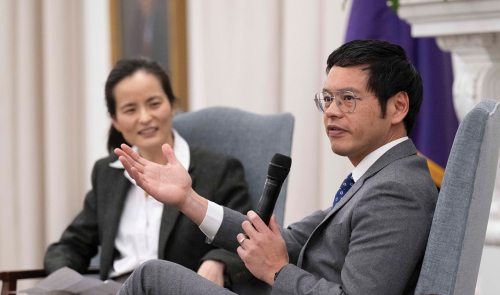
Delivering the 2026 Fred T. Korematsu Lecture, US District Court Judge Dale Ho of the Southern District of New York emphasized that public trust in legal institutions—despite their inherent flaws—is crucial to safeguard rights and the rule of law. “It is, of course, difficult to keep faith in our institutions when that faith is all too often unrewarded,” Ho said. “But the case that I want to make to you tonight is that if you care about equality, if you care about dignity, if you care about freedom, then our institutions, including the rule of law, are essential pieces of the puzzle.”
The February 3 event was sponsored by the Asian-Pacific American Law Students Association and the Asian/Pacific/American Institute at NYU. Professor of Law Sarah Seo served as Ho’s interlocutor. The annual lecture series was founded in 2000 to provide a forum for Asian American perspectives on the law and to honor their contributions to the development of the law.
“As we all know, courts lack the power of the purse or the sword, and so we’re largely left dependent on a broader cultural commitment to the rule of law and to the legitimacy of the judiciary in our system of government to ensure compliance with our rulings,” Ho said. “I’m quite certain that some rulings that I have issued—parties, private individuals, entities, or government officials at the local, state, and federal levels have not liked some of those rulings. But with very few exceptions, I have, in my admittedly limited time on the bench, seen almost uniform compliance.… That’s only possible because of a culture that—maybe not unanimously and maybe not as consistently as we would like it—ultimately believes in and adheres to the rule of law. And so right now, I believe that it’s incumbent upon all of us to help sustain that culture.”
In his remarks, Ho cited polling data showing a steady erosion in public confidence in the US Supreme Court and the legal system as a whole. As he began his own legal career, Ho said, he also viewed the legal system with some skepticism. Many of his misgivings were driven by history, including Court rulings such as Plessy v. Ferguson, which in 1896 upheld racial segregation, and Korematsu v. United States, which in 1944 held that the wartime internment of Americans of Japanese descent was constitutional.
“On the one hand, I believed in the judiciary and the rule of law as institutions where the promise of equal protection of law for all could be vindicated,” he said. “But on the other hand, I imagined a future role for myself as a civil rights lawyer in which I wouldn’t be what I would describe as an institutionalist. I didn’t think that I would be an insider within an institution. I thought my future and my career would be as an outsider, seeking to hold institutions accountable, to point out their failures, and to prod them to do better.”
Before being nominated to the federal bench by President Joe Biden in 2021, Ho spent ten years leading the ACLU’s Voting Rights Project and had also been an assistant counsel at the NAACP Legal Defense Fund. Discussing some of the cases that he worked on, Ho explained how those experiences had helped moderate his attitude toward legal institutions. The litigation included North Carolina NAACP v. McCrory, in which the Fourth Circuit Court of Appeals struck down North Carolina’s Voter ID law, and Fish v. Schwab—which Ho called “a highlight of my career”—in which the 10th Circuit Court of Appeals ruled that a Kansas law that required proof of citizenship in registering to vote had violated the US Constitution’s Equal Protection Clause.
“When I look back on those cases, and others that I’ve litigated as a lawyer, it’s clear to me that I couldn’t have accomplished anything if I didn’t have the privilege of appearing before judges who took their solemn oath to apply the law faithfully and fairly with the utmost gravity,” Ho said. “Now, as a judge, I try to do my best every day to do the same.”
Throughout his address, Ho also sought to inspire students. While discussing Korematsu, he told the story of Tsuneko Tokuyasu, who is believed to be the first Asian American woman admitted to the New York bar, in 1950. “Think about what it might have been like to be her for just a minute,” he said. “Your family has lost everything that they have, including their farm. You’re forced to relocate to another state. You witness the internment of members of your family and members of their community. And yet you still don’t lose faith in the rule of law.”
“I highlight her story,” he added, “not to minimize the burdens that you all are bearing right now—and will bear after you graduate—through some sort of unfair comparison, but just to note that your generation is not the first that has been called upon to endure. Yes, our institutions fail us sometimes. Yes, they often need to be improved or reformed… sometimes dramatically. And as we have been warned, institutions will not by themselves save us. But that doesn’t mean that we don’t need them.”
During the question-and-answer portion of the event, Ho—who spent two years as an actor prior to attending Yale Law School—advised students to embrace opportunities to engage in civil discussions with those who carry opposing ideological views, and to prepare for unpredictable career trajectories.
“Now, if you had told me 20-plus years ago, maybe when I was a student at Princeton [University], that I would be giving this lecture, and if you asked me what message I thought I might be delivering, I can tell you with close to 100 percent certainty that I did not think it would be this. As I said, at that time, I harbored some skepticism of institutions. They seemed too slow, too sclerotic, [and] too cautious to accomplish the kind of changes I believed were necessary in our society,” he said. “But one thing that I’ve learned during my career as a civil rights lawyer, before coming to the bench, is that the work of obtaining justice is very, very hard. It’s painstaking. It’s slow sometimes. And it’s, frankly, never complete.”