Second look laws can reduce excessive prison terms, say experts in Kenneth Thompson Lecture
Second look laws, which enable judges to review and potentially modify lengthy prison sentences, are becoming increasingly prevalent. At least 25 states, the District of Columbia, and the federal government have adopted some form of what is also called sentencing review, according to the Sentencing Project, a research and advocacy group. On April 2, a panel of experts at the Kenneth P. Thompson ’92 Lecture on Race and Criminal Justice Reform discussed how second look laws work and how courts, judges, and policymakers can use them to address excessive prison sentencing.
The annual lecture honors the legacy of Thompson, who as Brooklyn District Attorney from 2014 until his death in 2016 instituted groundbreaking reforms, including the launch of a prosecutorial unit dedicated to investigating wrongful conviction claims. In opening remarks, Dean Troy McKenzie ’00 commended the Thompson Lecture series for probing “difficult questions about power, [the] criminal legal system, and race.” Co-hosting the event were the Peter L. Zimroth Center on the Administration of Criminal Law and the Center on Race, Inequality, and the Law (CRIL).
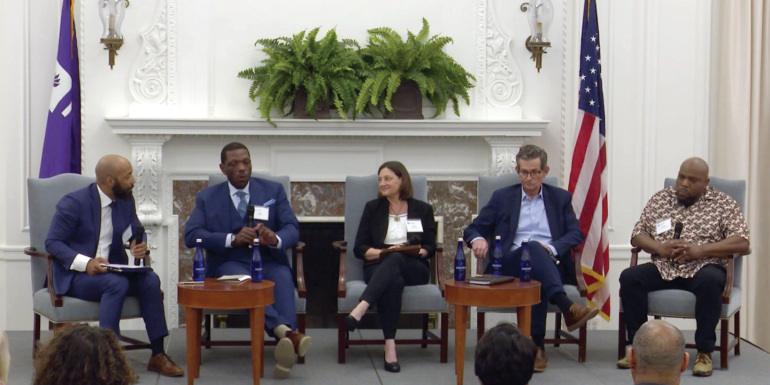
The panel’s participants brought a range of different experiences in the criminal legal system: John Gleeson, a former federal district judge, now a partner at Debevoise and Plimpton; Jule Hall, assistant director of ambassadors and external programs communications at the Innocence Project; Sara Cohbra, director of the Sentencing Project’s Second Look Network; and Kevin Haynes, who served nearly 27 years in federal prison. The conversation was moderated by Professor Vincent Southerland, CRIL’s faculty director.
In 2016, Gleeson founded the Holloway Project, which works to reduce lengthy mandatory minimum sentences for incarcerated individuals, after he successfully convinced prosecutors to set aside a portion of the 57-year prison sentence that, as a federal judge, he had given to convicted Brooklyn carjacker Francis Holloway in 1996. To date, the Holloway Project, a pro bono program at Debevoise, has brought about sentence reductions in more than 70 cases. “Anybody who thinks that someone who’s guilty of a crime can’t receive an unjust sentence, that’s grossly excessive, hasn’t been hanging around federal court for the last 30 years,” Gleeson said. “And anybody who thinks someone who fits the description can’t turn themselves around.... into an admirable human being has no idea what people are capable of.”
Second look laws and initiatives differ from other early prison release programs, including parole and clemency, in that they allow courts to review and reevaluate sentences after an individual has served a period—usually about a decade—in prison. In choosing to reduce a sentence, judges weigh considerations such as the nature of the offense, the incarcerated person’s age at the time of the crime, their rehabilitation efforts while incarcerated, and the support network available upon release.
Still, Cohbra pointed out, the reach of second look laws is restricted. “There are many people who have been serving really lengthy sentences for serious crimes, but who have completely rehabilitated or who are doing very well, who are mentoring other people in prison, who are supporting their families through work that they do in prison.... and those people are excluded because of the way that some of the laws are written,” she said.
Hall emphasized the racial dynamics that contributed to the lengthy prison sentences that were issued during a high-crime period in the 1980s and early 1990s. “The numbers show [and] the evidence shows that [it is] disproportionately people of color who are impacted by law enforcement, policing in certain communities, receiving harder sentences and—in the case of the work that I’m doing—wrongfully convicted, and incarcerated for crimes.”
Watch the full video of the Kenneth Thompson ’92 Lecture:
During the question-and-answer portion, an audience member asked whether second look programs adequately factor in the voices of crime victims. “‘Yes’ is the answer,” Gleeson said. “And as the lawyer for folks seeking relief, I try to find [the crime victims]. In a lot of cases, they’re hard to locate 27 years later. But I try and find them, because, way more often than not, they support what we want. Every victim in the wake of crime feels the way victims do, and that is considered at the original sentencing. But as time goes on, I’ve spoken to people who were the victim of a bodega robbery 22 years ago, and they’re shocked. They’re shocked that the person who did it is going to spend the rest of his life in prison.”
For nearly three decades, Haynes told the audience, he feared that he would never leave prison. He was arrested for his role in a string of bank robberies in Brooklyn and Queens. After rejecting a plea deal that would have resulted in seven or eight years of incarceration, Haynes was convicted in 1994 and received a prison sentence of 46 and a half years, because the criminal counts were combined under federal law. He was released from prison in 2020 after reaching out to Gleeson, who advocated on his behalf.
As Haynes reflected on his experiences, he shared how he benefited from will power, prison-based educational programs, and a close-knit group of supporters. Not everyone in prison has those resources, he noted. “What if I didn’t do something to reform myself? What if I tried and there just wasn’t [anything] there? And these people coming out here with no education, with nothing, you understand? When I came home, the majority of my people [were] dead,” he said. “Thank God for my sister, my brother-in-law... and Judge Gleeson.”
Selected remarks from the Kenneth Thompson Lecture:
John Gleeson: “We’ve over-incarcerated. We need to de-incarcerate. But change, even a little change, that endures to the benefit of defendants is—even when everybody agrees we need it—like turning the Queen Mary around.” (video 1:10:48)
Jule Hall: “When I was incarcerated in 1993, let’s put this in a larger context, college programs were stripped from prison. And I went into prison, and I had to make a choice of just going to the law library to pro se litigate my case, because I felt that I had issues with my case. But I saw how when the college programs were stripped out of prison, people got into all types of [problems] because they didn’t have anything better to do with themselves. My grandmother used to always say, ‘Idleness is the devil’s playground.’” (video 33:12)
Sara Cohbra: “There are many, many people with disabilities in our prison system. And many of those people are excluded from a lot of the programming that does exist for a variety of reasons. Either there are educational requirements that somebody needs to have satisfied in order to be admitted to some sort of program. Or they have a physical disability that requires them to be housed in a separate unit that doesn’t have access to programming.” (video 1:00:46)
Kevin Haynes: “When you first come in the system, you’re angry. You’re not going to do right in the first five or six years, because you can’t give [people] a life sentence and then tell them, ‘Oh, be good for the rest of this time.’ You just can’t. It’s just not going to happen.” (video 31:01)