

Transformative Justice Project
Across the world, legal empowerment practitioners are advancing justice, protecting democracy, and resisting autocracy by placing the law in the hands of people directly impacted by injustice. Legal empowerment is an approach to legal services that aims to increase the capability of people and communities to know, use, and transform the law to vindicate their rights and achieve justice. It places the primary focus on people and their legal needs, with legal professionals (including lawyers but also community justice workers) playing a supporting role in helping them to solve problems and challenge injustice.
Legal empowerment efforts have advanced justice across a wide range of issues: protecting indigenous land from exploitative mining, securing equal access to health care, ending abusive labor practices. But this approach does more than challenge discrete injustices: it also strengthens each community's commitment to and capacity for democracy. By building up people's knowledge of the laws and legal institutions that belong to them, and by building their power to act collectively, legal empowerment enables communities to hold their political leaders accountable and demand change. With democracy under threat around the globe, legal empowerment is more critical now than ever.
The Transformative Justice Project (TJP) aims to support and advance legal empowerment efforts worldwide by mobilizing the international community to support this work. Specifically, the TJP aims to accomplish this in three primary ways:
- by developing a set of indicators—grounded in how legal empowerment practitioners currently measure the impact of their work (or would if they had the time and resources)—that the UN, its Member States, and other international stakeholders can use to measure a community’s capacity to resist autocratic trends;
- by developing a policy agenda of concrete steps that multilateral organizations can take to support and advance legal empowerment as a strategy for fighting autocracy; and
- by launching a Transformative Justice Platform to galvanize broad-based collective action to advance these policy goals.
Join us in our efforts to advance justice, protect democracy, and resist autocracy!
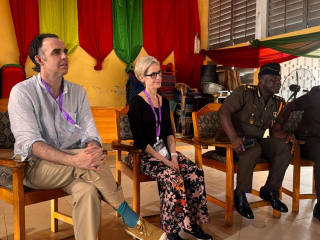
NYU Research Symposium on Legal Empowerment and Autocracy
In March, the Bernstein Institute’s Transformative Justice Project convened the NYU Research Symposium on Legal Empowerment and Autocracy in Accra, Ghana. This event brought together scholars, practitioners, and grassroots justice leaders from around the world to examine the role that legal empowerment can play in strengthening democratic resilience in an era of rising authoritarianism.
The symposium opened with a powerful opening keynote address by the former Dean of the University of Ghana Law School, Raymond Atuguba, who urged participants to broaden their conceptions of democracy beyond the Western liberal template by considering "experiments in democracy" across Africa that center the legal empowerment of ordinary citizens as the true foundation of a resilient democracy. A range of panels led by leading scholars like Kathryn Hendley, Eva Pils, Siri Gloppen, Maame Mensa-Bonsu, and Rebecca Sanderfur then explored these issues from a range of perspectives.
One highlight of the event was a site visit organized by two grassroots justice organizations, the POS Foundation and Namati, in which symposium participants visited a High Court in session and the traveled to Nsawam Medium Security Prison to observe the POS Foundation’s innovative In‑Prison Paralegal Program that trains inmates and prison staff to challenge excessive sentences of incarceration. Another highlight was the closing keynote address, delivered by Justice Mansoor Ali Shah, who had recently resigned from his role as Chief Justice of the Pakistan Supreme Court in protest of a constitutional amendment that fundamentally undermined the judiciary's independence.
The symposium marked a major milestone in advancing global research and collaboration on the intersection between legal empowerment and democracy. This tremendous event was made possible through support from NYU’s Global Opportunity Grant program, the Charles Stewart Mott Foundation, the Legal Empowerment Fund, the American Bar Foundation, the International Development Research Center, and NYU Abu Dhabi.