

Legal Empowerment Learning Lab
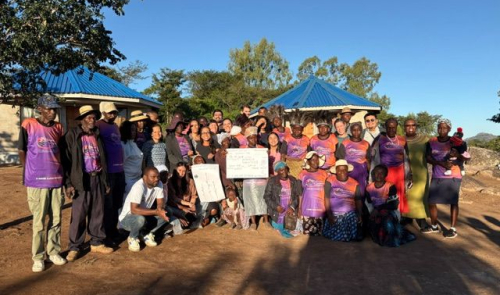
Hanyanya community members and LE Lab participants celebrating cross-border learning and exchange.
The Legal Empowerment Learning Lab (the Lab) was launched in 2020 with the goal of supporting legal empowerment practitioners with the tools, resources, and accompaniment support needed to engage in participatory methods to understand what justice issues matter to their community and to evaluate the impact of their work.
Fundamentally built on an ethic of care, the Lab opens up democratic forms of inquiry to explore what works, what matters, and what's needed to achieve transformative justice from the grassroots. The Lab offers 14 monthly co-learning sessions that provide a foundation on participatory action research (PAR) and its interplay with legal empowerment. The Lab also hosts tea time, an opportunity for our community members to find common challenges and insights across borders. Whether discussing global politics or a daughter's first day back to school, these gatherings are crucial to sustaining the trust and mutual investment in the deep care work that participatory methodologies require. Additionally, we organize one-on-one accompaniment with our participants. Our facilitators meet individually with each participant to bridge theory and practice. Together we identify concrete opportunities to apply session takeaways, ensuring learning translates into actionable approaches in everyone’s work. The lab couples virtual learning and community building sessions–all of which were collaboratively determined based on the needs and interests of participants– with an in-person learning exchange led by community-based researchers.
The Learning Lab is a global-yet intimate space dedicated to democratizing research and supporting legal empowerment practitioners with the tools, resources, and accompaniment to engage in participatory action research (PAR) methods to advance their work. The Lab is currently hosting it's third cohort. For the past year, 18 practitioners from over 15 countries including Brazil, Colombia, India, Mexico, Myanmar, South Africa, Thailand, US, and Zimbabwe have gathered virtually to share tools, build community and foster a shared sense of learning on legal empowerment. Members engage in a range of cutting edge human rights issues spanning climate, gender, labor, land, housing, immigration, and criminal justice.
Participants from each cohort have traveled to Zimbabwe for a one-week PAR learning exchange led by Mela Chiponda, a Zimbabwean ecofeminist and PAR researcher. Mela has partnered with a collective of women community-based researchers to engage in feminist participatory action research (FPAR) as a strategy to address forced displacement, the global climate crisis, and structural violence. Our members have left the exchange feeling invigorated and inspired to embrace PAR and legal empowerment as acts of resistance, community-building, and knowledge production.
In the name of legal empowerment and as a commitment to an ethic of care, we have made our work accessible to the public and free to download. Our resources include:
- A Resource Library on Participatory Action Research, Legal Empowerment, and more.
- Two interactive workbooks created with our community: Hand and Heart Workbook and Connect and Walk Alongside Book
- An article titled “Human Rights Beyond the Colonial Imagination: Legal Empowerment and Techniques of Delegitimation” co-authored by 15 Lab participants
The Bernstein Institute has facilitated three adaptations of the Learning Lab since 2020. We invite you to meet our first and second cohort of participants. Please contact us at law.bernstein-institute@nyu.edu to learn more about our work and ways to get involved.
Participatory Action Research
The Lab is a learning workshop on Participatory Action Research (PAR) offered to grassroots organizers, legal empowerment practitioners, and academics. PAR is a methodology that affirms the right of people who are typically treated as a subject by traditional research approaches to instead be actively engaged in the process. It also affirms the expertise they hold by virtue of lived experience. There are many iterations of PAR (i.e., Feminist PAR and Youth PAR) that are specific to the type of community being engaged. Each iteration has its nuances. However, at its core, PAR seeks to centralize isolated communities and thus necessitates the participation of members from those communities in all possible stages of research. At its best, PAR serves as a vehicle for action that results in positive, and oftentimes tangible, benefits to the communities engaged in its methods. The Lab’s structure includes a mix of conceptual sessions, fundamental skill modules, case studies, intimate accompaniment, warm encounters for community and witnessing, and small working group sessions. Visit our Resource Library to access and download our entire curriculum.