

Grunin Prize for Law and Social Entrepreneurship
Lawyers play a critical role in designing, implementing, and advancing models by which economic and social activity are conducted globally. The Grunin Center administers the Grunin Prize for Law and Social Entrepreneurship to celebrate the contributions of lawyers who purposefully engage in advancing the fields of social entrepreneurship, impact investing, and sustainable development.
The award of an annual Grunin Prize for Law and Social Entrepreneurship recognizes lawyers’ participation in the ways in which business is increasingly advancing the goals of sustainability and human development. This prize aims to reward the innovation, potential impact, and replicability and/or scalability of projects and solutions developed by lawyers to advance the fields of social entrepreneurship, impact investing and sustainable development.
The Grunin Center for Law and Social Entrepreneurship is made possible through a generous endowment from NYU School of Law graduates Jay Grunin ’67 and Linda Kalmanowitz Grunin ’67, and the Jay and Linda Grunin Foundation. Jay and Linda have dedicated their philanthropic endeavors to investing in innovative projects that have measurable impacts creating meaningful, transformative change.
The 2027 Grunin Prize for Law and Social Entrepreneurship
The 2027 Grunin Prize for Law and Social Entrepreneurship will be awarded at a special ceremony on June 1, 2027, as part of the Annual Conference on Legal Issues in Social Entrepreneurship and Impact Investing—in the US and Beyond, which is co-hosted at NYU School of Law by the Grunin Center for Law and Social Entrepreneurship and the Impact Investing Legal Working Group.
Learn more about our prior finalists and winners through the right-hand navigation menu.
Why apply for the Grunin Prize? Grunin Prize finalists receive recognition from a global community of lawyers, academics, policymakers, and other impact professionals. Finalists are invited to participate in the annual IILWG/Grunin Center conference to showcase their projects in front of hundreds of conference attendees. Finalists will then be honored at a special cocktail reception where the winner will be announced. Past finalists and winners have also received media exposure from NYU Law and external media channels.
See submission guidelines below and complete your submissions by Friday, January 29, 2027. For any questions or concerns related to the Grunin Prize, please contact the Grunin Center at grunincenter@gmail.com.
Eligibility Criteria
The Grunin Prize is open to individual lawyers or legal teams from across the globe. Practitioners, legal educators, policymakers, in-house counsel, and other legal teams that develop an innovative social enterprise, impact investment, or sustainable development solution using existing law, legal education, or new legal structures are eligible to apply.
- The Grunin Prize will recognize inputs, such as new uses of old laws or reframing of the conceptual framework surrounding the law, and outputs, such as the development of a new legal structure or organizational design.
- The nominated project must be completed or implemented on or before December 31, 2026. Only projects that have been completed or implemented within the past two years will be considered.
- Examples of the types of legal projects that may be submitted for consideration include: innovative financing, contracting or entity structure, enacted legislation or adopted model laws, or design of new legal courses or tools. Learn more about our prior finalists and winners through the right-hand navigation menu.
Qualifying projects will be evaluated against the following criteria: innovation, potential impact, and replicability and/or scalability.
Nominations
To apply for the Grunin Prize or to nominate another party’s project, please complete the Phase 1 Grunin Prize submission form.
- Applicants and nominators may submit more than one project for consideration. A separate submission form must be completed for each project.
- Applicants and nominators are welcome to resubmit a previously nominated project that did not receive the Grunin Prize (as long as the project was completed or implemented within the past two years).
- If nominating another party’s project, nominators must coordinate with nominees to ensure all required information is provided in the submission form.
- Supplemental materials will not be accepted. However, as needed, applicants may be asked to provide additional information for consideration by the judging panel.
- Grunin Prize applicants will complete Phase 1, then, if selected, will be invited to participate in Phase 2:
- Phase 1: Due January 29, 2027, applicants will submit a brief summary of the project, including the innovative features, impact, and replicability and/or scalability.
- Phase 2: By mid-February, selected applicants will be invited to participate in Phase 2 which includes more detail on the project, as well as a schematic representation, and references. The Phase 2 application will be due on March 9, 2027.
- By the end of March 2027, Phase 2 applicants will be notified of whether they have been selected as Grunin Prize finalists.
Once notified, Grunin Prize finalists will be expected to (i) participate in a Zoom interview with the judging panel during the week of May 24, 2027, and (ii) liaise with the Grunin Center to coordinate a communications plan and develop a Grunin Prize podcast episode.
Timeline
- January 29, 2026: Deadline to complete a short Phase 1 submission form.
- Mid-February 2027: Applicants informed of whether they are invited to participate in Phase 2.
- March 12, 2026: Deadline for Phase 2 application.
- April 2026: Finalists will be announced.
- April-Early May 2027: At least one representative from finalist team records Grunin Prize podcast episode (more information below).
- Week of May 24, 2027: Finalists will meet with the Grunin Prize judging panel.
- June 1, 2027: The Grunin Prize finalists will be recognized and the Grunin Prize will be awarded at a special ceremony.
Grunin Prize Podcast
The Grunin Center will use podcast episodes to spotlight finalists in order to maximize reach and ensure consistent content. The Grunin Center Executive Director, Zvia Schoenberg, will interview at least one member from each finalist group. You can find examples of finalist podcasts on the 2026 Grunin Prize webpage.
The Interview
- Format: Recorded via Zoom.
- Duration: Approximately 30 minutes, which will be edited down to a 10-15 minute podcast episode.
Required Materials
Finalists will share the following materials in addition to participating in the interview:
- Headshots: Headshot(s) of those involved in the podcast interview.
- Visuals (Encouraged): You are encouraged to submit visuals (e.g., slides and/or diagrams) or links to video content that will be included in the podcast show notes.
- Documents: You are welcome to share deal documents, marketing materials, or reports that you feel will demonstrate the innovation, potential impact, and replicability and/or scalability of your project.
2027 Judging Panel
The judging panel is composed of NYU Law representatives and industry experts who select the Grunin Prize winner based on the submission materials, references, and a final interview.
Meet the 2027 judging panel below:
- Deborah Burand

Deborah Burand
Professor of Law Emerita, NYU School of Law; Faculty Director, Grunin Center for Law and Social Entrepreneurship
Deborah Burand is a Professor of Law Emerita at NYU Law. Before retiring from NYU Law, she founded and directed the International Transactions Clinic from August 2015 through August 2025. She continues to serve as the Faculty Director of the Grunin Center for Law and Social Entrepreneurship and currently teaches in NYU Law’s Paris program.
During 2010-11, Burand served as general counsel to the Overseas Private Investment Corporation (now called the DFC), the development finance institution of the United States. Earlier in her career, she worked in the environmental sector (Conservation International), microfinance sector (FINCA International and Grameen Foundation), and US government (Federal Reserve Board and Department of the Treasury). She also has worked in private practice at a global law firm, where, among other things, she supported, on a pro bono basis, the development of the world’s first debt-for-nature swap.
Burand received her BA from DePauw University cum laude, and a joint degree, JD/MSFS with honors, from Georgetown University.
- Jay Grunin

Jay Grunin
Co-Founder and Chairman, Grunin Foundation
Jay Grunin is Co-Founder and Chairman, Grunin Foundation. Jay graduated from Brooklyn College (with honors) in 1964, and from NYU School of Law in 1967, where he was an Editor of the NYU Law Review and where he met his future wife and business partner. After a brief exposure to academia—as Research Assistant to an NYU Law professor teaching a seminar on legislative history—as well as a brief stint in Big Law in New York, followed by a one-year Appellate Division clerkship in New Jersey, Jay, who would never have to rue about the road not taken, opted to then take the advice of his lawyer-wife who implored him to “go south young man, go south.” And so Jay and Linda “hitched on to the second wagon train” and landed in a then small town on the Central Jersey Shore called Toms River.
After a few years, Jay and Linda decided to open up their own small “mom and pop” law firm. In the 1970s, as Ocean County became one of the fastest growing counties in the entire United States, Jay and Linda’s law practice flourished. At the same time, Jay and Linda expanded their business interests to include real estate and other investments.
In the 1990s, the Grunins dissolved their law practice so as to concentrate full time on their greatest passions, business investments and philanthropy. In 2013 their philanthropic endeavors were formalized with the creation of the Grunin Foundation.
- Helen Scott
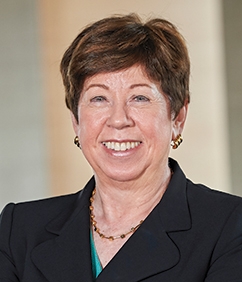
Helen Scott
Professor of Law Emerita, Founder and Former Faculty Co-Director of the Grunin Center and the Jacobson Leadership Program in Law and Business
Helen Scott is a Professor of Law emerita at NYU Law. She is the Founder and former Co-Director of the Mitchell Jacobson Leadership Program in Law and Business at New York University School of Law, as well as a Co-Founder and former Faculty Co-Director of the Grunin Center for Law and Social Entrepreneurship at NYU Law. In that capacity, she has participated in the development of innovative law and business courses, including Investing in Microfinance, Law & Business of Corporate Governance, and Professional Responsibility in Law and Business. Scott oversees the competitive Leadership Scholars Program, and runs the capstone seminar for the program, Law and Business Projects. She has been a member of the NYU Law faculty since 1982 and teaches a wide variety of business law courses, including the basic contracts and corporations courses.
Scott currently serves on the board of directors of IEX LLC, the newly launched stock exchange. From 1999 to 2004, Scott co-chaired the Listing and Hearing Review Council of the NASDAQ Stock Market, an independent advisory committee to the board of directors, with primary responsibility for formulating and recommending corporate governance and quantitative listing standards for that market.
In 2023, Scott was the first recipient of the Grunin Prize for Sustained Commitment for her extraordinary dedication to supporting law students who are intent on doing good within their transactional and business law practices. In 1997, Scott received the Legal Advocate of the Year award from the US SBA in recognition of her participation in the development of the Angel Capital Electronic Network (ACE-NET) project to increase financing available to early-stage entrepreneurial enterprises. Before joining the NYU Law faculty, Scott practiced law in Washington, DC, and New York.
- Rachel Robbins

Rachel Robbins
Independent Strategic Advisor
Rachel F. Robbins is currently an independent strategic adviser with Atlas Mara Limited, a UK-listed financial services company whose aim is to be the premier financial services company of Sub-Saharan Africa. She is also a Trustee of NYU School of Law and an Advisory Board member of the Grunin Center for Law and Social Entrepreneurship. She previously served as a Non-Executive Director of FINCA Microfinance Holding Company, a global microfinance company.
From 2008 to 2012, Robbins served as vice president and general counsel of the International Finance Corporation and as a member of its Management Group. She joined the IFC with three decades of experience in legal and financial services, including extensive experience in corporate governance and in managing global teams through periods of change. Between 2006 and 2008, she was executive vice president, general counsel, and secretary of the New York Stock Exchange and NYSE Euronext. She spent 20 years at JPMorgan & Co. and was managing director, general counsel and corporate secretary from 1996 to 2001. From 2003 to 2004, she was general counsel of Citigroup International.
Robbins holds a JD from New York University School of Law and a BA in French literature from Wellesley College.
- Emmeline Liu

Emmeline Liu
General Counsel, Calvert Impact Capital
Emmeline Liu is the General Counsel of the Calvert Impact Group. Emmeline oversees all of Calvert Impact Group’s legal affairs including its overall legal structure and approach to impact. She helps to structure creative and innovative legal structures for new impact products Calvert brings to market. She oversees regulatory compliance and securities issues relating to all of Calvert Impact’s products including the Community Investment Note, the Cut Carbon Notes, the small business credit funds and Mission Driven Bank Fund. She was a recipient of the 2024 Grunin Prize for her work on Cut Carbon Notes.
- Jesse Gero

Jesse Gero
Adjunct Professor of Clinical Law, Acting Director of the International Transactions Clinic, and Senior Legal Fellow of the Grunin Center for Law and Social Entrepreneurship
Jesse Gero is Adjunct Professor of Clinical Law, Acting Director of the International Transactions Clinic, and Senior Legal Fellow of the Grunin Center for Law and Social Entrepreneurship. Prior to joining the NYU School of Law, Gero served as Associate General Counsel at the United States International Development Finance Corporation (DFC). There, Gero was one of the principal architects of the program in which DFC uses political risk insurance to unlock capital markets transactions, oversaw the legal work for that program, and served in similar oversight roles for DFC's Office of Health & Agribusiness and Office of Development Credit.
Before turning to public service, Gero worked in international project finance from the Paris office of Willkie Farr & Gallagher LLP and in corporate lending and structured finance from the New York office of Skadden, Arps, Slate, Meagher & Flom LLP. Gero is a member of the New York and Paris bars and holds a JD from the NYU School of Law, where Gero served as Co-Managing Editor of Academic Events for the NYU Journal of Law & Business and was an early member of what is now called the Social Enterprise & Startup Law Group. Gero holds an MA in Philosophy from Georgia State University and an AB from Dartmouth College.