

Access to Justice
As many as 90% of Americans show up to state civil courts without a lawyer.
There, they must face highly bureaucratic and complicated legal systems already overburdened by too many cases and not enough staffing. How can we make courts usable for self-represented litigants? How can we ensure that they receive the type of assistance they need and want, in places and formats that are accessible?
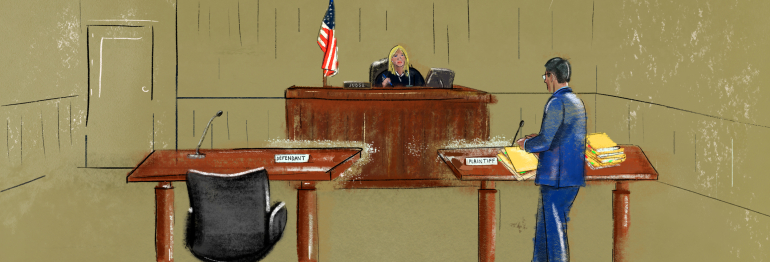
For many of these litigants, they face issues impacting everyday life — evictions, landlord disputes, divorces, child custody battles, wage theft, immigration status, and more — these are problems disproportionately impacted by low-income and marginalized communities.
State courts were not designed for such a huge number of self-represented litigants, yet this is the crisis with which it is currently faced. When civil legal problems are not resolved fairly or effectively, the consequences can include financial instability, loss of housing or employment, unsafe living conditions, and poor physical and mental health.
This issue begs several questions about the future of our state civil court systems and solving civil legal problems at large: Does every problem really need a lawyer? What kind of non-lawyer roles can be developed to accommodate for the masses of self-represented litigants? Do we know what type of assistance people want and how best to provide it? Can we design early intervention models that are fair and just for self-represented persons? How should we consider community input when creating innovative programs? What potential does AI have in performing legal tasks and providing legal support to self-represented litigants and legal service providers? Given the environmental impact of AI data centers, as well as the privacy risks associated with AI, does the usage of AI in A2J actually hurt the communities it seeks to serve? How do we bring A2J innovations to scale? What role should the courts play in making justice more accessible?
The Center on Civil Justice works towards innovative solutions to make courts more affordable, effective, and usable for people without lawyers.
Access to Justice Summer 2026 Fellowship
Three NYU Law students, Nala Sharadjaya, Tag Quijano, and Henry Muhlheim will be in our inaugural cohort for the Access to Justice Fellowship. Fellows will spend the summer writing a policy paper on a key access to justice issue.

Access to Justice Scholars Program

The new CCJ Scholars Program builds sustained partnerships with leading scholars and practitioners committed to solving the nation’s most persistent civil justice challenges. We are excited to be joined by Kathryne M. Young, our Senior Scholar on Empirical Access to Justice Research, and Sateesh Nori, our Senior Research Fellow on AI and Access to Justice Research.
Spotlight: International Access to Justice 2025 Conference
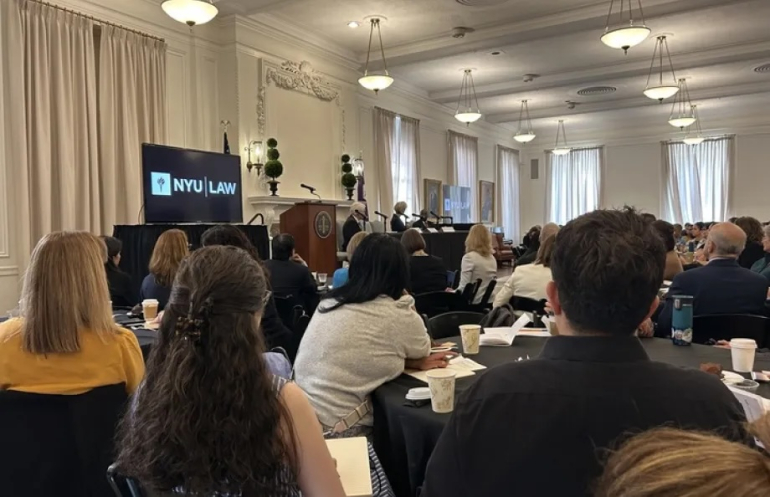
The 2025 International Access to Justice Forum was hosted by New York University and Fordham Law Schools. Access to justice is essential to the enforcement and protection of rights for vulnerable individuals and communities across the globe. It is a core prerequisite to achieving equal justice under law. Despite its primary importance, in many ways, it is the exception rather than the norm. All too often, individuals face insurmountable barriers to asserting rights through legal systems.
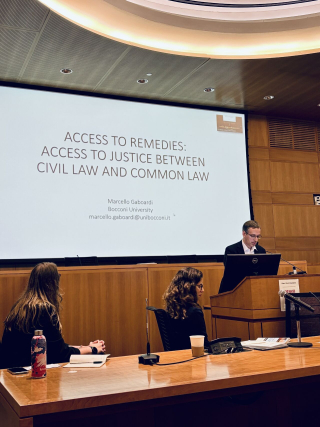
A broad community of scholars, researchers, jurists, practitioners, reformers, court and dispute resolution experts around the world are focused on addressing this intolerable deficit, so that rights and legal protections can become a reality, rather than an aspiration.
The 2025 International Access to Justice Forum brought together almost 300 members of the access to justice community from more than 20 countries including Argentina, Australia, Austria, Bangladesh, Brazil, Canada, Chile, El Salvador, Ethiopia, Ghana, Honduras, India, Italy, Mali, Mexico, Netherlands, Nigeria, Pakistan, Paraguay, Poland, Portugal, United Kingdom, United States and Zimbabwe.
Over the two days, we saw robust discussion of exciting new research, theory, and policy developments and innovative programs in the global movement for civil justice. Topics included a broad range of work advancing access to justice through community empowerment and engagement, court reform, diversion programs, law schools, tech and AI, and through human rights and democracy efforts. There were also two plenary sessions consisting of moderated discussions with global access to justice leaders.
Events
Check out the conferences, panels, and events we've put on for Access to Justice issues!
The 2025 International Access to Justice Forum was hosted by New York
University and Fordham Law Schools. Access to justice is essential to the enforcement and protection of rights for vulnerable individuals and communities across the globe. It is a core prerequisite to achieving equal justice under law. Despite its primary importance, in many ways, it is the exception rather than the norm. All too often, individuals face insurmountable barriers to asserting rights through legal systems.
A broad community of scholars, researchers, jurists, practitioners, reformers, court and dispute resolution experts around the world are focused on addressing this intolerable deficit, so that rights and legal protections can become a reality, rather than an aspiration.
The 2025 International Access to Justice Forum brought together almost 300 members of the access to justice community from more than 20 countries including Argentina, Australia, Austria, Bangladesh, Brazil, Canada, Chile, El Salvador, Ethiopia, Ghana, Honduras, India, Italy, Mali, Mexico, Netherlands, Nigeria, Pakistan, Paraguay, Poland, Portugal, United Kingdom, United States and Zimbabwe.
Over the two days, we saw robust discussion of exciting new research, theory, and policy developments and innovative programs in the global movement for civil justice. Topics included a broad range of work advancing access to justice through community empowerment and engagement, court reform, diversion programs, law schools, tech and AI, and through human rights and democracy efforts. There were also two plenary sessions consisting of moderated discussions with global access to justice leaders.
There has been a rapid shift in the caseload of state courts. Costs of litigation are increasing, time to disposition of litigation increasing, trials are decreasing, and it is increasingly difficult for plaintiffs to find representation to vindicate their rights in civil suits. However, an even larger shift has occurred with a dramatic increase in “assembly line plaintiffs” taking over state court dockets for debt collections, evictions, and foreclosure, leaving more defendants unrepresented than plaintiffs. How should our state courts respond to these changes?
See more here.
The COVID crisis has dramatically altered the way courts conduct business, but any judge will tell you, with a sense of pride, that the courts never closed. How have courts – an institution notoriously slow to change – adapted to provide access to justice throughout a pandemic?
See more here.
NYU Law’s Institute of Judicial Administration and Center on Civil Justice co-sponsored a two-day conferenceon April 28-29 springing from Beyond Elite Law: Access to Civil Justice in America, a book co-edited by Dwight D. Opperman Professor of Law Samuel Estreicher. Academic experts, attorneys, and judges from across the country convened to discuss the plight of Americans unable to afford legal representation.
See conference videos here.
See press here.
Forced arbitration clauses in contracts deprive Americans of their rights to sue in court, leading to unfair outcomes and a rigged system. We hosted a documentary screening and discussion for Lost in the Fine Print, a film that explores this issue.
Jury trials in civil cases are part of our Bill of Rights, and the jury trial has always been thought of as a pillar of American democracy. In practice, however, it is increasingly rare. Why is this happening? What does the demise of the jury trial mean for our civil justice system? Does it change democratic citizenship? Can the trend be reversed? Should we try, or just allow the jury trial become a relic of an earlier time? Our distinguished panel of trial and appellate lawyers and academic experts discussed these and other hotly debated questions.
See more here.