

Global leaders convene at NYU to explore the evolution of class actions and mass torts
Wednesday, September 30
The Center on Civil Justice co-hosted the Global Class Actions and Mass Torts Conference alongside Perfect Law.
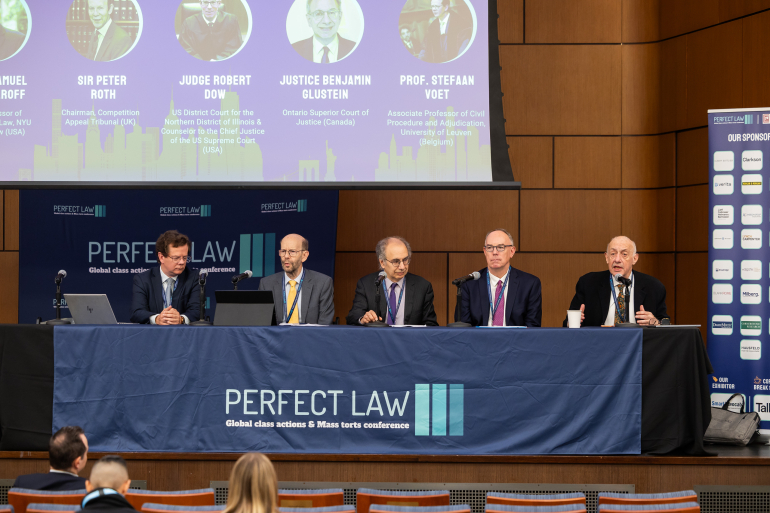
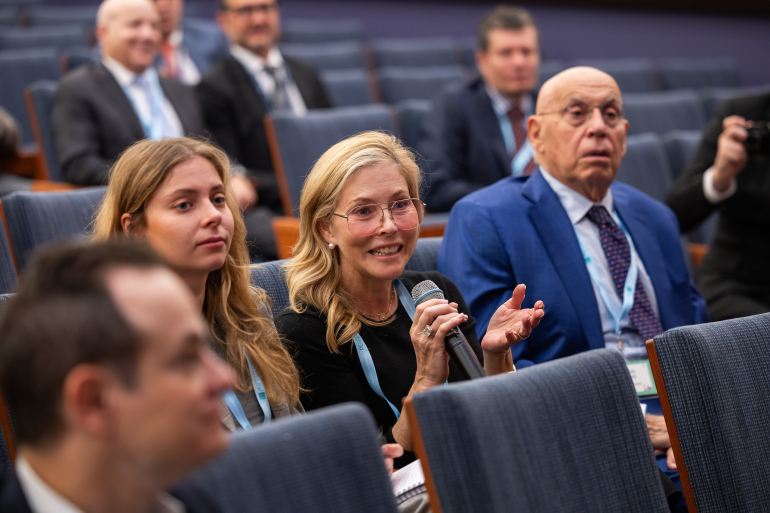
We opened with “Class Actions on the International Stage,” chaired by Professor Samuel Issacharoff, Reiss Professor of Constitutional Law at NYU School of Law, with leading judges and academics from the US, UK and Canada.
- Professor Stefaan Voet welcomed the rise of a class action bar in Europe, including growing involvement from US lawyers. He also noted that some judges still try to fit collective cases into traditional procedural rules, while smaller EU countries need greater scale for these actions to succeed.
- Professor Samuel Issacharoff highlighted the four key hurdles for class actions: certification, trial, remedy, and funding the lawyers. He noted that European jurisdictions are increasingly opening the door to contingency fees and third-party litigation funding.
- Justice Benjamin Glustein explained how Ontario handles individual damages after common issues are decided, with tiered claims ranging from flat payments to claims requiring proof of causation.
The discussion also touched on the growth of collective actions and third-party funding across Europe, including in antitrust, privacy, and environmental claims.
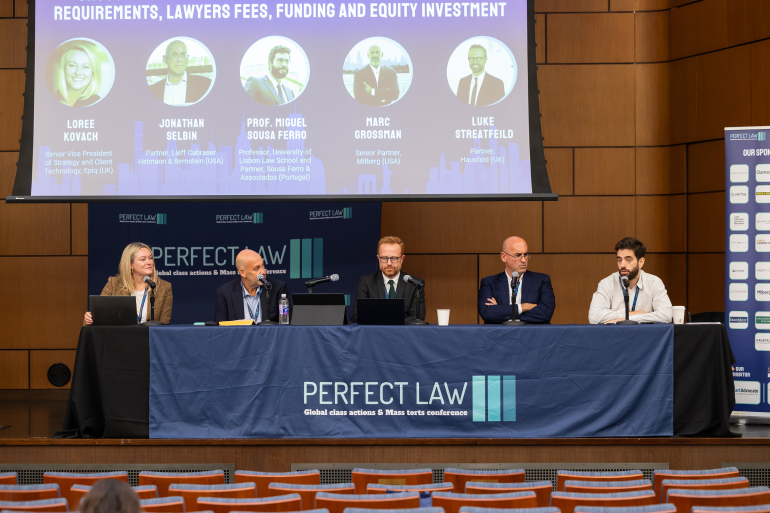
The second panel, Choosing the Battlefield: Jurisdiction, Certification Requirements, Lawyers Fees, Funding and Equity Investment, chaired by Loree Kovach vice president at Epiq, brought together Jonathan Selbin (partner at Lieff Cabraser), Professor Miguel Sousa Ferro (class action law office in Portugal), Mark Grossman (Milberg) and Luke Streatfeild (partner from Hausfeld) to discuss jurisdiction, strategy, and funding in collective litigation.
- Professor Miguel Sousa Ferro described Europe as “many, many individual countries with some mechanisms bringing them together,” highlighting the uncertainty that can still surround cross-border collective actions.
- Luke Streatfeild explained his approach to choosing a jurisdiction, saying: “The kind of issues that I think do matter when you're choosing which jurisdiction to pick first is harm.” He also pointed to the importance of the defendant, claimant group, and cause of action.
- Jonathan Selbin stressed the importance of ethics when entering new jurisdictions: “The first thing I always think of is the ethical rules.” He also highlighted the need to understand the local legal and cultural environment before bringing a case.
- Mark Grossman took a commercial view of funding, emphasising the need to consider “duration risk” and adding: “Make sure you have good partners. Pick the right firm there.”
The panel offered a practical look at how lawyers and funders assess where collective cases should be brought, how they should be structured, and what it takes to finance them.
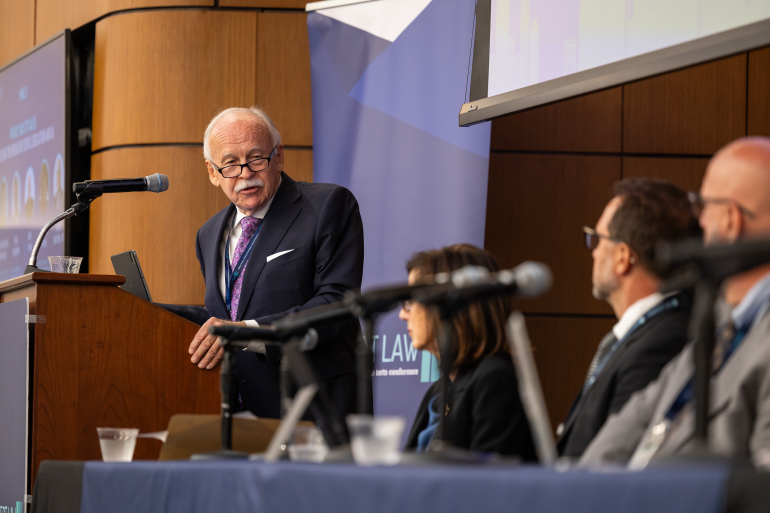
The third panel, Privacy Has Its Value: Litigating for Breach of Data Legislation and AI, chaired by John Yanchunis (Morgan & Morgan), started with one question: "What is privacy worth?" He was joined by Ryan Clarkson (Clarkson Law Firm), Gary Lynch (Lynch Carpenter), Hon. Madeline Cox Arleo (US District Court, New Jersey), Professor Jagna Mucha (University of Warsaw), and defense counsel Gerald Maatman (Duane Morris LLP).
Key moments:
- Ryan Clarkson on AI and existing law: "Fraud is fraud," he said, describing AI cases as "new facts applied to existing law." On pre-filing investigation, he noted, "The defendants know what's in the black box. We don't."
- Gary Lynch on statutory privacy claims: Courts, he argued, have conflated data breach analysis with statutory intrusion claims, and on how sensitive the data was, "It shouldn't matter."
- Judge Arleo on standing and AI: Traceability is "a component of standing," and on whether the profession is ready for AI: "I don't think anyone's prepared."
- Professor Jagna Mucha on Europe's approach: "We in Europe are very good in substantive law," she said, and she favors combining it with the US private-enforcement model. On public enforcement: "Consumers do not get any compensation." Individual GDPR awards in Poland, she noted, are around 250 euros.
- Gerald Maatman on the state of the case law – “The case law is not necessarily consistent, the legal state of play is in flux, and many decisions turn on specific factual situations. This is an area of great change.”
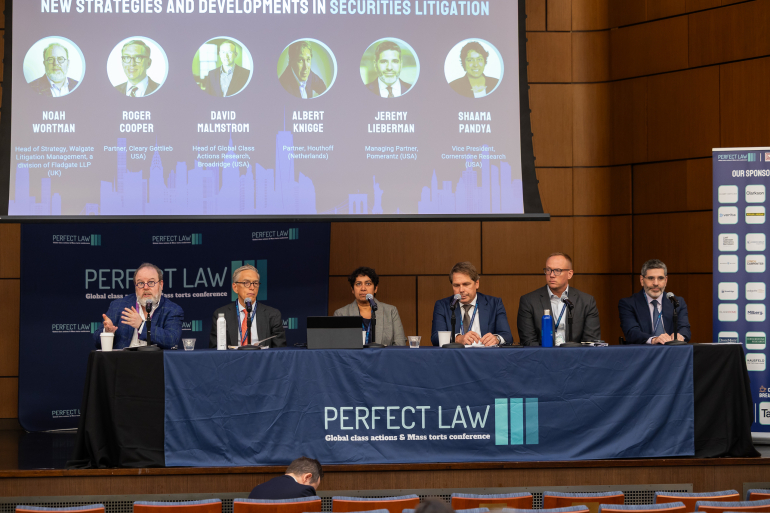
The New Strategies and Developments in Securities Litigation panel opened with a simple observation from chair Noah Wortman: the conversation “has become increasingly global.” He was joined by Roger Cooper (Cleary Gotlieb) Shaama Pandya (Cornerstone Research), Albert Knigge (Houthoff), David Malmstrom (Broadridge), and Jeremy Lieberman (Pomerantz). The panel focused on class certification after Goldman Sachs, Comcast, and Boeing.
- Roger Cooper (defense view): Goldman has given defendants “some tools to oppose class cert” that they had long been looking for.
- Jeremy Lieberman (plaintiff view): “Class cert is not a guarantee anymore in securities class actions,” and he expects a circuit split to reach the Supreme Court.
- Shaama Pandya (economist view): about market efficiency is “a fool's errand.” Of the roughly 120 cases since he Goldman where defendants opposed class certification, about 25% have seen certification denied or narrowed.
The next panel, The Globalisation of Antitrust Litigation: Big Tech, Cartels and Collective Redress, was chaired by Greg Haber (Verita Global). He was joined by Joseph Ostoyich (Clifford Chance), Ravi Bhalla (Susman Godfrey), Linda Visser (Siskinds), and Damien Geradin (Geradin Partners).
Key moments:
- Joseph Ostoyich on algorithmic pricing: Government cartel fines in the US have been under $10 million for four years running, while private cases over pricing software are rising. To test when software crosses the line, he borrowed a former FTC commissioner's question: "What if a guy named Bob did it?" He also noted that the Ninth Circuit affirmed dismissal in a casino-hotel software case, while the Third Circuit allowed a similar one to proceed.
- Ravi Bhalla on enforcement trends: Government interest is shifting from classic cartels toward monopolization cases against big tech, and he called the state coalitions behind them "one of the few bipartisan issues." He added that private cartel cases are "still alive and well."
- Linda Visser on Canada: Plaintiffs face cost risk and a tougher certification test, and in Ontario the adverse costs rule is "a real barrier to bringing some of these cases."
- Damien Geradin on Europe: He explained that filing before the UK's Competition Appeal Tribunal takes months of work, while in the US a claim can be "a 20-page document with a beautiful story."
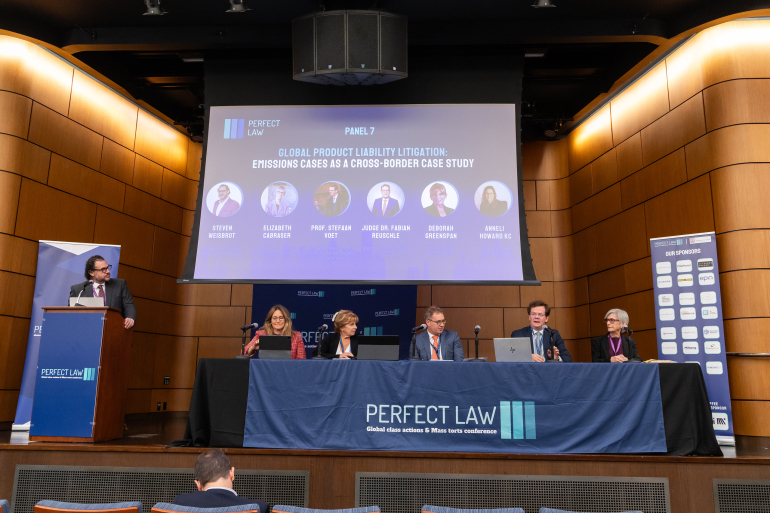
The closing panel "Global Product Liability Litigation: Emissions Cases as a Cross-Border Case Study" was chaired by Steven Weisbrot (Angeion Group), who framed the discussion around "what actually travels about a product claim when it crosses a border." He was joined by Elizabeth Cabraser (Lieff Cabraser), Anneli Howard KC (Monckton Chambers), Judge Dr. Fabian Reuschle (Stuttgart Regional Court), Professor Stefaan Voet (University of Leuven), and Deborah Greenspan (Blank Rome).
Key moments:
- Elizabeth Cabraser on the US Dieselgate legacy: The US litigation, she said, is seen as "the catalyst for a lot of procedural and legal development" worldwide, with Dieselgate cases pending in 35 countries. But she stressed that it "almost didn't happen."
- Anneli Howard KC on the UK trial: The UK group action against 15 manufacturers, covering more than 2 million claims, began on the assumption that all of them used the same switching technology. As the evidence emerged, none did, and the case shifted to a debate over engine calibration. Her conclusion: "it was the technical evidence that was really decisive."