Kenji Yoshino and David Glasgow offer a new road map for diversity, equity, and inclusion

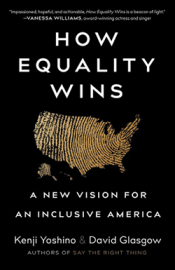
How Equality Wins: A New Vision for an Inclusive America, the second book co-authored by Kenji Yoshino, faculty director of NYU Law’s Meltzer Center for Diversity, Inclusion, and Belonging, and David Glasgow LLM ’14, the Meltzer Center’s executive director, was released on February 17.

Yoshino, who is Chief Justice Earl Warren Professor of Constitutional Law, and Glasgow are aiming to meet a very different moment than the one in which their first book appeared. Say the Right Thing: How to Talk About Identity, Diversity, and Justice, published in February 2023, came at a time when Americans were leaning into the cause of diversity, equity, and inclusion (DEI). The national reckoning with racial inequality that occurred in the wake of George Floyd’s murder by police in Minneapolis in 2020 prompted both individuals and organizations to reexamine their stances on DEI. White Americans in particular sought guidance in navigating a multiplicity of sensitive and complex issues.
Three years later, the DEI landscape has changed dramatically. Back then, Glasgow says, “people were feeling a lot of fear and anxiety, but it was coming from the opposite angle. It was the fear of getting canceled, the fear of not doing enough to address long-simmering inequalities. Now the fear and anxiety is really in the other direction of ‘What if we get sued by anti-DEI activists? What if the current administration comes after us?’”
The Supreme Court’s 2023 opinion in the companion cases Students for Fair Admissions v. Harvard and Students for Fair Admissions v. University of North Carolina abolished the consideration of race in most college admissions, effectively invalidating affirmative action initiatives in that sphere. DEI opponents subsequently seized on that development by targeting DEI programs in the corporate world and government. DEI began to be used as a pejorative term, much the way the adjective “woke” had been.
In How Equality Wins, the co-authors recall the skepticism that greeted them when the Meltzer Center was founded in 2016, at a time when many observers saw DEI work as more appropriate for a social sciences department or business school than a law school. But after the 2023 Supreme Court opinion, they write, “suddenly it seemed like a brilliant idea to have a center devoted to DEI operating out of a law school,” as organizations feared lawsuits targeting diversity programs everywhere. The panic only increased at the beginning of the second Trump administration with an onslaught of anti-DEI executive orders.

In July 2024, the Meltzer Center launched an online tracker of all DEI-related federal lawsuits to give the public a clear picture of the new landscape. Yoshino and Glasgow have advised organizations on their evolving legal exposure, taking pains to explain that pulling back from commitments to diversity carried its own legal risks. As they point out in the book, despite an uptick in legal challenges to diversity initiatives from white men, most discrimination complaints still come from members of historically marginalized groups.
A primary aim of How Equality Wins is to show how to find a realistic middle ground in the current moment. Yoshino and Glasgow lay out seven strategies:
- Reveal the stakes of the debate by exposing the weakness of anti-DEI arguments, such as their failure to acknowledge ongoing inequality.
- Support dissent within the pro-equality coalition by allowing for reasonable differences of opinion and withholding judgment rather than rigidly enforcing orthodoxy—for example, including those who endorse some, but not all, progressive causes.
- Welcome new groups into the pro-equality tent, including groups with existing legal protections that are not robustly enforced, such as the disabled and the elderly; groups that are in most respects dominant but nevertheless have fallen behind in certain areas—for example, men earning college degrees; and groups that have not been widely recognized for DEI purposes, such as people from lower socioeconomic backgrounds.
- Level the playing field by shifting from “lifting” approaches that give preference to disadvantaged groups to “leveling” strategies that use identity-neutral practices to even out the playing field for all.
- Embrace the universal by working to include everyone in equality programs rather than limiting them to certain groups.
- Reclaim the notion of merit from DEI opponents by pointing out that true meritocracy should encompass a variety of backgrounds.
- Highlight the risks of retreat from the ideals of equality, such as the threat of discrimination lawsuits and a negative reputation.
“This is not meant to be a high-concept book,” says Yoshino. “It’s meant to be a very practical, tactical book that people can use in order to safeguard the really important ideals of equality and inclusion in a time when those values are under assault.”
Overall, the seven strategies have the aim of promoting greater inclusion within what the co-authors often call the “project of equality.” They point out that only a small minority of Americans self-identifies as strongly liberal; a winning strategy must include the vast ideological middle. While DEI has flourished in institutions such as Fortune 500 companies and top colleges, these conversations are happening much less frequently in less privileged circles.
“All these dynamics have made it easy for opponents to paint the field as ‘elite,’ ‘establishment,’ and ‘out of touch,’” Yoshino and Glasgow write. “They’ve also allowed a false narrative to flourish: the idea that efforts to advance equality for people of color, women, and LGBTQ+ individuals are forms of non-economic ‘identity politics’ that conflict with the interests and values of working people.”
Strategic solutions to promote broader inclusion include greater tolerance for dissent in the equality movement, expanding the types of groups included under the DEI umbrella, and extending a universal invitation to participate in diversity programs. There are trade-offs: uncomfortable disagreements, the potential stretching of limited DEI resources, and less candid exchanges among minority group members when members of majority groups are part of the conversation.
In the end, however, Yoshino and Glasgow see the current upheaval in the equality space as an opportunity to reevaluate not just legal risk, but also the efficacy of DEI initiatives that had not previously undergone such careful scrutiny.
“It gives people the chance to fundamentally reassess,” says Glasgow. “What have we really been doing all this time? Has it been working? And are there deeper changes that we can make so this work is more effective and sustainable?”
While some say that the term “DEI” has been rendered toxic along with other once-favored language, the co-authors assert that, whatever the terminology of the moment might be, the work is crucial and longstanding and will continue under different names. They add that, while some organizations have dialed back their DEI efforts, many more have maintained or even bolstered their commitment.
“My instinct when someone is weaponizing a word is to try to educate and elevate the conversation,” says Yoshino, “so that even if we disagree, we don’t misunderstand each other…. Rather than just responding to the loudest, scariest voice in the room right now, try to put yourself in the position of yourself five years from now, and think about who you will want to have been in this moment to make sure that you’re making values-based decisions rather than getting pushed around by the prevailing winds of the moment.”
Yoshino and Glasgow write: “In the end, this work will survive by persuading the skittish people in the middle of the room, who are deciding how to respond to the swirling DEI controversy, to hold on to two truths. One is that the risks of walking away from the project of equality are too high. The other is that an era of retrenchment need not cause an era of retreat. It can instead prompt a renewal, making the work better than before.”
Updated August 31, 2026