Richard Dieguez ’85 talks about his life as street photographer Xiomáro
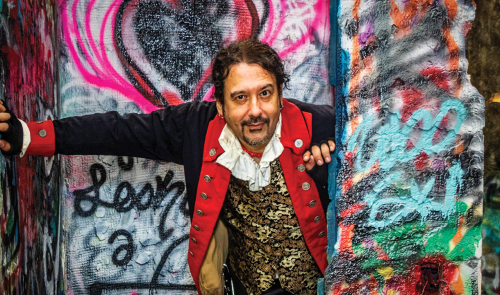
Richard P. Dieguez ’85 aka Xiomáro.
Richard P. Dieguez ’85 has long been captivated by the creative arts, even while otherwise working as a full-time attorney. For two decades, Dieguez—a singer and guitarist—was a solo practitioner with clientele that included pop star Lisa Lisa, the disco band Village People, and the rock club CBGB. Now Dieguez is in the spotlight as a curator and street photographer under the pseudonym Xiomáro—which means “ready for battle” in Spanish. Last year he published his second book, Street Photography of New York City: Street Haunting in the Big Apple (Sutton Publishing, 2025).
The work captures weary commuters on the Long Island Railroad platform, pro- and anti-Trump street protests, police officers and costumed characters in Times Square, and nattily-dressed pedestrians.
In this Q&A, Xiomáro reflects on balancing law and art and explains how finding a new creative outlet helped him stay resilient after facing cancer and personal tragedy.
What led to your interest in law?
I attended Manhattanville College in Purchase, New York. I entered as a pre-med major, but I went to a career day, when I spoke to a nun who was also the head of the philosophy department. She pitched me on the idea of switching majors to philosophy. It was about concepts such as ethics, democracy, and what does it mean to be free. Those subjects really appealed to me because it was all about critical thinking. I switched my major to philosophy and decided to pursue law school.
Why did you choose NYU Law?
I narrowed it down between Georgetown and NYU Law. But NYU appealed to me because, as a New Yorker—I was born in the Crown Heights section of Brooklyn—I knew that I would be comfortable in my own environment. But as an artist, I also have to admit this: NYU is a beautiful school. I really enjoyed the architecture, like the arches. It was warm and inviting.
How was your experience at NYU Law?
What I enjoyed the most happened in my second year when I joined the editorial staff of the Journal of International Law and Politics. It was kind of like running your own business. Then in 1983, I joined the student newspaper, The Commentator. From 1984 to 1985, I was editor-in-chief at both the Journal and The Commentator. The newspaper wasn’t just for NYU, but for the neighborhood. I guess that was a foreshadowing of getting to work on books today.
A lot of the professors could be intimidating. But I was really impressed to be in the criminal law class of David A.J. Richards [Edwin D. Webb Professor of Law]. I had actually read some of his work in my philosophy classes as an undergrad. I just thought that he had a different way of presenting the material that made it more engaging. I wish that I could speak as beautifully as he does. On the last day of class, he gave a speech to encourage us to go forward. I don’t know if he wrote it in advance, or if he presents it every year, but it was just an amazing speech. We all applauded at the end.
What happened after you graduated?
Going to a corporate law firm or being an investment banker was what everybody was gravitating towards. Because it was in the zeitgeist, I figured, “Let me just try it and see what it is.”
I went to work in the litigation department at Morgan Lewis & Bockius in their Park Avenue office. But I was only there for a year. In 1987, I went to another firm, called Battle Fowler. I was disappointed, however, because I thought it would have a better balance of time between work and family life. I decided to take a job with a solo practitioner.
You later established your own practice. How did that come about?
It was a gradual process. I wasn’t making a lot of money with the solo practitioner, but he was explaining things to me. I learned a lot and, over time, I leaned towards setting up my own practice. I decided in 1990 to leave and take a chance.
I started hanging out at different nightclubs. It was still the beginning of hip-hop becoming commercial, and then you had a lot of the Latin freestyle artists. Many of them were comfortable with me because we had similar backgrounds. That’s how I started getting clients—not just artists, but writers, producers, and engineers.
Building the practice appealed to me because I felt I was more within my tribe with people who were on the same wavelength as me. A lot of the work was about trying to get higher advances from the record labels. I had famous artists, but I was also representing clients who couldn’t afford my services to negotiate a contract. Many of them were young Black and Latino artists who saw the music industry as a way out of certain neighborhoods and as a chance to succeed. If the label paid a $10,000 advance and my fee was, say, $3,500—there were times when I would defer it as they tried to get into the industry. And that was a way to help them out. That became more complicated when the 2008 recession happened.
Part of my interest in the law was learning how artists can protect their intellectual property and copyrights. Having that knowledge allowed me to be of service. And now it’s helping to inform a lot of what I’m doing as an artist myself.
How did you develop a focus in photography?
Everything changed when [the file sharing service] Napster came in, because record sales started to decline. [From 2008 to 2011] I became an independent contractor with Paul, Weiss, Rifkind, Wharton & Garrison, and then I was a full-time staff attorney there from 2011 to 2021.
I was writing, recording, and performing with my band whenever I could. But then I got prostate cancer, and doctors weren’t sure what the outcome was going to be. I had already bought a digital camera, just to photograph my shows and promote them on my website. When I was recovering from surgery, I started going to national parks out west, including Colorado and Utah. I had no intention of exhibiting what I shot, but lots of people really liked the images.
And then I got an email from the Automobile Club of America promoting this national park in Connecticut called Weir Farm National Historic Site. It was the home of a famous American painter named Julian Alden Weir. So I went there with my wife. During the tour, the ranger said that they have an artist-in-residence program. To my amazement, they actually accepted me when I applied. I was later contacted about using my pictures to promote the park. And Senator [Joe] Lieberman, who introduced the legislation to create the park, exhibited my work at his office in Washington, DC. That became a launching pad.
Describe your approach as a street photographer.
I like the challenge of getting as close as possible. Sometimes I’ll put the camera by my hip. And I will tilt the camera without even looking into the viewfinder. And I approximate where they’re going to be in relation to the tilt. It doesn’t always work out. Sometimes heads are cut off. But I’ve been amazed at how many times I’ve gotten shots that way.
Those photographs were taken over a 10-year period, during my commute. That was also a very difficult period. My mother was bedridden with dementia, my father died of cancer, and my daughter, who was 30 years old, died of a drug overdose. The photography really became something therapeutic.
Given all that you’ve experienced, what is the overarching lesson from your life?
I’m just astounded by it and I’m grateful because a lot of it happened by happenstance. I just try to seize the day. Carpe diem. That’s why I had to strike my own balance. It’s nice to have a lot of money, but I don’t think money is the end-all or be-all. Life is short. So you have to really think about what kind of difference you want to make.
Photo by Janette Pellegrini