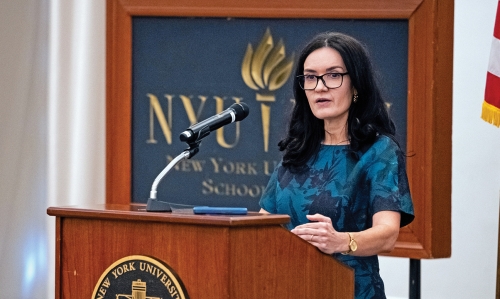
In the Tillinghast Lecture, Reuven Avi-Yonah suggests how to harness de-globalization for the greater good

The tariffs and immigration restrictions enacted in the second Trump administration have triggered global economic and political uncertainty. But on September 14, in the 28th annual David R. Tillinghast Lecture on International Taxation, Reuven S. Avi-Yonah, Irwin I. Cohn Professor of Law at the University of Michigan, suggested that these actions have an upside: They have created potential opportunities to rethink US taxation systems and rebuild social safety nets that have been eroded by international tax competition.
Back in 1980, when Ronald Reagan was first elected president, the top individual and corporate income tax rates in the US were 70 percent and 46 percent, respectively, said Avi-Yonah. After Congress repealed the withholding tax paid by foreign investors on portfolio interest, foreign capital flooded into US bonds, prompting many other countries to abolish exchange controls in order to remain competitive.
At the same time, multinational corporations were becoming more mobile, allowing for flexibility in the location of their operations. Avi-Yonah recalled advising the Israeli government when Intel asked for a $600 million grant to upgrade its fabrication plant in Israel. After the government declined that request, Intel opted instead to build a new fabrication plant in Ireland, whose government offered generous tax adjustments in lieu of a capital grant. As with the abolition of exchange controls, he said, the rest of the world followed suit.
“Multinationals were paying tax less and less,” said Avi-Yonah. “And this became even more extreme after the internet was invented in the mid-90s, because at that point physical presence really became unnecessary. We have digitization and all of these companies that are basically entirely intangible, like…Amazon, Google, Microsoft….. So all of these companies were able to essentially earn tremendous amounts of money in countries where they had no physical presence.”
The problem of declining corporate tax revenue drew sharper attention with the global financial crisis of 2008. Governments began scrutinizing strategies such as the “double Irish with a Dutch sandwich.” In this complex arrangement, companies such as Google, Apple, Meta, and Microsoft would license their intellectual property to a subsidiary incorporated in Ireland but managed in a tax haven such as Bermuda. The Irish subsidiary would then sublicense the IP rights to a second Irish subsidiary, which collected sales revenue and paid royalties back to the first. By routing the royalties through a Dutch subsidiary on its way to the tax haven, the parent company could avoid Irish withholding taxes on the payment transfers between the two Irish subsidiaries.
In response, Avi-Yonah explained, the Organisation for Economic Co-operation and Development (OECD) initiated the Base Erosion and Profit Shifting (BEPS) project to crack down on such practices. But US pushback helped render BEPS largely ineffective. The Brexit vote and the election of Donald Trump in 2016, he said, ushered in “the current era of de-globalization” that made multilateral agreements far more difficult. That de-globalization, he added, encompasses tariffs and export subsidies, immigration restrictions, and the potential for new exchange controls.
“De-globalization, most people would concede, is not a great thing, because it means higher prices, it means inflation, it means potential unemployment, possibly a recession…. But the truth is that it is with us,” said Avi-Yonah.
If it’s no longer politically feasible to curb tax competition, he said, there might still be creative ways to deal with what economist Dani Rodrik has described as “the political trilemma of the world economy” in the face of globalization. Rodrik argues that a country cannot have democracy, national sovereignty, and global economic integration all at once—only two of the three.
Avi-Yonah offered a three-part prescription for the US. The government could establish a federal consumption tax in the shape of a value-added tax—a huge source of revenue for other developed countries; implement a progressive corporate tax (80 percent on profits above $10 billion); and double down on US citizenship–based taxation on Americans living overseas.
He argued that these initiatives were more politically plausible than they might at first appear, and noted that Republican Paul Ryan had promoted a consumption tax plan when he was speaker of the US House of Representatives. As for the corporate tax, Avi-Yonah said, the new tariffs penalize US multinationals that try to avoid a higher tax rate by moving operations overseas and then re-importing their products. Further, the physical data centers powering the AI boom anchor companies in the US due to the businesses’ need for proximity to the centers, coupled with national security regulations. Both phenomena discourage the corporate exits of the past, Avi-Yonah suggested. Finally, he said, citizenship-based taxation of expatriates could be more palatable now that immigration restrictions have made right of entry to the US more valuable.
“There’s now more or less a bipartisan consensus that the full-fledged globalization of the 1990s and early 2000s was not such a great idea for working-class Americans,” said Avi-Yonah. He asserted that de-globalization could have a “silver lining” if approached the right way. “We stand, in the US and in other places, at a really critical juncture in terms of our ability to collect sufficient revenues to avoid a massive fiscal crisis and a further erosion of the safety net,” he said.
Watch the Tillinghast Lecture: