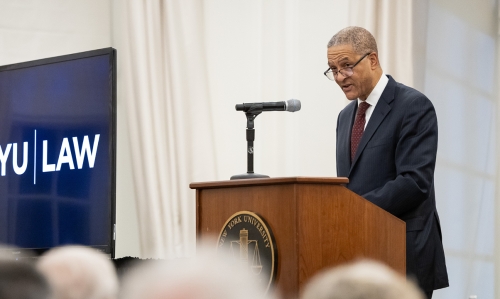
Judge Patricia Millett examines and champions rule of law in Madison Lecture

Judge Patricia Millett
Delivering the James Madison Lecture on October 26, Judge Patricia Millett of the US Court of Appeals for the District of Columbia Circuit traced the historical origins of the rule of law and offered remedies for ensuring that it remains a bulwark against tyranny. Since the first Madison Lecture in 1960, the annual series, which is presented by the Arthur Garfield Hays Civil Liberties Program, has hosted more than a dozen US Supreme Court Justices and upwards of two dozen US Court of Appeals judges as part of its mission to enhance the appreciation of civil liberty.
At the start of her remarks, Millett noted that while her address, “What the Rule of Law Means to Me,” would focus on Western society, historical contributions to the development and evolution of the rule of law also occurred elsewhere, including Africa, where an indigenous system of governance known as Gadaa dates back to ancient times.
With the 13th century as a starting point, Millett outlined how public acceptance of the rule of law advanced over the course of centuries after England’s Magna Carta, a charter of rights, was issued in 1215. “Among other things, the Magna Carta confirmed, frankly, that the king was subject to the law... [and it] also provided that the king did not punish citizens without due process. The seeds of the rule of law were planted,” Millett said. “While it took some time for the Magna Carta’s promises to take root, it eventually became the foundation of the British common law principle that law protects citizens from the king.... In 1644, the [Scottish] theologian Samuel Rutherford put it in more familiar words, declaring that the king is not the rulemaker, but is under the rule of law.”
Millett then explored how the rule of law became a bedrock principle in the US Constitution in which governmental authority functions within a system of checks and balances. “The separation of powers was designed to be our Constitution’s key mechanism for implementing and maintaining the rule of law by preventing the dangerous and destructive concentration of power in any one branch,” said Millett. “And in so doing, to promote liberty.”
But courts, she added, cannot guarantee compliance with their rulings. Millett spotlighted two 19th century Supreme Court cases, Cherokee Nation v. Georgia and Worcester v. Georgia, which recognized the rights of Native Americans to be protected from state encroachment. Despite those rulings, thousands of Native Americans died between the 1830s and the 1850s while being removed from their homelands by the federal government, a forced migration that became known as the Trail of Tears.
“The separation of powers is checks and balances. And it works when there is buy-in from the other branches. The [system] must either work together or fail together,” she said. “At the end of the day, the people of the United States must demand compliance with the law from governmental leaders and hold them accountable when they refuse or delay. Having a government and governors that are obedient to the rule of law is not a spectator sport.”
Turning to current events, Millett observed that ensuring the safety of judges and their families is foundational to the rule of law, a remark which sparked a round of applause. “And to be clear, critiquing and disagreeing with the substance of court decisions is both healthy in a democracy and constitutionally protected speech,” she said. “But threatening the life, or livelihood, of a [judge] is out of bounds.”
Millett also emphasized the need to reinvigorate trust in the judiciary as a whole. “It’s hard for the... public to see the rule of law in the middle of what feels like a high school cafeteria food fight,” she said. “[A judicial] opinion should be written with the losing party in mind. The winning party will happily accept the decision and say the court was great. But the true measure of trustworthy justice is when the losing party accepts the decision, even when it means the loss of precious interests and freedoms—like a deprivation of liberty, loss of children, [or] a business collapse.”
Throughout the discourse, Millett largely took a scholarly and straightforward approach, but her tone became more emotional as she delivered concluding points. Millett, who argued 32 cases before the US Supreme Court before becoming a judge, recalled representing Somalis who said they had been tortured under the dictatorship of Mohamed Siad Barre. The suit was ultimately successful: In 2010, in Samantar v. Yousuf, the Supreme Court ruled that government officials such as Mohamad Ali Samantar, Somalia’s former prime minister and defense minister, are not shielded from civil suits under the Foreign Sovereign Immunities Act. However, Millett shared a vivid recollection of the uncertainty she felt just after arguments, as she stood on the steps of the Supreme Court with lead plaintiff Bashe Abdi Yousuf. Had she chosen the best legal strategy? Would the justices prove receptive? At that moment, NPR legal correspondent Nina Totenberg approached them.
“[Totenberg asked] Bashe what he thought of the Supreme Court arguments. He said simply, ‘Whether we win or lose, I had my day in court,’” said Millett. “Still brings tears to my eyes. I’m focused on whether we will win or not—but this man who had suffered so much at the hands of a lawless government was content just to have his story told.”
The memory of that moment, Millett added, still carries important lessons. “We can forget that the most important contribution to an independent court system’s capacity to enforce the rule of law is that parties like Bashe participate in the rule of law by bringing their disputes to court through peaceful resolution, rather than taking the law into their own hands,” she said. “When the parties do that, we as lawyers and judges must honor that trust by zealously providing justice to each party, in each case, every day.”