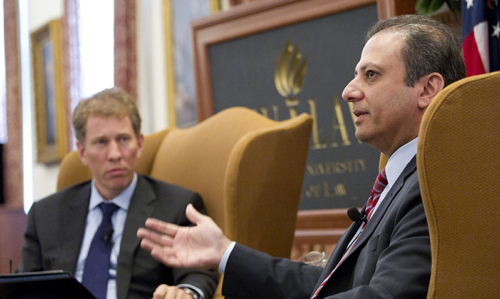
Theodore Hertzberg ’08 takes reins as chief federal prosecutor in Northern District of Georgia

In September 2025, Theodore “Teddy” Hertzberg ’08 was appointed US Attorney for the Northern District of Georgia after being named to the post in an interim capacity four months earlier by Attorney General Pam Bondi. In his new role, Hertzberg has been revving up the office’s law enforcement activities across 46 counties, an effort that has yielded several large-scale drug confiscations and the arrests of two state representatives charged with embezzling pandemic-era federal unemployment funds.
In this Q&A, Hertzberg recalls how NYU Law helped him fulfill his ambition of becoming a prosecutor, explains why he continues to go to court, and talks about his goals for the office.
What are some of your key priorities in leading the Northern District office?
One of the biggest issues for me is efficacy. And part of that involves looking at our organization and understanding where the bottlenecks are, where the inefficiencies have been, and coming up with ways to eliminate those impediments. Although I have not sought to completely restructure the office, I did push down decision-making. Previously, the criminal chief, who was four levels removed from the trial line, made every decision at every point in every case. Supervisors were disenfranchised and demoralized by the lack of autonomy. And line prosecutors were frustrated by the resulting delays. One of the things that I did early on was to say, “I trust my people, and I want them to take responsibility for their cases.”
By decentralizing authority, we’re nimbler than ever. We can react quickly when we need to and attorneys feel a heightened sense of ownership over their matters. I know that the community and our law enforcement partners have noticed that we no longer indict cases four years after the fact or go to trial six years after some crime was committed. Instead, we’re building a reputation for decision velocity and violence of action.
As you implement these changes, what challenges do you face?
Our attrition last year was unprecedented, following the change in administration and due in part to the incentives that were pushed out from DC to encourage folks to leave public service. At one point, I believe we were down about 50 percent of our criminal prosecutors. Of course, departing employees don’t take their cases with them when they leave. Their cases stay and become the responsibility of someone else who already has a full caseload.
To address that, I told supervisors on my first day as US Attorney that I expect them to lead investigations, carry caseloads, appear in court, and even handle duty matters that require immediate action. In that same vein, I am still indicting and prosecuting cases. Doing that not only reduces the burden on my hardworking prosecutors, it allows me to remain fully aware of how our judges conduct proceedings and to better understand the situation on the frontline.
Given the directives that we’ve received from Washington—and the priorities that have been set forth by the Attorney General, which I support fully—my primary challenge is to do more with less. That has affected morale, because my people are already stretched thin. The effect on morale has also affected productivity. And all of that, I think, has impacted our ability to recruit. There’s a vicious cycle at work that I have tried hard to break. Thankfully, I have made progress in that regard by successfully petitioning Washington for dozens of exemptions from the government-wide hiring freeze. I have hired more than 20 lawyers since August, and I would welcome more applications from NYU Law alumni.
How did law become a field of interest to you?
I was born in Queens and raised on Long Island. I was always attracted to law and government. In high school, I was on the debate team and enjoyed engaging with ideas. At Amherst College, I was a law, jurisprudence, and social thought major. Law was always going to be in my future. But I didn’t want to look back at the end of a long legal career and grumble about a path not taken. And so, after I graduated from Amherst College in May 2004, I worked at Lehman Brothers as an investment banking analyst, but it was not for me.
Why did you choose to attend NYU Law?
I felt attending NYU would provide me with access to major law firms. I was determined to take full advantage of whatever opportunities came my way, inside and outside the classroom. What I discovered early on was that living in Greenwich Village was very different from attending school in the Pioneer Valley of Massachusetts [where Amherst is located]. I was very distracted during my 1L year because I had friends in the city from Lehman Brothers, from college, and from high school. Their social lives did not revolve around my exam schedule. After a disappointing first semester, I had some catching up to do. By my second year, I was much more focused and seized opportunities to get into the courtroom and gain practical experience.
In the second semester of my 2L year, I was in the Prosecution Clinic. It was taught by two outstanding assistant US attorneys, one of whom was Marshall Miller. Marshall became the principal associate deputy attorney general of the United States during the Biden administration. That clinic gave me the opportunity to question a witness during a federal jury trial in the Eastern District of New York. Judge John Gleeson, who presided over that trial, was later my professor for the Sentencing Seminar at NYU. During my 3L year, I was in the Federal Defender Clinic, which also regularly put me in court. It was led by David Patton [executive director and attorney-in-chief] at the Federal Defenders of New York and [commercial litigator] David Clem, who did appellate work on the state level. My experiences in those clinics were very formative.
What happened after you graduated from NYU Law?
I joined Kramer Levin Naftalis & Frankel LLP, where I worked most closely with Barry Berke and Eric Tirschwell, two of the co-authors of the textbook we used in the Prosecution Clinic, The Practice of Federal Criminal Law: Prosecution and Defense. I also clerked for a federal judge in the Southern District of Alabama. Following my clerkship, I started applying to US Attorneys’ Offices.
The US Attorney’s Office in the Southern District of Georgia in Savannah was the first to make me an offer. And they gave me an opportunity to join as the chief of their asset forfeiture section. Once I got there, I seized every opportunity I could to prosecute criminal cases. In the course of about 18 months, I tried seven criminal cases. All felony cases. But, at the end of about three years, with a one-year-old at home and another kid on the way, my wife and I figured that we should move to a bigger city. And we resettled in Atlanta in 2018.
Is there a case from your portfolio that continues to stand out for you?
I’m very proud of the outcome of and also the approach I took to the Stacy Wisener case. Wisener was a US Postal Service employee who stole mail and, more importantly, over the course of several years repeatedly raped an underage girl. He was a registered sex offender and had used his victim to produce child pornography. Initially, the state of Georgia was handling the investigation and prosecution. But when I found out about Wisener, I ensured that he would be prosecuted federally.
To avoid the need to put his minor victim through protracted legal proceedings, I spoke with his attorney about pursuing a pre-indictment resolution, and I pushed for a speedy disposition. The time from when the matter was brought to me [in March 2022], to when Wisener received a 30-year prison sentence [in August 2022], was a matter of months. In that case, I also relied on my asset forfeiture experience to ensure that Wisener forfeited to the government the home in which he produced the child pornography. The sale proceeds, nearly $200,000 worth, were given to the victim for therapy and other services.
What piece of advice would you give to current NYU Law students?
Work hard during the first semester of your 1L year. That semester really determines so much of what will follow and which opportunities will be available. At least when I was there, those first-semester grades were the determining factor for many students as to whether or not they got onto a particular journal. And getting onto a particular journal became a determining factor as to what sort of summer job they might have. And those summer jobs become a determining factor as to which firm they might join thereafter or for what sort of clerkship they will be competitive. Starting off strong is incredibly important. Otherwise, what follows will be two years of playing catch-up.
This interview has been condensed and edited.
Photo by Arvin Temkar/The Atlanta Journal-Constitution