Tax lawyers must be “gatekeepers” of the tax system, says Megan Brackney LLM ’09 in Manning Tax Salon
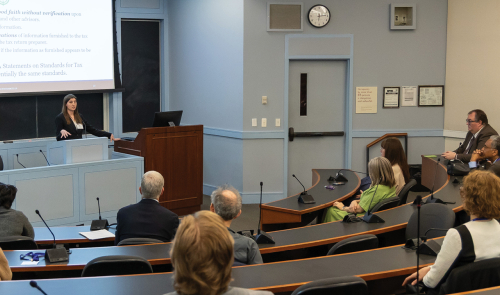
The United States tax system operates primarily through voluntary compliance—so how can responsible tax attorneys optimize a client’s tax outcome while also following the law faithfully? Megan Brackney LLM ’09, a partner at Kostelanetz specializing in tax controversy, tackled this issue candidly when she spoke in April at the fifth annual Jerome Manning ’52 Tax Salon, which served as a kickoff for NYU Law’s 2026 Reunion weekend.
Brant Hellwig LLM ’00, James S. Eustice Professor of Taxation and faculty director of the Graduate Tax Program, introduced Brackney, who teaches Survey of Tax Procedure and Civil and Criminal Tax Penalties and Procedures at the Law School.

It would be impossible for the US government to police every taxpayer, Brackney began. Fortunately for the government, 84 percent of taxpayers say that cheating on taxes “is not at all acceptable,” according to a recent survey by the Internal Revenue Service. The real concern, Brackney said, was about the other 16 percent, which is why tax attorneys must be the “gatekeepers” of the system.
Tax practitioners have three ethical duties, she said: duty to the tax system, duty to the client, and duty to oneself. “We want to have a framework for how we act that honors each of these three things, which sometimes compete,” she said. “What’s tricky about the ethics rules is, how do we act in a way that serves these three goals all the time, as best as we can?”
Circular 230, a Treasury Department publication, contains the rules and regulations applying to those whose practice involves the IRS. Brackney likened the circular to “Mom.”
“It tells us what we can and cannot do,” she explained. “And it’s wonderful to have that guidance, because it really takes the judgment and the stress off of you to make these hard decisions…. [Following it] helps the system, it helps your client because it keeps them out of trouble, and helps yourself because it gives you the ability to put your work down at night and know that you haven’t done anything that’s going to come back and haunt you in a year or two when the IRS sees it.”
Brackney discussed three pillars of Circular 230: competence, diligence with regard to accuracy, and the standards for positions taken on tax returns. On competence, she said, “Either become competent if you can, or accept the fact that we’re all not good at everything all the time.” Referring to diligence, she advised, “You don’t have to verify every piece of information, but you can’t ignore the implications of information furnished to you or that you already know based on your knowledge of the world or common sense.”
The positions taken on tax returns, she said, should be supported by substantial authority, such as the tax code, treaties, or IRS guidance or regulations. But if the law is in a gray area or if the taxpayer is taking a more aggressive stance than the norm, the position taken must have a reasonable basis, along with adequate disclosure of uncertainty. “It’s kind of shocking when people first hear about what the penalty standards and the advice standards are,” she noted. “You don’t have to think you’re right. You just have to think you’ve got a shot that your argument isn’t frivolous.”
In the end, Brackney said, what’s important isn’t the likelihood of triggering an IRS audit, but rather doing things the right way: “The crucial part of being the gatekeeper to the system is that you say,… ‘We’re going to think about it as if we are sitting together with the IRS and they’re looking at it.’”
Watch the video of the Manning Tax Salon: