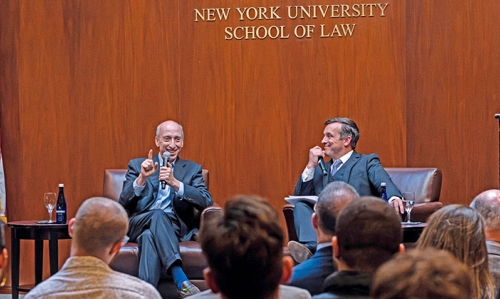
Rodge Cohen of Sullivan & Cromwell reflects on a five-decade career shaping the banking industry

In more than five decades of practice, H. Rodgin “Rodge” Cohen, senior chair at Sullivan & Cromwell, has been a pivotal figure in helping some of the world’s largest banks navigate seismic changes, including the 2008 financial crisis. On February 3, Cohen offered his insights into the development of the modern financial system during an installment of “A Life in the Law,” a speaker series hosted by NYU Law’s Institute for Corporate Governance & Finance (ICGF).
Joining Cohen in conversation were Jay Clayton, the US attorney for the Southern District of New York and former chairman of the US Securities and Exchange Commission, and Edward Rock, Martin Lipton Professor of Law and co-director of ICGF.
Clayton, a former Sullivan & Cromwell colleague, described Cohen as “not only the financial services lawyer of his generation…[but also] for the generations below him and above him.” Citing landmark economic and political events from each decade of Cohen’s practice, Clayton asked Cohen to recall the impact of these developments, starting with the sweeping banking regulation changes of the 1970s.
The Bank Secrecy Act, Cohen said, required financial institutions to assist the government in detecting financial crimes, essentially giving them a policing role. He added that the Community Reinvestment Act—passed to eliminate discriminatory lending practices and compel banks to better serve lower-income neighborhoods—had made an “amazing difference” in bringing financial services to more people: roughly one-third of Americans didn’t have a bank account back then, he said, as opposed to 5 percent today.
In the 2008 global financial crisis, Cohen, representing multiple major financial institutions, was at the center of efforts to keep the banking system from collapsing. Clayton asked him to identify key moments. “There were probably several real valleys or holes in the universe,” Cohen recalled. “The morning when the decision was made to let Lehman [Brothers] fail, which [we] had worked so hard on for so many months to try and prevent…. I knew, because we were working on it, that AIG was next, and we were not going to survive an AIG failure. And it was about six hours before the government finally decided that they had to step in…. We were on the edge of a cliff.”
Clayton lauded Cohen’s ability “to read statutes rigorously and be ready when the market needed a new interpretation or an interpretation that people hadn’t seen before.” Before the 1980s, for example, banks were restricted from operating across state lines, but Cohen helped usher in a new era of interstate banking by using a regulatory provision that permitted banks to move their headquarters within a 50-mile radius.
At the end of the conversation, Clayton asked Cohen to look forward to the next significant issue the financial industry must address. Cohen pointed to cryptocurrency regulation, proposing a corollary to Gresham’s Law, which states that bad money drives out good. “Bad regulation drives out good regulation…. And I do worry, unless we get the regulation of cryptocurrency right, that there will be a problem which will emerge,” Cohen said. “Crypto is what it is,” he added. “Economics are what they are. [Good regulation is] controlling the waves, it’s building the dikes, rather than just holding up your hand and saying, ‘Stop.’ So those dikes have to be built well.”