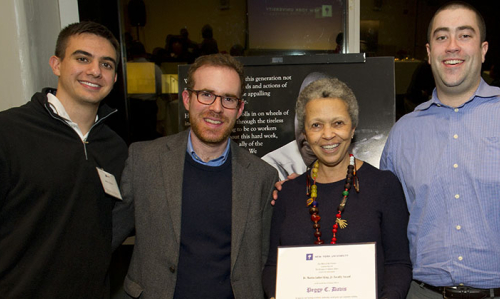
AALS recognizes Peggy Cooper Davis with Ruth Bader Ginsburg Lifetime Achievement Award

Peggy Cooper Davis
Honoring Peggy Cooper Davis’s impact on legal education and scholarship, the Women in Legal Education Section of the American Association of Law Schools (AALS) has selected the NYU Law professor as a recipient of a 2026 Ruth Bader Ginsburg Lifetime Achievement Award. Davis, who is John S. R. Shad Professor of Lawyering and Ethics Emerita, will receive the award during AALS’s annual conference in January.
“Professor Peggy Cooper Davis has championed civil rights, transformed legal pedagogy, and inspired generations of law students,” said Angela Onwuachi-Willig, president of the Women in Legal Education section and dean of Boston University College of Law, when she announced the award. “She has mentored countless lawyers and law professors, many of whom are women whose careers she helped shape and elevate. The trajectory of our profession as legal scholars and educators would simply not be the same without her influence.”
Patricia Williams, University Distinguished Professor of Law and Humanities at Northeastern University, is also a recipient of the AALS section’s 2025 lifetime achievement award, which is named for its inaugural recipient, Supreme Court Justice Ruth Bader Ginsburg. It honors individuals who have had distinguished careers of teaching, service, and scholarship and whose work, advocacy, and mentorship have had a significant impact on women and the issues that affect them, the legal community, and legal education.
Davis’s 1997 book, Neglected Stories: The Constitution and Family Values, illuminated the importance of antislavery and civil rights traditions as guides to the scope and meaning of Fourteenth Amendment liberty interests. In that book and in subsequent works, she has developed an antislavery constitutionalism that justifies federal protection of rights of personal and family autonomy. Her work on antislavery constitutionalism also stands in defense of arguments for protection of the unenumerated but important rights to education, to public accommodation, and to political participation.
Additionally, her analyses of cross-racial interactions within the legal system have been widely cited and used in legal training. Her analyses of judicial reliance on the social and psychological sciences have been pivotal to thinking about child placement decision-making in both public law and matrimonial contexts.
Davis’s scholarship has also influenced the critique and evolution of legal pedagogy. For more than 10 years, Davis directed the Lawyering Program, a widely acclaimed course of experiential learning that distinguishes NYU Law’s first-year curriculum. As director of NYU Law’s Experiential Learning Lab, she has developed and written about learning strategies for addressing interpretive, interactive, ethical, and social dimensions of legal practice. She received NYU’s Distinguished Teaching Award in 2008 and its Dr. Martin Luther King Jr. Faculty Award in 2016.
Davis joined the NYU Law faculty in 1983 after having served for three years as a judge of the Family Court of the State of New York. Earlier, she worked as an associate counsel for the NAACP Legal Defense Fund’s Capital Punishment Project, as a clerk for Judge Robert Carter of the Southern District of New York, and as a staff attorney for the Community Action for Legal Services in New York, among other positions.