Nicholas Saady LLM ’20 plays to win in music, entertainment, and sports
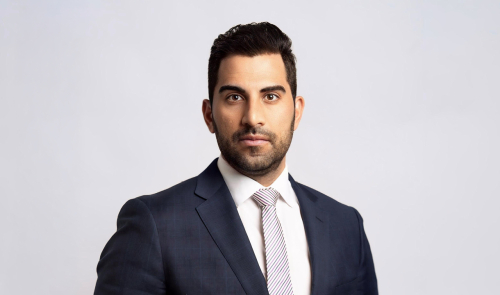
Nicholas Saady LLM ’20
More than a decade ago, Nicholas Saady was playing cricket professionally in England. Today, he’s counsel at Pryor Cashman LLP, with a diverse client base focused on music, entertainment, and sports. He’s helping recording artists, entertainers, athletes, and emerging ventures break new ground in the marketplace.
A high-stakes litigator and dealmaker, Saady has represented all three major music groups—Universal, Sony and Warner—in significant disputes and has worked on multibillion-dollar matters in sports and media over the last decade. He presently advises cutting-edge artists on the global stage, including electronic DJ/producer Anyma, Netherlands-based dance music DJ/producer Sara Landry, and house music breakout star Cloonee. And in his representation of Major and Minor League Cricket, he’s helping grow the sport he loves in the United States while handling their most important legal issues.
In 2026, the American Bar Association named him one of its Top 40 Young Lawyers.
In a Q&A, Saady talks about his unconventional journey, about litigation and dealmaking during an era of AI-generated disruption, and about the opportunities he found at NYU Law.
What are you currently working on?
Right now, I’m working with the best music litigators in the country at Pryor Cashman, representing the National Music Publishers’ Association and the Nashville Songwriters Association International in the Copyright Royalty Board proceeding that will set the mechanical royalty rates that streaming services such as Amazon, Spotify, Apple Music, Pandora, and Google will pay to songwriters and publishers from 2028 to 2032. I’m also representing the world’s most prominent female DJ, Sara Landry, in an intellectual property and management dispute, and working on several significant transactions across the music and entertainment industries.
I also handle litigation and intellectual property work for Major League Cricket (MLC) and Minor League Cricket. Last year, we represented MLC in a significant trademark dispute with Major League Baseball and in a multibillion-dollar fight with the sport’s national governing body, USA Cricket, which ranged from arbitration in San Francisco to courts in Denver. The outcome has determined the direction of the sport in the US going in to the 2028 Summer Olympics in Los Angeles, the first time cricket will be in the Olympics since 1900. It’s exciting to be part of growing the world’s second most popular sport.
I’ve never been intimidated by the unknown—in fact, I love the challenge of the unfamiliar to me and finding ways to bring something new to the table. My work with cricket is a testament to that. Another example is my litigation and transactional work for the Baller League in the US [an innovative soccer league that launched in Germany in 2024]. They have a unique business that brings together sports and social media, which is continuing to propel soccer’s rise in the US.
I have the opportunity to serve as general counsel to some of the biggest music artists in the world. These clients are at the top of their industry while expanding their brand across entertainment and even into new industries. For me, it’s extremely exciting and rewarding to help grow businesses on a global scale while vigorously helping to develop and protect creators’ IP, and safeguard talent in high-stake situations.
What led to your interest in law?
I grew up about two streets from a beach in Sydney, Australia. My parents are great, hardworking people who taught me the values of respect, integrity and empathy. My mom was a secretary, and my dad sold suits. Growing up, I was more concerned with sports than anything else. I played a lot of rugby and a lot of cricket. I was really set on becoming a cricketer. Cricket is an incredibly strategic game—you’re constantly reading your opponent, picking up on small signals and adjusting your plan as conditions change. I didn’t know it then, but it was great training for litigation.
When I was 13, I played cricket in a team with a few attorneys. That sparked my interest in the law. I talked to them about what they did, and they told me that I should try it out myself someday. They all became—and are still to this day—great mentors of mine. I made many trips to the courtroom with them as a teenager, watching how great advocates think on their feet. It was an amazing introduction to the law, and I truly believe it accelerated the development of my legal mind from an early age.
I then went on to study law at the University of Technology Sydney (UTS), which is one of the leading law schools in Australia, and is similar in many ways to NYU. A lot of faculty are practitioners and it is in the heart of the city of Sydney. Despite my passion for the law, I decided to take an offer to play cricket professionally in England. It afforded me the opportunity to live in a new country with exposure to athletes at the highest level. But after that season, I started missing what I had been studying. I went back to UTS with a renewed passion to become a lawyer. I poured everything into my degree and started publishing articles in Australian law journals—one was later cited by the Supreme Court of Western Australia. I was then lucky to receive a job offer from Herbert Smith Freehills in Sydney [now HSF Kramer], and my career went from there.
Why did you decide to enroll at NYU Law?
I threw myself into getting practical experience while I was still at UTS. Having spent so much of my teenage years in the courtroom, I had a deep passion for everything “law,” so I started working formally for Ian Neil SC, who is one of the best trial attorneys [barristers] in Australia. Then, in my last two years at UTS, I clerked for two justices of the Supreme Court of New South Wales in Sydney, which is the highest court in the state—first Justice John Sackar, then Justice Monika Schmidt. I did both clerkships while studying law full-time, which very few clerks in the Court’s history have done. It was a grind, but it was worth every minute. Both justices were such exceptional legal minds and even better people. They really pushed me hard to develop my legal skills, to think well outside of the box, and to always be focused on the big picture.
Then I went to HSF Kramer, where I spent about two years as an associate working on employment and labor litigation. I was fortunate to work on some of Australia’s highest-profile disputes, including Rugby Australia’s dispute arising from its termination of star player Israel Folau and the federal government’s prosecution of the country’s most prominent trade union, [the Construction, Forestry and Maritime Employees Union].
I then applied to NYU and got an offer of two merit scholarships. I decided to speak to a close friend and mentor and all-round great human, Joe Sponholz, who spent a lot of time in New York and studied at NYU. I told him I was considering some other offers and thinking about applying to a few other schools. And he said, “What are you talking about? Take the NYU offer right now!” And he said something that still resonates with me today. He said, “New York is the place where no matter what industry you’re in—whether it’s the arts, Broadway, music, finance, or law—the best in the world go there. You need to just get into that city and see what happens.”
What stands out in your memory when you reflect on your time at NYU Law?
NYU Law allowed me to take courses focused on the psychology of law as well as trial and negotiation strategy, which was unlike other law schools. NYU Law also provides an intensely practical education, namely because many professors are practitioners. My studies equipped me with a deep understanding of the psychological and strategic considerations in law, which are critical to my practice and give me an edge in my work every day.
NYU Law’s other unique advantage is that it brings together the country’s most elite legal minds. I had many amazing professors like Samuel Estreicher [Dwight D. Opperman Professor of Law] and Judge Albert Rosenblatt, one of the state’s great jurists. Both were exceptional mentors and supporters, which I appreciate to this day. I was also lucky to be taught Civil Procedure by the legendary Arthur Miller [University Professor and Warren E. Burger Professor of Constitutional Law and the Courts] and an Advanced Trial Simulation class by Evan Chesler ’75, the chairman of Cravath, Swaine & Moore LLP. They were all at the top of their fields—you just don’t get exposure to those sorts of figures at a lot of other schools, but NYU Law brings them all together.
The NYU Law community was also enriching because it brought together a mix of people from so many walks of life and so many states and countries. That diversity made for a fantastic environment—everyone could draw on one another’s experiences and different ways of practicing law—and living. I still keep in touch with so many of them today, and we even refer work .
What happened after you graduated?
I went to work for Davis Polk & Wardwell LLP on complex, high-stakes civil litigation. In 2021, I was part of the legal team that led an impeachment investigation into a prominent political figure. And I worked on a number of other high-profile litigations and white-collar investigations. Working on matters of that significance alongside some of the finest lawyers in the country gave me great confidence and confirmed to me that I could hold my own in the US.
I moved to Pryor Cashman [starting in February 2022] to build out my own practice and get more involved in the music, entertainment and sports spaces. Pryor has really enabled me to flourish. It’s a great and supportive environment where I can draw on all of my diverse experiences to best serve my clients. Growing up in Australia, playing professional sports, and living on three different continents, I’ve spent time with people from every walk of life. Those experiences taught me how to read people—what drives them, what worries them and what they’re not saying. That’s invaluable in litigation, whether I’m dealing with a witness, opposing counsel, or my own client.
Since then, I’ve been fortunate to be trusted with significant disputes in music, sports and media. It has been quite an adventure, which continues to this day, and fortunately we have had some important wins along the way.
Given the rapid changes unfolding in the industries that you work in, how are you adjusting to those developments?
I always try to think differently and creatively to find the best solutions for my clients. I love change, because it gives me the ability to do exactly that. New issues require new solutions. On the sports side, the influx of money into pro and college sports has created unique issues. This includes NIL litigation, particularly around the NCAA’s eligibility rules, and investments into sports teams and leagues. Advising clients in that space has been really interesting. Do we litigate? Do we not litigate? Who has the leverage, and what is the other side likely to do next?
Working through those questions has been fascinating—particularly because of the investment that is now on the line, and in the NIL space, because we’re often talking about extremely young individuals. You have student athletes who are barely 20 years old, trying to make massive decisions with hundreds of thousands of dollars, or millions, on the line for them. That’s part of why I’ve also advised college athletes through the NIL Pro Bono Project, which I helped launch with New York Law School.
On the music and entertainment side, AI raises serious concerns for creators and owners of copyrighted works as well as trademarks. I’ve written a lot about this over the last few years, including in Billboard and the Sports Business Journal. We’re in a content economy, and AI is built on that content. How do you compete with AI, particularly if it’s ingesting all of your works and not paying you for them? Imagine a future where all you had were AI artists and everything was being created by AI. It’s not a world that I would want to live in. The EU is further ahead than the US on this. Hopefully we’ll see some legislative action here, because there need to be guardrails, and they need to be put in place before it’s too late. Until then, a lot of these questions are going to be decided in the courts—which I guess is good for the lawyers.
You have also handled refugee resettlement cases on a pro bono basis. Can you share more about this work?
It’s something that I’m passionate about, because my family migrated to Australia from another country, and I later migrated to the US myself. When I was in Australia, I volunteered to work with refugees from conflicts in Sri Lanka, Iraq and Syria.
In 2021, I worked with Afghan refugees who had fought alongside US troops in some of the worst war zones in the world, and were looking to start a new life in the US. On a human level, it was just important for me to help in whatever capacity that I could—particularly when you’re dealing with people who are coming from a place of danger. I still think about what they had to endure, and how they put their lives on the line for this country and for our troops. It was a privilege to give back in some way, and to honor what they did for this country.
How do you view the unexpected turns and transitions in your career?
I’m not very good at looking back. I’m always thinking, “Okay, what’s next?” But when I do reflect, I see every turn and transition as an opportunity to grow and develop. I’m lucky to have had so many diverse and rich experiences in life, as well as some great challenges. That’s the beauty and joy of life—it makes it exciting. I’ve never been afraid to take the leap—and once I do, I work relentlessly to make it count.
You just have to have the confidence and fearlessness, along with a strong work ethic, to take whatever twists and turns life throws at you and deal with them. I think that’s the key to success, and it’s the same mindset I bring to every case.
This interview has been condensed and edited.