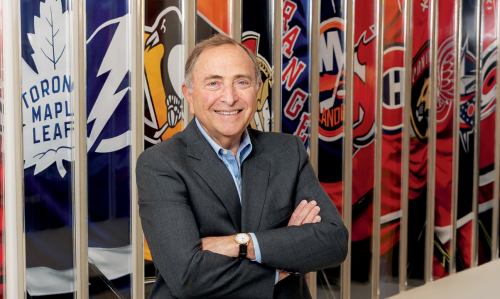
Gary Bettman ’77 on his winning record

Gary Bettman ’77
On September 28—the day before the 2026-2027 season opener in the National Hockey League got underway—Gary Bettman ’77, the league’s commissioner, returned to NYU Law to recall his journey and to discuss some of the business and legal dynamics at play in professional ice hockey today. The event was hosted by NYU Law’s Sports Law Association, the Law and Business Association, and the Journal of Law & Business.
Fielding questions from Professor Jodi Balsam ’86, who teaches Sports Law, Bettman talked about his role in steering the NHL through labor strife—including a lockout in the 1994–1995 season and one that canceled the 2004–2005 season—to reach its current state of stability, expansion, lucrative contracts, and record revenue, which is now projected to hit $8 billion this season.
“I’m excited that with all the cord-cutting and everything that’s happening digitally with AI, there is no substitute for live sports,” he said. “It is the most valuable content there is. And even in a world of AI, people are going to especially crave things that are actually real.”
In the keynote conversation, Bettman noted that he was “very bullish” about the NHL as the sport broadens its global presence. “We’re doing more to engage with fans internationally. We’ll be playing real games in Germany and Finland this year. Thirty percent of our players come from outside of North America. We’re probably the most international of the North American sports leagues,” he said. “And we’re bringing back the World Cup [of Hockey]. The [2026 Winter] Olympics was incredible. But the World Cup will be even better because we can control it.” [The event, which will be held in February 2028, will be staged jointly by the NHL and the NHL Players’ Association].
Still, throughout the discourse, Bettman—who likens his role to that of a chief negotiator—frequently returned to the point that his being a sports executive remains a marvel in itself. Born in Queens, Bettman attended NYU Law, where his favorite course was Contracts Law, before he landed an associate position at the New York law firm Proskauer Rose Goetz & Mendelsohn. In vivid detail, he recounted a turning point in his career when he quit Proskauer—against the advice of a legal mentor—and joined a small New Jersey practice.
He instantly regretted the move. Bettman recalled attempting to game out next steps amid fears of having committed what he called “professional suicide.” In 1981, he said, he received a lifeline via a surprise telephone call from Proskauer Rose partner George Gallantz, counsel to the National Basketball Association, asking if Bettman would be interested in joining the league’s legal and marketing departments. Bettman went on to spend 12 years at the NBA, where he eventually served as senior vice president and general counsel and where he pioneered the use of a salary cap.
“There’s a certain serendipity to life,” Bettman said. “The point being, you never know what’s going to happen, and you leave your eyes open to the possibilities.”
Bettman took questions from students on a range of topics. One audience member asked whether he had any advice for his counterpart in Major League Baseball—which faces the prospect of a lockout next season over a proposed salary cap. “It really is going to be a function of what the league really thinks it needs, and whether or not the owners stay together,” Bettman said.
On gambling and the NHL, Bettman recalled his role in helping to advance the Professional and Amateur Sports Protection Act, which legally barred sports betting in most states from 1992 to 2018, when it was overturned by a US Supreme Court ruling. Now, however, he told the gathering that he’s reached a point of acceptance. “I think there’s some real downsides to sports betting, but it’s a fact of life,” he said. “And so, I have a responsibility to make sure that our game is providing to sports fans the same thing that other fans in other sports can do as well.”
Bettman’s 33 years as the chair of his league is the longest such tenure in the history of professional sports. He did not shy away from discussing his eventual retirement—a subject he said he’s also broached with team owners.
“I can’t do this forever, OK? And I know that. And as important as collective bargaining, or TV contracts, or any of the other things we do [in the NHL]... is important, succession has to be on your checklist, because there needs to be an orderly transition,” he said. “When you have somebody who’s been a CEO for as long as I have, it’s kind of hard to find somebody who can just step in and do it, just because of the body of knowledge and the history. And that’s something that any CEO of any major organization has to focus on, because your responsibility isn’t just the here and now. It’s providing for the future.”