Mathura Sridharan ’18 stands up for Ohio as the state’s Solicitor General
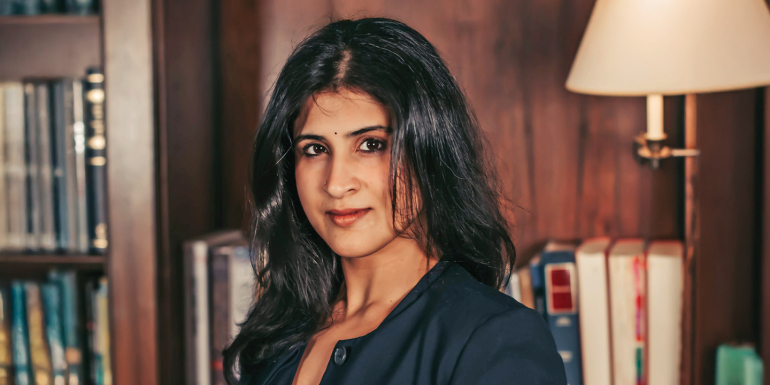
In July 2025, Mathura Sridharan ’18 became Ohio Solicitor General, just a year after she helped secure a notable administrative law victory before the US Supreme Court in Ohio v. Environmental Protection Agency, representing three states as an Ohio deputy solicitor general. The 5-4 ruling—which temporarily blocked the “Good Neighbor” plan that required 23 states to reduce their ozone pollution—was one of a series of recent high-profile Court decisions curbing federal agency powers.
Now, as the state’s top appellate litigator, Sridharan continues to have an active docket of cases focused on the boundaries between state and federal authority. It includes a bipartisan amicus brief at the US Supreme Court that opposes federal preemption of state road safety regulations, and the defense of an Ohio law that requires social media companies to verify users’ ages and to obtain parental consent for those under 16. In this Q&A, Sridharan talks about how her STEM background shapes her legal work, recalls how NYU Law broadened her ambitions, and delves into how she prepared for arguments before the US Supreme Court.
Can you talk about some of your duties as Solicitor General?
The Solicitor General’s Office, first and foremost, is the chief appellate office for the state. That means that we are working in the Ohio Supreme Court, the US Supreme Court, and the federal courts of appeals. Within the Office of the Solicitor General, there’s also the Tenth Amendment Center, which is a litigation center that is meant to address federalism issues. It’s about protecting the balance of power between the federal and state government.
And I also oversee our opinions division. One of the traditional functions of the Attorney General is advising various state and local officials whenever they ask for it, in the form of opinions interpreting Ohio law. It’s roughly analogous to the Office of Legal Counsel in the US Department of Justice.
And so my day can be governed by any number of things, but pending litigation deadlines in court often dictate my schedule. We also file briefs and argue in various courts. And I’m very hands-on in reading and editing drafts and briefs. Those go through multiple layers of review between me and the lawyers who write them.
I also advise the Attorney General. He may have questions and thoughts on something, and I answer those. And then there are longer-term projects, institutional projects, as well as advising and counseling clients.
What do you enjoy the most about this role and what challenges have you faced?
I enjoy the fact that I get to touch on so many areas of law so quickly. And having the opportunity to be well-read and versatile in various areas of both state and federal constitutional law, and then being able to deploy it quickly as our clients’ and the Attorney General’s needs evolve. I also always tell people that I have an all-star team. Being able to work with people who are extremely engaged and who are incredibly experienced thinkers helps, because having an overarching, bird’s-eye view of the law is essential to my role.
What can be challenging is the dual system of state and federal law. American law is very unique in that respect. And it requires successfully policing the boundaries of federal and state powers to maintain that constitutional balance. Ohio is just one of the states engaged in this work, but it’s an important role and an interesting one.
Talk about your decision to pursue law and what led you to NYU Law?
I originally wanted to be a physicist. One of the major reasons I attended Massachusetts Institute of Technology as an undergraduate was because I had a lot of admiration for Richard Feynman, the famous physicist, who attended MIT and taught at the California Institute of Technology. I ultimately went to MIT, where I studied electrical engineering, computer science, and economics as an undergrad. And then in 2013, I earned a master’s degree in electrical engineering and computer science.
I wanted to try something new, and when I moved out to New York, I started off at a finance firm. Then it quickly became apparent to me that I should go to law school to learn a bit more about trading and working on complex derivatives. Now I will say that I never really went back to that. But in 2015, a lot of things were changing in my life. I enrolled at NYU Law and got married in that same year.
Looking back, what stands out the most from your time at NYU?
I was so bright-eyed and excited. Law school was just a world that I never really thought about before. But I’ve always loved learning, and I was just in awe of everything that was going on. At first, I wasn’t sure as to whether I should be a lawyer, return to a job in finance, or do some other non-traditional job. But my goals slowly changed throughout law school. I’ll never forget sitting in Con Law during my second semester. Professor Trevor Morrison [Eric M. and Laurie B. Roth Professor of Law] was talking about executive powers. And I was just sitting there telling myself, “This is awesome. I cannot believe my only job right now is to listen to this person tell me about the executive powers in the Constitution.” It was this [feeling of], “Wow, my life is so blessed.”
But that was just one of the many classes that I enjoyed. Professor [Mark] Geistfeld [Sheila Lubetsky Birnbaum Professor of Civil Litigation] was wonderful. I took Product Liability with him. I also took several classes with Sam Issacharoff [Bonnie and Richard Reiss Professor of Constitutional Law]. As I think back on it, those classes changed my outlook on society. For me, it was just in understanding the underpinnings of the legal process, how that affects the markets, and how that affects how we interact with one another. These classes brought that all to the forefront.
I also participated in the [Orison S.] Marden Moot Court competition, which I sort of did on a whim. I won, so it was all’s well that ends well. Overall, it was a great competition, and just as important was that the people who competed against me were of such high caliber. It really inspired me to be better in everything I was pursuing.
What did you experience professionally after graduating?
As a 3L, I landed a clerkship with Judge Deborah Batts. It was a two-year clerkship on the Southern District of New York. And, she unfortunately, passed away in the second year that I was clerking for her. She truly was quite the trailblazer, but she was also very supportive. She really was the wind beneath my wings there. Before Judge Batts passed away, I secured another clerkship with Judge [Steven] Menashi of the US Court of Appeals for the Second Circuit. And just like Judge Batts, Judge Menashi has been—and continues to be—such a significant influence in my career, both from a substantive perspective and as an incredible mentor.
It was Judge Menashi who suggested to me that my talents would be well used in a state attorney general’s office that does high-stakes impact work of national importance. And when [former Ohio Solicitor General] Ben Flowers wanted to recruit me to Ohio, it was perfect timing. That was at the tail end of COVID, and my husband and I had some flexibility to make the move.
As Ohio’s deputy solicitor general, you argued before the US Supreme Court in Ohio v. EPA. How did you prepare yourself in that instance?
I was directing Ohio’s Federalism Institute. In that capacity, I initiated lawsuits against the federal government over regulations that exceeded their statutory boundaries or were otherwise unlawful. The “Good Neighbor” plan was national, but it mattered a great deal to Ohio, to our industries, and to our own state EPA. We had to ensure our ability to regulate our air quality on our terms. The case was meaty, weighty, and very technical.
It was only the third time in the history of the Supreme Court that the Court asked for argument on an emergency application. And that was really, really shocking to all of us. But it was also exciting because the Court was taking the matter seriously. In terms of arguing the case itself, it was both fun and daunting. It’s tremendously difficult, honestly, to put some of these concepts into words. And I relied on my STEM background to communicate technical concepts in a way that was easily digestible. It was a case that covered the technical aspects of many industries. It was a chemical engineering problem combined with a math problem. And so being able to stand before the Supreme Court and represent not just one state, but three states, was an immense honor. But it was also immense pressure to ensure that I did right by the states that put their trust in me.
What piece of advice would you give to current students at the Law School?
I fear that many law students don’t keep an open mind and let opportunities find them. In large part, it’s because law is a prestige-focused profession. Prestige is good. It is indicative of success, competency, and accomplishment. But I think what’s really important for law students to keep in mind is that the arc of your career is very long. Look for places to grow, take the opportunities as they come, and don’t be too precious about prestige.
And the second thing is a little more of a reflection on the times. I think that when you enter the legal profession, you have to understand that, first and foremost, you are an advocate. If you choose to be a lawyer, view yourself as a servant to the position that you’re being asked to take. Remember that everybody you work with is doing a job. It’s okay to disagree on the substance of things that you might be working on, but it does not have to accelerate to a personal level. On a personal level, you should be engaging with anybody who’s willing to learn with you, work with you, and to be a source of support in your life. It’s a dispersed way of saying: make friends, not enemies. We all have positions we have to take, but that doesn’t mean you can’t be friends with the people who take [those adverse to yours].
What imprint do you hope to leave on the Solicitor General’s Office?
What I tell my team every time we have our meetings is that my office has a reputation for excellence. It is my intention to make sure we always put out excellent work—work that makes the best arguments and the best case for our clients, for the state, for the public welfare, and for justice. Our approach is being excellent throughout that process. It’s just something that we live by. And I hope that people will associate my tenure here with excellence in legal advocacy.
This interview has been condensed and edited.
Photo by Jomel Spurlock.