

Margaret Satterthwaite ’99 honored with Judicial Independence Award
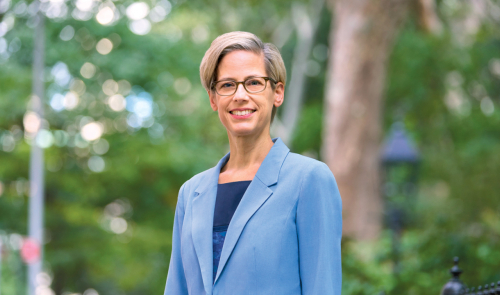
Margaret Satterthwaite ’99
On October 12, Professor Margaret Satterthwaite ’99 was awarded the 2025 Judicial Independence Award by the International Association of Judges (IAJ) for her work on promoting the independence of judges and lawyers around the world. This award recognizes her scholarly contributions and her ongoing efforts as United Nations special rapporteur on the independence of judges and lawyers.
Special rapporteurs are independent topic experts selected by the UN Human Rights Council who have a mandate to report and advise member states and the organization on thematic or country-specific topics. Since becoming a special rapporteur in 2023, Satterthwaite has produced seven thematic reports on topics that include protecting the independence of judges and lawyers in the face of autocracy; upholding the rights of Indigenous Peoples to maintain their own justice systems; and the use of artificial intelligence in judicial systems.
In just three years, Satterthwaite says, her role has become more prominent. “When I started…a lot of people would say to me, ‘Oh, that’s an interesting mandate. It’s very technical.” Instead, she says, the issue of maintaining independent judiciaries throughout the world has become increasingly relevant, requiring rapid action to protect justice actors as well as specialized recommendations to governments.
Satterthwaite notes that the IAJ award is especially meaningful to her because Norma Lucía Piña Hernández, former president of the Supreme Court of Mexico, is also a recipient of the 2025 Judicial Independence Award. Piña Hernández, the Court’s first woman president, faced years of vitriolic and personalized attacks by the former president of Mexico following Supreme Court rulings that he disliked, Satterthwaite says. Piña Hernández opposed a 2024 judicial reform effort in Mexico that would dismiss all of the country’s sitting judges and replace them with judges elected by the general population; she warned that the shift would erode the independence of the judiciary. Despite executive attacks and online threats, Piña Hernández “continued to be an outspoken advocate for judicial independence. So that was important to me,” says Satterthwaite.
Satterthwaite attributes some of her success as special rapporteur to the students in her Legal Empowerment and Judicial Independence Clinic, who work as student legal advisers to her in her UN role. Students verify factual submissions, draft individual complaints, conduct human rights legal analysis, and advise on strategic issues. They talk to experts in the field, prepare expert statements or amicus briefs, examine the latest scholarship, and convene “discussions with people who might have a stake in the issue, [as well as] potentially sometimes going onsite to visit,” Satterthwaite explains. During Fall 2024, Satterthwaite and some of her students visited tribal courts in Oklahoma to gather perspectives for her report on the rights of Indigenous Peoples to develop and maintain justice systems. The students spent time with Judge Gregory Bigler of the Seminole and Sac and Fox Nation Tribal Courts. “He became like a mentor for the whole process, and that was really amazing,” Satterthwaite says. "We got much more of a sense of his life and how he thinks about the role of tribal courts and advancing self-determination.”
Faculty members and other experts in the NYU Law community have provided invaluable support, Satterthwaite adds. Both Philip Alston, John Norton Pomeroy Professor of Law, and Pablo de Greiff, senior fellow and director of the Transitional Justice Program and Prevention Project at the Center for Human Rights and Global Justice, previously served as UN special rapporteurs. “[They] gave me so much incredibly important advice on what this role is and how to approach it,” she says. Kevin Davis, Beller Family Professor of Business Law; Maggie Blackhawk, Moses H. Grossman Professor of Law; and Justine Olderman, scholar in residence at the Center on Race, Inequality, and the Law, have provided important input on her recent work, she says. “I feel like on almost any topic related to my mandate, I’m going to find an expert on our faculty.… It makes things much easier and much more exciting and fun,” Satterthwaite says.
Despite the serious threats to judicial independence internationally, Satterthwaite’s interactions with students and the legal community worldwide help her remain hopeful: “I feel like it is really a huge advantage to be working with new lawyers about to become professionals in our field,” she said. New lawyers are well-positioned to argue for judicial independence and the role of the legal profession in protecting the rule of law, she says.