2026 LACA Spring Dinner salutes alumni and reimagines American democracy
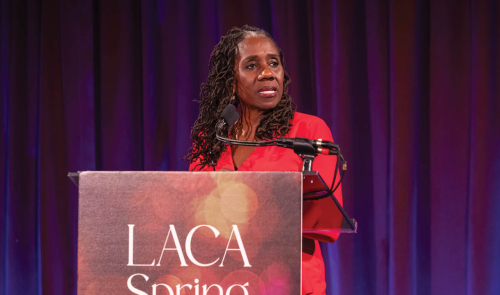
Sherrilyn Ifill ’87 delivered the keynote address at the LACA Spring Dinner.
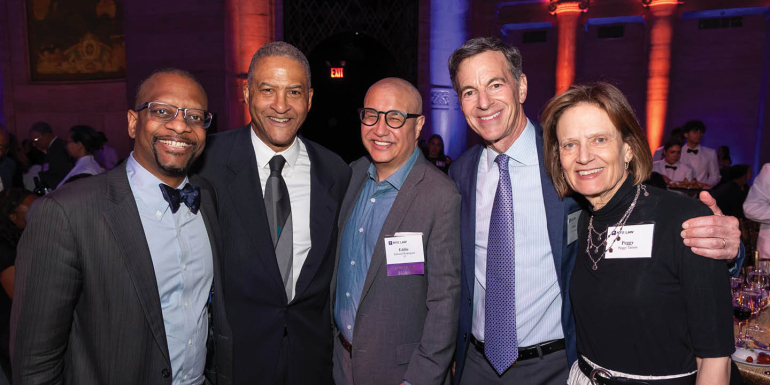
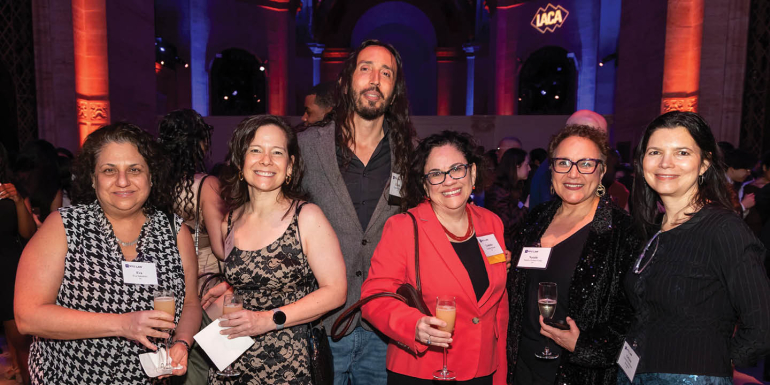
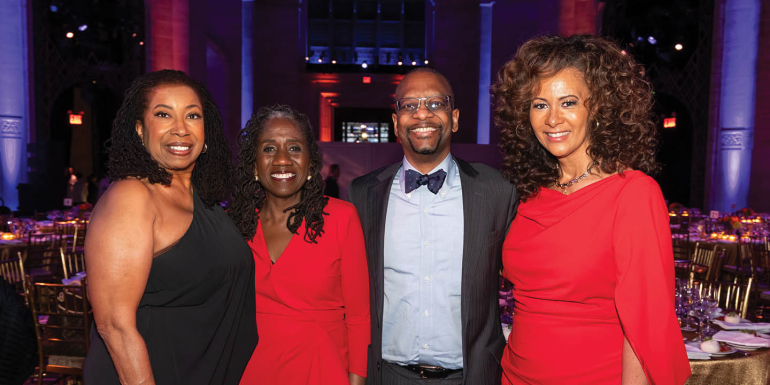
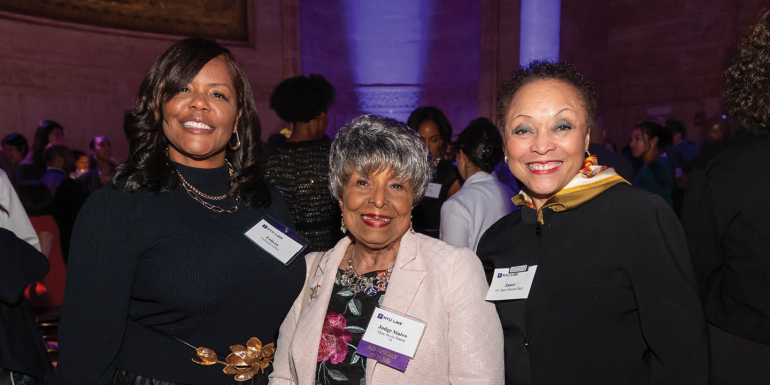
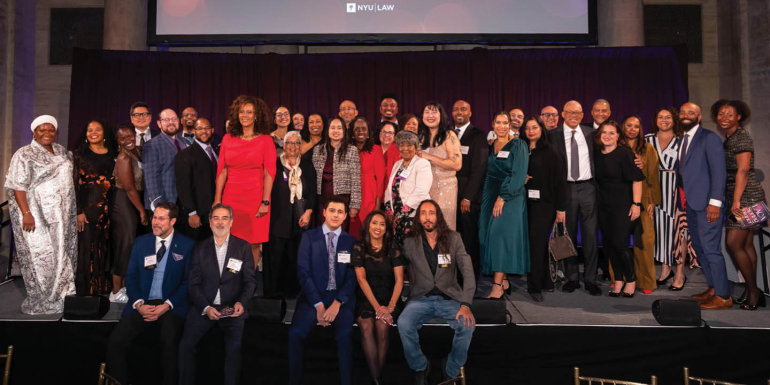
In a ceremony steeped in solidarity, tradition, pride, and determination, NYU Law’s Law Alumni of Color Association (LACA) honored alumni and student scholarship recipients at its annual Spring Dinner on March 27. Held at Cipriani in Lower Manhattan, the 48th LACA gala—which gathered a diverse group of alumni, faculty, notables, and current and prospective students—was dedicated to the theme of “Reimagining American Democracy.”
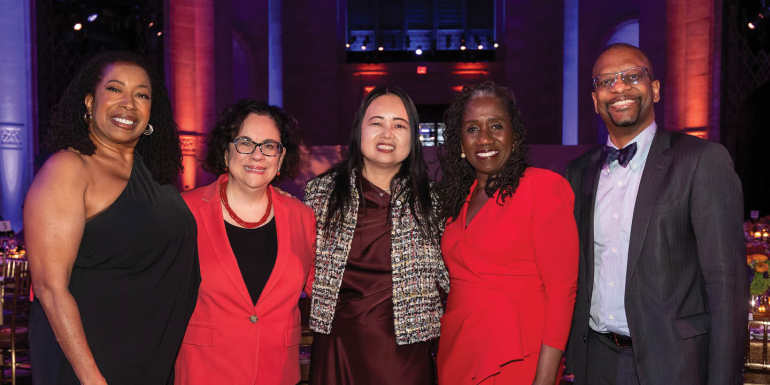
The LACA dinner celebrated three eminent alumnae with its Distinguished Alumni Achievement Awards: Lourdes Rosado ’95, president and general counsel of the Bronx-based nonprofit LatinoJustice PRLDEF; Jennifer Wu ’04, a founding partner of the patent litigation firm Groombridge, Wu, Baughman & Stone LLP; and civil rights lawyer and scholar Sherrilyn Ifill ’87, who served as president and director-counsel of the NAACP Legal Defense and Educational Fund, Inc. from 2013 to 2022. In addition, Lisa Marie Boykin ’95 introduced her short film on the life and work of the late Derrick Bell, the pioneering civil rights scholar and activist who was a full-time professor of constitutional law at NYU Law for two decades.
In remarks to the gathering, LACA president Judy Bartlett ’95 praised the event as a reflection of LACA’s guiding principles such as “courage, liberty, [and] service.” Dean Troy McKenzie ’00, Cecelia Goetz Professor of Law, underscored LACA’s historical legacy and its present-day significance. “LACA reminds us that the legal profession is at its strongest when talented people—all talents from every background—can find support, opportunity, and belonging within this profession,” he said. “And that kind of community is something worth building and something that we must fiercely
protect.”
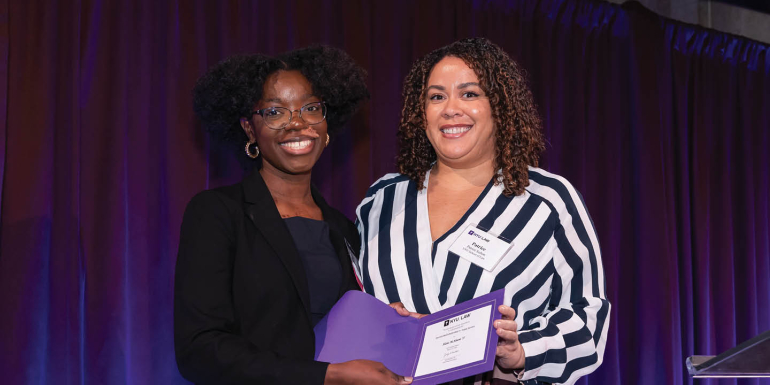
Several students were recognized with scholarships: Seulgi Dianne Lee ’28 and Alanis McAlmont ’27 received the Derrick Bell Scholarship for Public Service, Kalin Elliott ’27 was named the recipient of the Rasheed M. McWilliams Scholarship, and Donna Webster ’27 was awarded the Lisa Marie Boykin Scholarship. LACA also announced the launch of the Kim Taylor-Thompson and Tony Thompson Fellowship, named for two emeriti faculty members at NYU Law whose teaching influenced generations of clinical students. Thompson is the founding faculty director of the Center on Race, Inequality, and the Law.
In receiving the Distinguished Alumni Achievement Award, Rosado credited NYU Law with providing the tools and “such a critical foundation” for her three-decade-long career in working for civil rights, immigrant rights, and voting rights. “Every day we all have to take a deep breath and hope to be a happy warrior, with an amazing team of friends. Because this is really what we’re trained to do. It’s our vocation as lawyers,” she said. “The principles that we are defending—due process, the right to participation in our democracy, and to have access to opportunity, and even the fundamental rule of law—they are not slogans today. They are the bedrock of a fair and just society.”
Honoree Wu was lauded for her pro bono work in representing Asian victims and families in cases of racially motivated bias attacks. She reflected upon growing up painfully shy, adding “I found my voice” at NYU Law. Of her life since then, Wu said: “If you have a voice, if you can stand at a podium like this, if you have that privilege of going to NYU Law, you have a responsibility to speak for those who do not have a voice.”
Keynote speaker Ifill, who is the founding director of the 14th Amendment Center for Law & Democracy at Howard University, was introduced by her classmate Gemma Solimene ’87. Ifill began her remarks with a dose of nostalgia—recalling how she ventured out with Solimene and their close-knit circle of friends to the Greenwich Village club the Bottom Line, to a Whitney Houston concert, to underground dance palace Paradise Garage, to thrift shops along Eighth Street.
“There are many people who say they hated law school,” Ifill said. “I absolutely loved it.” She expressed gratitude to NYU Law for “introducing me to this profession I love” and fostering her interest in public interest work and civil rights law.
Turning somber, Ifill said that she is saddened over the current sociopolitical climate and voiced regret over the state of the nation that she fears her grandson will someday inherit. “I’m not even giving him a world that’s better than the one that was given to me. For me, it’s a shame. Generationally, it is a sin,” she said. “That’s our job as adults: pass on a world that is, in some measure, better than one that was given to us. We have broken something, a sacred commitment—not because we haven’t tried. But it’s broken. And I think it’s okay to admit that, because I think it is critical that we confront the truth about this moment and also about this country that we live in.”
Ifill invoked history for examples of valor, resilience, and inspiration for facing present-day obstacles. She referenced the largely overlooked period when Black scholars, lawyers, and advocates such as Charles Hamilton Houston, Robert Carter, Thurgood Marshall, Constance Baker Motley, and Leon Andrew Ransom Sr. pushed for equality during the 1930s and 1940s. “There was literally nothing happening in the United States in 1935 that would make you think you could break the back of Jim Crow,” she said. “And yet those individuals set out determined to transform their lives and this country.… These are people who had only ever lived under Jim Crow. Their parents had lived under Jim Crow. Many of their grandparents had been enslaved. So they had no blueprint for what they were trying to accomplish, and yet they set out on that journey, believing that it was possible.”
Making an argument for reimagining American democracy, Ifill cited the abolitionist movement of the 19th century, including the antislavery efforts of lawyers and politicians like Thaddeus Stevens, John Bingham, and Charles Sumner; writers and activists such as Frances Ellen Watkins Harper, David Walker, and Frederick Douglass; and those whose names are often lost to history. “By God, I contend that enslaved people who kept trying to escape to freedom are framers of our Second Founding. The relentlessness of their determination to be free, and the full range of abolitionists who fought for freedom—John Brown, all of them—are founders and framers of our Second Founding, because they influenced the people who went into that room and wrote the words of the 13th, 14th, and 15th Amendments. [The authors] did not just go in the room and come up with that themselves. There were decades of people insisting on what freedom and equality actually meant.”
It took, Ifill noted, a generation of “ordinary people like John Lewis and Rosa Parks and Fannie Lou Hamer” to wage a multifaceted, human rights struggle in the Civil Rights Movement against repressive laws and court rulings. “We brought democracy to this country,” she said. “You could not rightly say that this country was a democracy before 1954. We did not call apartheid South Africa a democracy. Half of this country lived under legal apartheid prior to 1954. That is not democracy. Democracy came to this country because of us. And if it returns, it will be because of those of us in this room.”
“Things move,” Ifill said, “and the only way they won’t move is if we give up…. Those who come from this Law School, and who are in this profession—the legal profession—are a critical building block of a healthy democracy,” she emphasized. “We have the obligation to hold the line, to hold integrity, to hold ethics and professionalism, to speak of democracy, to equate civil rights work with democracy, to demand that the three amendments to the Constitution that were made for Black people—the 13th, 14th, and 15th—that they be honored.”
Ifill’s words were frequently punctuated by applause that grew louder and more sustained over the course of her remarks. Of her work, she concluded: “I hope, always, that I am making my people proud and that I’m making my family proud. That I have never betrayed what I believe, even when it makes me sound naive. I’m going to keep doing this work until I can no longer do it.”
Ifill departed the stage to a standing ovation.
Photos from 2026 LACA Spring Dinner: