IJA judicial panel weighs the rise of state constitutionalism
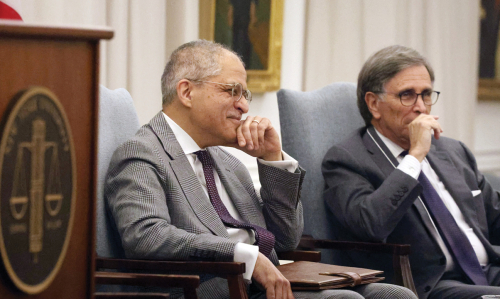
As recent US Supreme Court rulings have lessened a range of federal protections, constitutional action has increased in the states, according to three appellate judges speaking at an April event hosted by the Institute of Judicial Administration. “Assessing the Rise of Independent State Constitutionalism” brought together Judge Dan Friedman of the Appellate Court of Maryland and Judge Lisa Lorish of the Virginia Court of Appeals for a discussion moderated by Chief Judge Jeffrey Sutton of the US Court of Appeals for the Sixth Circuit.
Watch the full video of the discussion:
As an overview, Sutton traced the modern debate that contrasts federalism and state constitutionalism to a 1977 article in Harvard Law Review by Justice William Brennan. The jurist wrote: “State constitutions, too, are a font of individual liberties, their protections often extending beyond those required by the Supreme Court’s interpretation of federal law.” The article, Sutton noted, drew a response that year in the same outlet from NYU Law’s Burt Neuborne, now Norman Dorsen Professor of Civil Liberties Emeritus, who raised concerns over “funneling federal constitutional decision-making into state courts precisely because they are less likely to be receptive to vigorous enforcement of federal constitutional doctrine.”
Some two decades later, William Rubenstein of Harvard Law School, writing in Constitutional Commentary, challenged Neuborne from a progressive standpoint. Well before the landmark Obergefell v. Hodges legalized same-sex marriage nationwide in 2015, Rubenstein said, the clients he represented as an attorney for the American Civil Liberties Union’s Lesbian & Gay Rights and AIDS Project made significant headway in securing rights from state courts as opposed to their federal counterparts.
The decades-long ideological back-and-forth still hovers over the current landscape, in which states, via legislatures and courts, seek to wield constitutional power with greater authority. Sutton pointed to several much-debated issues: “If you pull the federal courts out of the mix, Congress is AWOL when it comes to gerrymandering…. It’s hard to imagine Congress entering the mix on abortion,” said Sutton. “So you really have a situation where it’s states or nothing. And the American people are not tolerating nothing. So they’ve gotten very involved, whether amending state constitutions, state court decisions, [and] state legislation.”
Virginia’s Lorish pointed out that for decades her state “fell into the lockstep camp” by generally deferring to federal precedent on constitutional matters such as free speech, search-and-seizure, and the cruel and unusual punishment clause. Now, she argued, Virginia is displaying signs of increasing independence: she pointed to a 2023 case, Vlaming v. West Point School Board, in which the Virginia Supreme Court relied on the state’s free speech and free exercise of religion rights—not their federal equivalents—when it reinstated a suit brought by a teacher who was fired after refusing to use a transgender student’s preferred pronouns.
The panel agreed that in shifting to the states, many new fronts have opened up over constitutional interpretations of access, equal protections, and a broad range of societal concerns. “Each of the 50 states has its own story and they are unique stories,” said Friedman. “They are different stories; they come from different places. And it’s really interesting how each one is put together and how they work.”
Selected remarks from the IJA discussion on the rise of state constitutions:
Jeffrey Sutton: “What we have lost track of in America is how these two systems are supposed to work together. That it’s American constitutional law, it’s not federal or state constitutional law. And it’s actually really exciting, because it goes to the great question in American history. The great question of American history, which we’re constantly debating over different topics, from 1776 to today, is what problems deserve a national solution, what problems deserve a local solution.” (video 24:55)
Dan Friedman: “Constitutions aren’t always written in the language of due process of law…. Sometimes they’re very mundane and sometimes, all it is, is it reflects the judgment of the people that we do not want this to be subject to the legislature.” (video 32:28)
Lisa Lorish: “And one unique feature of state constitutional interpretation…is the relationship between state courts and state legislatures. We, as state judges, are a lot more accountable—that’s one nice way to maybe put it—to the people in our states, to the legislators in our state. Another way to put it is that we can be removed a lot more easily. Our judicial offices can be persuaded much more easily by what’s happening in the legislature by our governors.” (video 48:14)