Can tort law address harms stemming from social media and AI?
In August, state attorneys general negotiated a $17 billion settlement with Meta over claims that the social media giant had violated child safety protections. The emergence of such high-stakes litigation—over whether social media platforms and artificial intelligence chatbots can cause foreseeable harms—was the backdrop for an October 21 NYU Law Forum, where expert panelists considered how tort law can address issues created by these rapidly proliferating technologies.
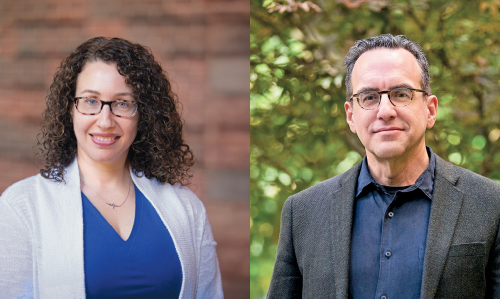
The potential harms of social media and AI needed to be balanced against “serious free speech interests about expressive conduct…[and] whether or not liability might chill or deter innovation and all of the upsides of these technologies,” said moderator Catherine Sharkey, Segal Family Professor of Regulatory Law and Policy.
Watch the full video of the NYU Law Forum:
Do online platforms provide a product or service? That’s a key question, said Jonathan Blavin, a partner specializing in internet, AI, and privacy-related litigation at Munger, Tolles & Olson in San Francisco. Other questions follow from this one, Blavin explained. Can something intangible be a product? Does the claim target content or ideas? Products liability has traditionally not applied to either. The legal theory chosen—strict liability, negligence, or public nuisance—changes everything that follows in a litigation, all the way through to jury instructions.
“There’s often a narrative that we’re living in an age with emerging digital technologies that our legal frameworks are not fit for,” said Meetali Jain, founding director of the Tech Justice Law Project. “To some extent, that might be true, right? I think the task of lawmaking needs to continue…in earnest. But that’s not to say that we don’t have existing frameworks that are capable…of meeting this moment.” Current tort law’s purpose fits the problem, she suggested, by making companies bear the costs of harm and narrowing the information gap between companies and consumers.
Mark Geistfeld, Sheila Lubetsky Birnbaum Professor of Civil Litigation and the reporter for the American Law Institute’s Principles of the Law, Civil Liability for Artificial Intelligence, noted that there has never been a fully developed principle separating products from services beyond the distinction between tangible versus intangible. Courts have previously settled the question with a First Amendment-style test that asked whether the alleged defect was content-neutral.
But that test fails for AI, he explained, because every AI output is information. Even a basic guardrail, like refusing to give a user a bioweapon recipe, filters content.
“The question then becomes, what kind of information ought to be filtered?” said Geistfeld. “And then you get into interesting questions about the role of negligence versus the defect-based rules of liability. And the tangible and intangible stuff factors into all of that…. It can be surprisingly nuanced to figure out how an established law applies to this new technology.”
Selected quotes from the discussion:
Jonathan Blavin: “A big issue in the social media cases, and in some of the chatbot cases, deals with whether or not you have a third-party actor who ultimately caused the primary harm, but the claim is predicated upon their interaction with the platform…. I think the courts are going to have to grapple with whether or not the platform’s interaction with the third party is actionable in and of itself, or if the third party itself is the intervening cause that cuts off the line of causation.” (video 35:37)
Meetali Jain: “[We often] anthropomorphize the AI. ‘They conspired,’ ‘They escaped’…. Really, this is an AI safety problem…. I’m not suggesting that…the existential threats to humanity are not real or should be minimized. But I do think we have to parse out what we can do in this moment rather than just feel a sense of hopelessness in the face of the media framing around it.” (video 38:19)
Mark Geistfeld: “I think the relation between [regulation and tort litigation] is synergistic and complementary, not antagonistic…. Tort law is better at the normative questions: ‘How safe should it be?’ and so on. But we lack uniformity, we lack speed, and so there’s lots of value to working out technical issues in a rulemaking context in Washington rather than on a case-by-case basis.” (video 53:30)