

NYU Law Forum explores changing landscape of climate change battles
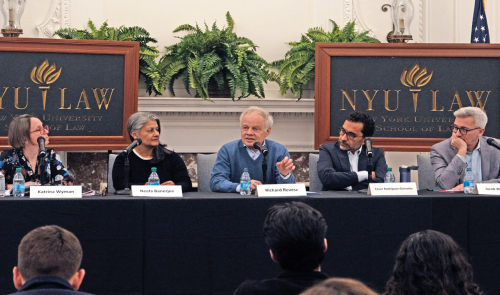
Left to right: Katrina Wyman, Neela Banerjee, Richard Revesz, César Rodríguez-Garavito, and Jacob Werksman. Photo: Kaleo Zhu
Even as the US government has halted a wide range of initiatives to curb carbon emissions, efforts to combat climate change continue in the United States and around the globe. That was the key theme of the discussion in an NYU Law Forum on February 18, “Fighting Climate Change in an Era of Opposition,” which explored recent legal developments and real-world impacts related to a warming climate.
The panel of environmental experts included Neela Banerjee, chief climate editor at NPR; Dean Emeritus Richard Revesz, AnBryce Professor of Law; Professor César Rodríguez-Garavito, chair and faculty director of the Center for Human Rights and Global Justice; and Jacob Werksman, principal adviser in the European Commission’s Directorate General for Climate Action and a senior Emile Noël fellow at NYU Law.
Watch the NYU Law Forum discussion on “Fighting Climate Change in an Era of Opposition”:
Moderator Katrina Wyman, Wilf Family Professor of Property Law, opened the discussion by asking panelists about important developments within the past year.
Banerjee noted that news audiences show growing interest in the effects of climate change. Listeners appreciate reporting on matters that affect their lives, she said, citing NPR’s reporting on the home insurance premium hikes driven by more extreme, less predictable weather patterns. “Home insurance prices are going through the roof in this country, and we and other media are covering this, too, and continue to cover it,” she said. “Climate change is definitely coming home to people’s budgets and forcing hard choices on people, even if they’ve not been hit by extreme weather yet.”
Revesz, the faculty director of NYU Law’s Institute for Policy Integrity, focused on the US Environmental Protection Agency’s recent repeal of its earlier finding that greenhouse gases endanger public health. “The main rules that [the repeal] affects are the vehicle emissions standards…[and] it’s very likely to affect the power sector standards,” he said. Also affected would be the regulation of methane emissions in the oil and gas industry and of emissions from aircraft, he noted.
Revesz critiqued the EPA’s legal arguments for rescinding the finding and predicted that the repeal would be successfully challenged in the US Court of Appeals for the DC Circuit. He disputed the EPA’s position that the Clean Air Act applies only to local and regional pollutants. “They also completely mangled Massachusetts v. EPA, which is the leading case in which the Supreme Court held that under this particular provision of the Clean Air Act, greenhouse gases are pollutants,” Revesz said. “I’m reasonably confident,” he added, “that even a judge who’s generally hostile to environmental regulation, taking a fair look at the arguments, would conclude that the administration position can’t stand.”
Both Werksman and Rodríguez-Garavito explored developments at the international level. The European Union remains committed to its goals of reducing carbon emissions 90 percent below 1990 levels by 2040, but “politically is hesitating about the consequences—the economic impacts, the social impacts—of that kind of transition in such a short period of time will have on the EU and the EU economy,” Werksman said. “….What you’re now seeing is becoming much more of a political discourse in the EU, not so dissimilar to the questions about the costs and impacts in the United States.”
In response to a question from Wyman, Werksman discussed the rollout of the EU’s new carbon border adjustment mechanism (CBAM), which puts a price on carbon emitted during the production of goods imported into the EU. “It’s perceived by many, particularly our developing country partners, as being unilateral in its character,” he said. “They see it as setting standards that are based on European standards and not taking into account that many developing countries have different priorities [and must meet] their basic energy needs.”
However, he said, the EU’s CBAM is beginning to encourage other countries to adopt their own carbon pricing policies. “If…someone’s going to have to pay for the carbon embedded in their product, wouldn’t it be better that that price goes to their own domestic economy, to their own government, rather than the price being charged by the EU and going into the EU coffers?” Werksman explained.
“Even if the US isn’t putting these kinds of policies in place,” he added, “their trading partners will and are.”
Rodríguez-Garavito hailed 2025 advisory opinions from the International Court of Justice and the Inter-American Court that affirm the obligation of nations to address climate change. Integrating a range of international frameworks, the courts’ decisions spell out in new detail how binding such obligations will be under international law, Rodríguez-Garavito said. They also give attention to how states must help communities and individuals adapt to the effects of climate change, including potentially paying reparations, he added.
“We now stand at an interesting moment in climate mitigation history, where we have the law that all of the litigants and many of the courts would have dreamed of 20 years ago,” Rodríguez-Garavito said. “It’s hard to get something more assertive than what the litigants got.… And yet climate politics is pulling in a different direction. So the gap is now more abysmal, more spectacular, and one of the challenges going forward is going to be how to leverage the letter of those decisions to help close the gap.”