Five Years Out: Melodi Dinçer ’20
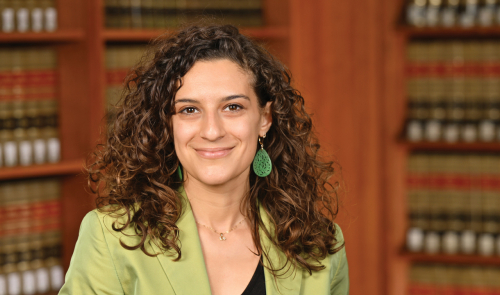
Policy Counsel, Tech Justice Law Project; Lecturer in Law, UCLA School of Law
Tell us about what you’re doing now. What are the challenges? What do you like most?
As a 2L, I was quoted in an NYU Law Magazine piece on students who had ambitions to practice in tech law. I said that I was preparing for a job that probably doesn’t exist, and I was absolutely correct. At Tech Justice Law Project, we bring cases that have never existed before. We filed the first-ever wrongful death lawsuit against generative AI companies. Several lawsuits brought by the families of teenagers who have taken their lives at the prompting and inducement of products like ChatGPT and Character AI—those are our cases.
I was TJLP’s first hire in August 2024. Within my first month, we filed a groundbreaking, first-of-its-kind wrongful death lawsuit against Character AI and Google, which we allege facilitated the Character AI co-founders in creating this product that led to the death by suicide of a 14-year-old. I applied my expertise in data privacy to this landscape to understand what kinds of claims we could bring concerning the [use] of a young person’s data in this kind of product. I was instrumental in drafting the unjust enrichment part of that complaint, as well as the unfair and deceptive business practices claim and some of the more novel remedies following the FTC’s innovation of ordering algorithmic destruction, model destruction, etc. We are claiming that if a model is trained on data that’s ill-begotten, that entire model and any subsequent models that are derivative of it should be destroyed, and companies should not be able to continue benefiting from them commercially.
The complaint received a ton of media coverage, and we’ve become one of the leading voices in the application of tort law to this landscape of AI liability, including products liability and negligence theories. It’s amazing to me to be relatively green in my legal career and yet have such a significant opportunity to impact the development of this area of law.
After we filed the Character AI case, we also received requests from lawmakers and policy folks asking how to take the lessons of the claims we were raising and translate them into proactive legislation and regulation. So a big part of my role has become influencing policy. And it’s not just confined to regulating chatbot products for youth harms. We recently filed seven more cases on behalf of adults who experienced intense delusional disorders due to their reliance on ChatGPT, a growing phenomenon commonly referred to as “AI psychosis.”
As a law student and in my first few years of practice, I focused a lot on biometric privacy: protecting people when their images, voices, and other unique body-based information are exploited, for example, as so-called deepfakes without their consent or even their awareness. One project I’m overseeing now is the development of a model bill and approach to regulating these kinds of digital replicas outside of a right of publicity or commercial framework. We want to develop this alternative because the likenesses of our clients and others, such as victims of school shootings, have appeared in these products, and we can’t really prove that there’s some commercial benefit to the developer of the chatbot that is impersonating these deceased victims of crimes. So I’m thinking about how to mount challenges based on privacy as opposed to intellectual property, and considering dignity-based harms.
I moved to Los Angeles at the beginning of 2024 to be a fellow at UCLA School of Law’s Institute for Technology, Law & Policy. My vision was to start a tech law clinic like the one I took at NYU Law. Every spring I teach the Information Policy Lab, an experiential course that exposes law students to real tech law and policy issues. This coming semester, the lab’s focus will be on digital likeness protections and digital replicas. We’ll potentially be working with groups here in LA like SAG-AFTRA and the National Association of Voice Actors, developing resources to explain what legal protections already exist against digital replicas and what we should advocate for in that space.
What led you to work at the Tech Justice Law Project?
After graduating, I spent a year in Washington, DC, as an appellate advocacy fellow at the Electronic Privacy Information Center (EPIC) before clerking for Judge Arenda Wright Allen of the US District Court for the Eastern District of Virginia. At the end of my clerkship, I was missing tech law and reached out to my former professor Jason Schultz, the director of NYU Law’s Technology Law and Policy Clinic. He was running a program through NYU Law’s Engelberg Center for Innovation Law and Policy called the Knowing Machines Research Group, and I became its legal research fellow. I took the work of the data scientists and science and technology scholars in that group and translated it into legal outputs—amicus briefs in ongoing litigation against facial recognition company Clearview AI as well as public comments to the White House Office of Science and Technology, the US Copyright Office, and the Federal Trade Commission on issues related to training data for complex AI systems.
At the same time, I was a supervising attorney with the Technology Law and Policy Clinic. That led me naturally to the UCLA fellowship. I was able to publish a piece with the Clinical Law Review and to start teaching the Information Policy Lab. Then the TJLP role came along, but UCLA wanted me to keep teaching the lab, so I have.
How did NYU Law prepare you for your career path?
My instructors have given me crucial career mentorship and guidance at pivotal points, particularly almost anyone affiliated with the Technology Law and Policy Clinic while I was a student there. Jason Schultz has been one of my most important mentors. My clinical teaching fellow when I was a student was Amanda Levendowski [’14], who now runs the Intellectual Property and Information Policy Clinic at Georgetown Law. She read a very early draft of my one and only published academic paper and helped me navigate what I might do next at the end of my clerkship. [Professor] Chris Morten [’15] has been really helpful as well. He’s given me a lot of moral support as well as practical insights into the clinical teaching market. Jake Karr [’18] and I became quite close when we were both supervising attorneys for the clinic, and I’ve really learned from him as a peer.
What were your favorite classes at the Law School?
Obviously, the Technology Law and Policy Clinic was hands-down the best thing I did. My 1L Contracts class with [Emilie M. Bullowa Professor of Law] Richard Brooks was a bit unorthodox, which I appreciated. He took a much more philosophical and sociological approach to Contracts. I loved that, coming from Brown University with my humanities degrees in hand. Professor Brooks taught me to think really deeply about the meaning of the words we’re using. In the work I do now at TJLP, I build our narratives. The wording shapes how people think about the role of the law in addressing a certain harm.
The National Security Executive, the Courts, and the Constitution was a great seminar with [Hiller Family Foundation Professor of Law] David Golove. He gave me the freedom to write my final paper about multilateral trade agreements governing data sharing. That became a huge topic, but at the time it was quite niche. He allowed me to use the framing of constitutional treaty powers and executive national security powers to go deeply into a very timely issue. Another wonderful class was The Listening Guide Method of Psychological Inquiry with [University Professor] Carol Gilligan. A psychoanalytic approach is useful in legal practice. When you’re deposing someone, even a basic awareness of human psychology is helpful in crafting your questions and dealing with someone who might be belligerent or passive-aggressive.
What advice would you give to students?
Talk to me! I love talking with students who are considering this path.
I think there’s this common notion that there has to be a reason for you to reach out to this professor, there has to be a reason for you to get coffee with this person. If you want to connect with a professor because you like their style, tell them you like their style. Don’t disqualify yourself in your own head from making connections that could help you later down the line in ways that you really can’t foresee now. There were a lot of people whom I reached out to two or three years into my career whom I didn’t really know, but they were still extremely helpful and gracious with their time. A lot of educators are doing this work and have built these careers because they want to help students, so I would say lean into that. And also, of course, the alum network is really rich and beautiful.
NYU offers free psychological counseling for students. Use that counseling service. I white-knuckled myself through some mental health challenges when I didn’t need to. Anyone who might be struggling with the pace or the expectations, feelings of incompetence, imposter syndrome, just try to talk to someone, because the school is offering you this resource for a reason. Try really hard to build space for self-reflection and for doing things that are not law school-related whatsoever.
As somebody working in the legal field, in what ways do you think NYU Law graduates are distinct from those from other schools?
There is definitely a certain energy from being so close to this historic neighborhood of non-traditional folks, artists, hippies, the LGBTQ resistance movement. A lot of really interesting things happened exactly where NYU is located, and even though law school can feel really formalistic sometimes, I think that there is an influence nonetheless. For me, to the extent that NYU Law students can really lean into and embrace that feeling of creative opportunity, the better. I think NYU Law students also tend to be a bit quicker to laugh, to be a little provocative, to think about things from many different perspectives and be able to hold all that in themselves at once.
This interview has been condensed and edited.