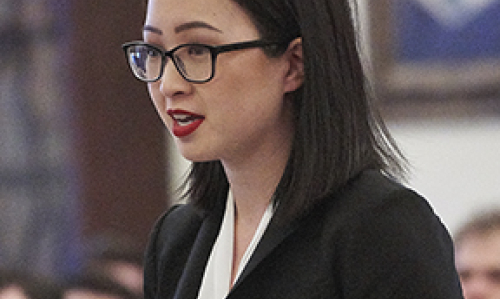
Five Years Out: Madeleine Xu ’20
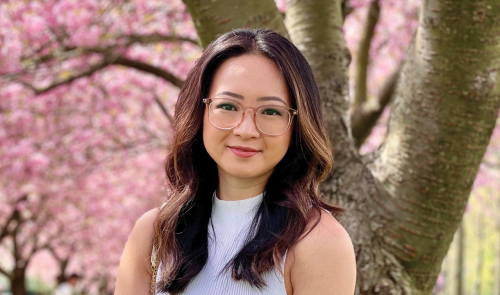
Senior associate, Litigation, Kirkland & Ellis
How did you end up at your current job?
I'm a sixth-year associate in the litigation department at Kirkland & Ellis. I always wanted to be a trial lawyer, that’s what I went to law school to do. My favorite classes from law school were Civil Procedure and Complex Litigation with [now-Dean] Troy McKenzie ’00, and that’s where I learned that there was a lot more to litigation than just trial. Coming off of my clerkship in 2022, I was looking for a place where I would not only actually get to do trial work, but where I would also get to do all of the 18 other phases of litigation at a very high level. I ultimately decided the place that would let me do that and build both the career and the life I wanted was Kirkland.
What are the challenges and what do you like most about it?
I really, really love the variety in my job. Litigation is a process, but the substance of it changes from case to case. On every single case, you have to learn something new to figure out how you're going to advocate the client’s position. I’ve gotten to work on cases in industries ranging from beer distribution to professional sports to video game publishing. I also like that litigation is inherently very collaborative. I work on teams with my peers, with juniors, and with partners and I enjoy that social aspect of litigation.
The challenge, particularly for a young associate working at a very large law firm, is figuring out what your path is going to be, what you want to do, and who's going to help you get there. When you’re very junior, you're just trying to get the muscle memory of how to do things well. But then you get to a certain point, and you have to think about things like, “What do I want my practice to look like?”
For example, I consider myself a commercial litigator. But Kirkland has an open staffing system, and so that means that I am often asked to join matters outside of pure commercial litigation. My approach to that is to think about opportunities I can pick up to supplement my skill set. What other cases are offering deposition opportunities? Interesting procedural disputes? Opportunities to go to trial? I look for those experiences so that I can still be a good commercial litigator, even when I’m not engaged in commercial litigation.
Figuring out how to navigate those kinds of dynamics is not intuitive. It’s not something that you learn in school, and there’s no guidebook for it. You need a little bit of guidance. You need advice. You need a community of peers that you trust and respect to be your sounding board. But you also need mentors and more senior folks to listen to what you’re experiencing and give you some input based on the 80 other people that they’ve seen in your position and what happened with them.
You worked through NYU Law’s clerkship office to get a clerkship on the US Court of Appeals for the Second Circuit. What was that experience like and what did you learn from it?
I didn’t know anything about clerking going to law school. It was not a concept that was on my radar. I think probably second semester 1L or first semester 2L, I had lunch with Professor McKenzie, and he said, “I really think you should consider clerking and here are the reasons why.” The way he positioned it was that clerking was a door that didn’t open for everybody, [and] since I had the qualifications, I should try to do it. I worked with [Assistant Dean for Judicial Clerkships] Michelle Cherande, who was amazing and very patient and tolerant with me. I would come to her with random lists of names and she would tell me whether what I wanted was realistic or not. I remember the clerkship office putting together stacks and stacks and stacks of paper applications for me, and handling getting all the stuff out there.
One thing that I learned clerking on the Second Circuit is just how much happens in between when a case is filed and any opportunity to actually stand up in court and argue something. It is rare that the actual advocacy, in an argument, is what changes the result. It’s the work you do beforehand. That’s also true in appellate litigation. Once the record is set, your options as an advocate just keep getting narrower and narrower.
There are, of course, wonderful trial and appellate lawyers who can take what they’re given and put together a much better case than anybody else could. That’s a skill set that I’m learning every day and still interested in learning more. But so much of what you do to put together a case that is going to get your client the result they want is in all the groundwork that you lay in discovery—the documents you’re reviewing, what you decide to produce, what you’re going to fight on, and what strategic decisions you’re making along the way. Without that process in the background, you’re going to be litigating at a disadvantage.
Are there any lessons from your time at NYU Law that you use in your work today?
Everything I learned in law school, I use in practice. Most of my cases are contractual, so I’m wrangling with language and I’m thinking about all of the things that Professor Clayton Gillette [Max E. Greenberg Professor of Contract Law] spent a semester raving about: What is the risk allocation here? What was disclosed? What was not disclosed? What is the common understanding? What are the little details you can pick up in the language, distinctions that you can make, to help you advocate a position? He really rewired my brain and that’s a huge part of my day-to-day work.
I use Civil Procedure all the time. I’m briefing personal jurisdiction issues, venue issues, transfer motions. I also took Complex Litigation with Professor McKenzie and I’m briefing class certification in antitrust cases, in data breach cases. I even get to federal courts topics like standing that arise in every single one of my class action cases, and I understand standing much better now practicing it than I ever understood trying to study it. The logic of procedure that Professor McKenzie taught us is what I intuitively apply to my practice, and I definitely used that knowledge to exercise judgment on my cases starting from day one.
Have you worked on any particular project or case that stands out?
One of the first cases that I had when I joined Kirkland as a third-year associate was a dispute between Anheuser-Busch, the plaintiff, and our client, who is a smaller US-only distributor of Corona and Modelo products. It was a commercial dispute, and the case was about whether a Corona Hard Seltzer met the contractual definition of beer in a licensing agreement.
When Anheuser-Busch merged with Modelo in 2012, the Department of Justice’s antitrust department made them spin off their US business. So they spun off one discrete aspect of the business in the US only, and signed a licensing agreement with our client that says that [our client is] allowed to produce things with the Corona and Modelo marks on it so long as those products are beer. As the seltzer craze happened, our client wanted to make a hard seltzer product to compete with other hard seltzer products. Anheuser-Busch sued, because they claimed it was not beer. It’s not yellow, it’s not hoppy, it doesn’t foam. The opposing lawyer literally poured a can of Corona during his opening statement as evidence against us.
There are two reasons why I love this case. One is that it comes back to first principles of contract law, because it’s not only about what you might think of as beer when you walk into a bar. [What was in the contract was] a very, very long, defined term, and we were litigating over the use of this language.
The other reason that I loved it was that it was my first trial experience. We went to trial in the Southern District of New York in front of a jury and Judge Lewis Kaplan, which was a crazy thing to get to do as a third-year associate. I got to work on witnesses. I got to work on motions in limine and Daubert motions, and I absolutely loved Evidence so I got to flex those muscles. I got to help the partners prep for evidentiary disputes and jury instructions, I helped put together the closing statement, and then I helped write the post-trial brief.
It was all of the stuff that people consider to be litigation, and I got to do all of it in one fell swoop. And the only thing I had to do to get those opportunities was put my hand up, say yes, and try really, really hard.
Did you win?
We did win! And not only did we win, but we went up on appeal on the Second Circuit, so I got to work on the appeal as well, and we also won at the Second Circuit.
And when you’re not working, what do you like to do?
[My husband and I] are big foodies. We love trying out new restaurants and spending time with friends. We also like going for long walks and doing things that make you feel grounded in the space that you’re in, and the life that you’re building. I live in downtown Brooklyn, and so every Saturday morning, my husband and I walk down Smith Street to our favorite vintage shop in Carroll Gardens and then we walk all the way back. It’s a routine that feels nice because you’re getting active, you’re breathing the air, and it's such a cute neighborhood. You get your pastry and your coffee and you feel very grateful for the life you get to live.
I obviously love my job, and I work a lot. But I don’t think I could do it well if I didn't have a life outside of work and friends outside of work. It just gives you your reality back to have those touchpoints.