

Five Years Out: Hannah Howard ’20
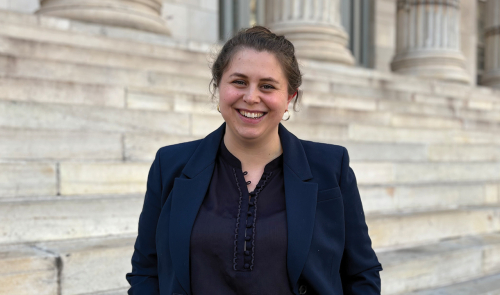
Assistant District Attorney, Kings County District Attorney’s Office
Describe your current position: What are the challenges? What do you like most about it?
I have been working as an assistant district attorney in the Domestic Violence Bureau for the past five years. It’s very rewarding work. I get to work closely with everyday people in Brooklyn. And I help them understand a complicated process during a very difficult time in their lives—when they’ve experienced harm at the hands of a partner. As lawyers, we sometimes forget that we’re service providers. I really try to approach cases that way. And I try to remind myself that many of the victims, survivors, and witnesses who come to us have never experienced working with our office before. A lot of people think that calling the police is the end of it. But that’s really the start of a much longer process. I always try to walk people through step-by-step and explain what is going to happen. I also really enjoy my colleagues, who are smart, passionate, and incredible people.
What I think is obviously the most challenging is the subject matter itself: domestic violence. But it can also be difficult to reassure people who feel that the system isn’t protecting them, or who don’t understand why our system is the way it is. A lot of times people tell me, “I don’t understand why this case has taken a year, a year and a half, or two years.” I really understand that. And it’s part of my responsibility to help them work through the system and to have all of the processes play out.
How has NYU Law prepared you for the work that you’re doing today?
I had a class with Peggy Davis [John S. R. Shad Professor of Lawyering and Ethics Emerita] called Family Practice Simulation. And it was different from any other class that I had. I got to explore how a family law firm operates, in which you’re interviewing clients, writing memos, and responding to emails from individuals inquiring about their own cases. The class focused on street smarts. It really gave me a sense of the actual work that you would do as a lawyer on a daily basis. And I thought that was so valuable—to have the opportunity to learn and get feedback from a really accomplished lawyer. [Davis] could tell me something like, “Oh, that’s kind of a weird word choice” or “You might think about saying it this way or that way.” As lawyers, we write so many emails or memos and it was really helpful to have the chance to build that muscle in a classroom instead of on the job.
What memory from your Law School days stands out the most?
The whole experience was pretty memorable. I think NYU Law—more so than other law schools—is just a place that really attracts people who are very community minded. I really enjoyed having Melissa Murray [Frederick I. and Grace Stokes Professor of Law] as a professor. She is so smart, a great communicator, and such a phenomenal lecturer. I learned so much from her by just sitting in class and seeing what she thought about family law issues or her takes on the news stories of the day.
My 1L year was actually a pretty difficult time, and I was trying to adjust. But I really enjoyed my contract law professor, Clayton Gillette [Max E. Greenberg Professor of Contract Law]. Contracts, obviously, is not really a thing that I do much of today. But he made the material really engaging. And he was so passionate and interested in the subject matter that it made it really fun. I appreciated the intellectual playground of that class. I look back on it as a real bright spot.
What piece of advice would you give to yourself as a law student?
I think that I’m definitely a lot wiser and smarter in many ways since graduating, even if it also still feels like I’m just at the beginning of my career in a lot of ways. A lot of learning has been packed into the past five years. But I think I would definitely have worked harder to get into a trial advocacy class. I wouldn’t say that not taking it has held me back, but I would have felt a lot more confident going into my first or second trial by having the opportunity to learn in a classroom setting as opposed to on the job.
As a survivor of domestic violence yourself, can you talk about how that experience influences your work and how you interact with other survivors?
I think it really brings a lot of meaning to the work that I do. It isn’t something that I typically share with victims on my cases. It’s about them, and not about me. But I think it just informs the way that I approach people and approach the decisions they make or have made, and I try to understand. I always tell people, “This is not your whole life. This is one thing that happened to you, and it will always be a part of who you are. But it doesn’t have to define you.”
As much as I try to make it as easy as possible, no one is ever in my office because they’re having a great time. I always tell people, “The strength that it takes to survive this experience is something that will serve you for the rest of your life, and you should never forget it.” One important thing that I try to stay grounded in is that my work is fundamentally reactive, and there’s nothing, unfortunately, that I could have done that would have stopped [what they experienced]. My responsibility is for the future and what I can help victims and survivors do with what has already happened. And so I really try to stay in that lane and leave work at work.
In that vein, what do you enjoy doing in your leisure time?
I bake a lot, and I’m always bringing baked goods in to work. I’m a good co-worker in that respect. And I really love to run. It’s such a great opportunity to just get into my body, get out of my head, and clear my mind. I actually ran the New York City marathon in 2022. That was my first and only so far, but hopefully not for long. And I also love to travel. It’s such a great way to get out of your everyday environment and have new experiences.