Five Years Out: André Ceccotti ’21
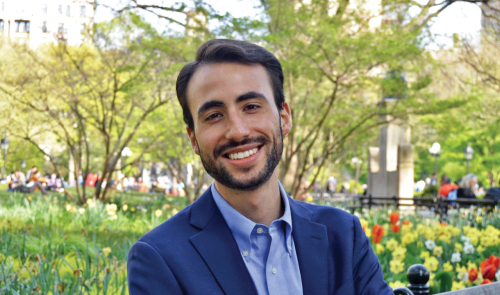
Associate, Pfeiffer Rudolf
Your caseload encompasses litigation over unlawful arrests, erroneous prosecutions, and wrongful convictions. Tell us about your work.
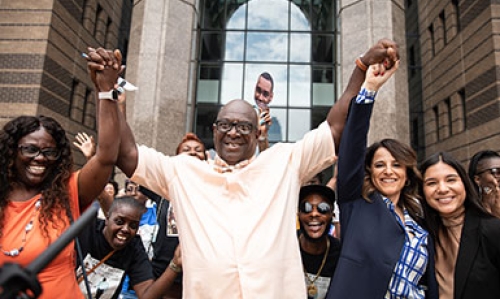
I have been representing people who were wrongfully convicted and have been exonerated with the help of either the Innocence Project or a law school clinic. Truthfully, the only thing that an exoneration does is get you out of prison. Nothing else. There are so many hurdles even after exoneration. People in that situation might not know how to use a phone after being locked inside a cage for 40 years. There is no money, and the possibilities of finding a stable job are laughable, because there might be other offenses that have happened before, and oftentimes there is no employment history.
And so I’m filing civil suits in federal court against the government officials who caused the wrongful conviction. In many instances, these cases involve police officers who either fabricated false evidence or hid evidence that would have prevented the wrongful conviction in the first place. While the lawsuits seek to address individual harms, they’re also an attempt to force municipalities to reform the actions of law enforcement that violate people’s constitutional rights. But unfortunately, because of liability insurance, a lot of the big settlements and verdicts that we have been seeing, across police departments and individual counties, are not actually leading—or leading quickly enough—to the kind of systemic reform we hope for.
What led to your work in public defense?
I was born and raised in Belo Horizonte, the sixth largest city in Brazil. At the age of 16, I moved to Costa Rica and finished high school there. Later, I went to the University of North Carolina at Chapel Hill [and earned a bachelor’s degree in economics] before enrolling at NYU Law. Initially, I conceived of myself as somebody who was going to work on issues of affordable housing and tenants’ rights. But after I interned at Legal Aid of North Carolina’s eviction diversion program in Durham, North Carolina during my 1L summer, I started thinking about what holistic representation meant. What does it look like to not only represent clients in an eviction case, but also to help them to have a consistent income stream? While navigating law school, I started falling in love with public defense as I discovered how issues like housing can overlap with the criminal legal system.
After graduating from NYU Law, I was an assistant public defender [in the Mecklenburg County Public Defender’s Office in North Carolina], where I was working in an underfunded space and juggling upwards of 250 cases. I never compromised on the quality of representation that I gave to my clients. But I grew frustrated because the work takes place on an individual basis. It was difficult to think about using the law to produce reform at the structural level. About two years in, I met David Rudolf ’74, who is a pretty famous defense attorney in North Carolina. I was already looking to leave the public defender’s office when he gave me an amazing opportunity [in 2024] to work for his firm [Pfeiffer Rudolf], doing civil rights-related work exclusively.
At Pfeiffer Rudolf, you are known as an “anti-racist lawyer.” Can you elaborate on the designation?
As an “anti-racist lawyer,” what I’m trying to communicate is that I am doing proactive work to dismantle racism and racist institutions. Sometimes you’ll hear people talk about doing “morally neutral work.” But there is no such thing. Racism exists, and it is endemic. In order to bring about change, you have to work proactively against it. I’m not setting an agenda. When I’m doing anti-racist work, it means that I am listening and trying to put into action the demands of my clients. It’s as simple as that. To fight against racism, I have to take an offensive stance. I can’t just be “morally neutral.”
What memory from your Law School days do you recall the most?
I loved my experience at NYU Law. Obviously, law school is very difficult, but NYU exposed me to a myriad of different ideas on how to deal with big issues that I wouldn’t otherwise have had access to. When I think about my time in law school, it’s the camaraderie that I had with my colleagues in the public interest law community and the informal one-on-ones that I had with amazing professors like Melissa Murray [Frederick I. and Grace Stokes Professor of Law] that have stayed with me. Marty Guggenheim ’71 [Fiorello LaGuardia Professor of Clinical Law Emeritus], who taught the Family Defense Clinic, became a really close mentor. It was in talking to him that I realized that there was space in my career to explore a range of questions, such as family representation, that had not been in my mind before.
But my NYU experience would not have been what it was without Lisa Hoyes [assistant dean for Public Service], who is the head of the Public Interest Law Center. When we talk about law school being difficult—and 1L year, in particular, being pretty tough—when you find somebody like Lisa who can hold your hand and tell you, “Don’t worry about it. You are a much better person than whatever grade you get in these classes,” it really makes a difference. She has advised me on all of my career moves, including ones that I’ve done after graduating from law school. She is somebody who has deeply touched my heart. I think that I will spend my lifetime trying to find ways to thank her.
Given the type of cases that you handle, how do you measure success?
Sometimes victories are really small, and sometimes they’re big. I can’t measure my success as an attorney based on how many trials that I’ve won and how many bond hearings where I have prevented a client from being incarcerated prior to trial. It’s out of my control whether or not a judge will see the humanity that lives within my client. And I can be the best storyteller in front of a jury, but it is up to the panel to approach these cases with open ears and open hearts.
Instead, I measure success through the trust that I build with my clients. In an ideal world, my clients would tell their own stories. They wouldn’t need me to be their mouthpiece. But we live in a world in which that’s not the case. When clients who entrusted me to tell their stories in the courtroom tell me that I captured what they experienced, I claim that as a win. It’s just like claiming a multimillion-dollar verdict—which is only interesting to the extent that it reflects my ability to tell someone’s story in a way that they would otherwise tell it themselves.
What piece of advice would you share with current students at the Law School?
I’m a believer in the concept of finding “the joy of a meandering career.” In other words, allow yourself to act upon your intellectual and academic curiosity. And don’t settle for the first thing that’s in front of you. If your career is going to span decades, how beautiful will it be when you retire that you can look back and say, “I did this. And when I was curious about this question, I did this other thing. And while that didn’t work out, it still taught me something new. And then I embarked on this third thing.” How wonderful would it be for you to realize that your career had amazing depth, but also beautiful breadth.
This interview has been condensed and edited.
Photo by Corey Risinger.