Tech lawyer Cyrus Ansari ’13 navigates dealmaking in the new digital frontier
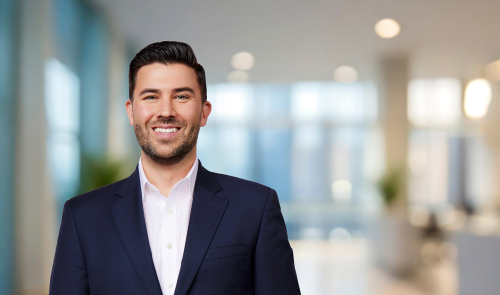
Cyrus Ansari ’13
“I think of myself as someone who helps any company buy or sell technology,” says Dorsey & Whitney partner Cyrus Ansari ’13, “whether it’s a tech company or a non-tech company that uses tech every day.” As a Seattle-based dealmaker and product counsel, Ansari advises on commercial transactions, licensing, IP matters, and regulatory compliance for companies in AI, digital media, interactive entertainment, fintech, and other sectors. While cutting deals at the forefront of a burgeoning digital economy, Ansari says he can relate to the rapid technological advances currently underway because they mirror his own evolving career path.
Tell us about your role at Dorsey & Whitney.
I’m a partner in the firm’s Technology Commerce Group. If my client is launching a product or entering into a partnership with another company, I try to be there at the beginning—to advise not only on drafting the contract, but on the business strategy and regulations surrounding the transaction too.
As product counsel, you’re close to the development or launch of a specific product line, whether it’s an AI product or a cloud hosting company offering an infrastructure product as a service. You’re embedded with that product team, and you’re their day-to-day lawyer. There might be a need to update the terms of service. Or, if it’s a new product that will ingest data from users and includes very specific geolocation data, how sensitive is that? Do we need an additional addendum or consent to collect that data? As outside counsel for these companies, I get to see a wide variety of projects.
Can you elaborate on advising tech companies on their products and services?
Over the last five years, a huge part of my business has been cloud services, software, and AI. And then a niche product area has been gaming and interactive entertainment, such as mobile apps and PC games. Let’s say a company wants to develop glasses to create an immersive experience on a famous golf course. They would need satellite imagery. So we would negotiate with a satellite company to get the mapping. We would also need a license for all of that mapping data to place it into the headsets to give the most accurate representation of the golf course. At the intersection of that deal, I could easily be sitting on either side.
Those transactions make up about half of the practice. And the other half has been advising startups to mid-sized companies that run the full gamut. Chances are good that they consider themselves tech companies. But they don’t have to be. It would be totally conceivable, for example, for an agricultural business to want to procure an enterprise software license and an AI subscription to analyze its crops. We’re talking about a farming business, fundamentally. But these days, farmers want to have quality data about their product. And they know that good software and AI products can analyze data in ways that weren’t possible five years ago.
What led to your interest in law?
I was born and raised in Bellevue, Washington, and I loved growing up here in the Pacific Northwest. I went to the University of Washington (UW) in Seattle, where I majored in international studies. Within my first month as a freshman, I wrote down on a piece of paper—that I still keep—that I wanted to go to law school and become a lawyer. Over the rest of my time in college, I explored other career paths through internships, such as finance, government, and politics. When I graduated college in 2009, in the middle of the Great Recession, I decided to pursue my original goal.
I enrolled at UW School of Law. At the same time, I was asking myself, “Will I stay in Seattle for life?” I was still a 1L when I applied to transfer to a handful of other law schools. At the time, I wanted the option. NYU Law was the only New York school I applied to. I’m sure that movies played a role, but I always admired New York City. I was thrilled when I got in.
During my 1L summer internship, before I accepted NYU’s offer, I remember telling a colleague about my acceptance at NYU Law. He said, “NYU is one of the best law schools in the country. You don’t have a choice.” He was right that NYU was an exceptional opportunity. By then I was committed to practicing law, and I wanted the best training I could get.
Tell us about your experience at NYU Law.
If I was going to travel across the country to go to another law school, it needed to be a once-in-a-lifetime opportunity. NYU Law definitely met that bar. I decided I wanted to be a litigator because of everything that I was learning from my professors.
I took two classes with Marcel Kahan [George T. Lowy Professor of Law]. I found him to be brilliant and eloquent. He spoke with textbook perfection. Also, Daryl Levinson [David Boies Professor of Law] taught Remedies. He asked questions that were profound and paused on them, without cold calling, and without providing the answer. He was my only professor in law school who used the Socratic method that way. It forced having the internal dialogue of, “Well, what is my answer to that question?” He was a role model.
What happened after you graduated?
I worked at Sidley Austin, where I was involved in class-action defense and securities enforcement work for securities firms, hedge funds, and banks. I thought of it as four years of law boot camp. I’m a better lawyer today because of how I was trained in that environment. In 2017, I moved back to Seattle to be closer to family and to break into its thriving tech sector. I joined Davis Wright Tremaine, which was a tech-centric practice. On day one, I was a commercial and consumer defense attorney as well as an IP attorney. Over the next four years at Davis Wright, I transitioned my practice into a transactional one through interacting with tech clients who initially brought litigation matters, but also had commercial and product counseling projects that flowed from them.
And then COVID hit. There was a moment for introspection, working from my dining room table, where I realized that I wanted to be a full-time transactional business attorney and product counsel. I joined the Technology Transactions and Privacy group at Perkins Coie (now Ashurst Perkins Coie) in 2021, where I advised tech clients for nearly five years. I joined Dorsey earlier this year because I was excited to work with its technology lawyers and help grow the practice here in Seattle.
Along with the innovation, there’s a great deal of public anxiety about AI. What is your response?
I think we should all recognize that we’re at a moment that will have as drastic an impact on society as the invention of the internet. AI is a tool that we can leverage, but people still want human judgment. I’ve advised an AI voice technology company. Another client creates financial analysis tools for fintech companies. The regulatory questions and commercial aspects are interesting.
On the flip side, I use AI every day myself while advising colleagues on how to do it. I do worry about people having AI fatigue. But I think it’s that important a technology, and that we have to be leading on it. Even if some are understandably annoyed with AI as a constant topic of conversation, we have to keep talking about it because of the pace of change and the implications for our clients and our profession.
There’s also the complicated legal question of copyright over works produced through AI. How do you generally advise in this area?
It’s something that we do product counseling on, whether it’s an executive who says, for example, “I designed a logo myself using AI. I didn’t go to the marketing department. But since I used an AI tool to do it, do we have copyright in it?” Or, “Can it be a part of our trademark if AI created it?” It’s complicated. Every situation is different. If it was generated by AI, depending on the extent of human involvement, there probably is not a copyright on the image. The more original human expression there is, the closer you are to something that can be protected.
In some ways, originality matters more. And in some ways, it matters less. Maybe what becomes valuable is not whether or not you have a copyright, but whether the product works and is marketed well. If you go to market before someone else, and you get traction with users, maybe it doesn’t matter that someone else could produce the same thing a month later if you have a product that’s compelling.
Which transactions are of interest to you at this time?
Something that has been coming across my desk over the past five years has been connected-vehicle technology. They’re more software-based than ever. I’ve worked on quite a number of significant deals in this area. Recently, I was working with an American technology company that wanted to use some international technology in its vehicles. After we worked on regulatory compliance with our international trade team, I drafted the licensing and assignment agreements.
Then there’s augmented reality and virtual reality [AR-VR], which has been in and out of fashion. Now we’re in a lull again. But I still imagine that we’re going to end up in a place where these devices are popular, even if it’s in niche areas. Imagine surgeons wearing glasses that give them a visualization inside the human body when they're using robotic arms to make precision cuts. To bring that kind of product to market, you need the company that makes the glasses and the company that makes the robotics. Then there’s software connecting the robotics to the glasses. I would love for my practice to continue to grow to be involved in transactions like that on a regular basis.
This interview has been condensed and edited.