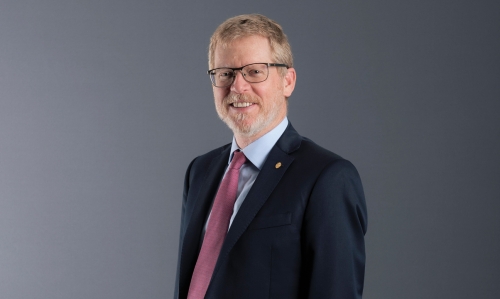
Antonio Del Pino ’94 charts Latin America’s economic rise one deal at a time
Antonio Del Pino ’94
Antonio Del Pino ’94 first visited Peru in 1993, as a summer associate at a large law firm working on the privatization of a phone company. At the time, he notes, the country was essentially in a civil war, with the insurgent group Shining Path actively planting bombs in Lima. “Today, Peru is a very different place,” Del Pino says, citing the country’s economic vibrancy, infrastructure development, and growing world-class culinary culture.
One thing that hasn’t changed is that Del Pino is still working on deals in Peru—now as a partner at Latham & Watkins and chair of the firm’s Latin American practice. Most recently, he advised CPP Investments in its investment, along with I Squared Capital, in Inkia Energy, which operates a diversified power generation portfolio in Peru. The deal comes at a total enterprise value of $3.4 billion. Additionally, he also counseled on Global Infrastructure Partners in connection with the combination of Saaví Energia—Mexico’s largest independent private power producer—with Grupo México’s energy business. The news outlet Latin Lawyer gave Del Pino its International Lawyer of the Year Award in January.
In this Q&A, Del Pino recalls how studying law at NYU prepared him for his career, considers how Latin America has changed during his career, and shares his hopes for the future of the region.
What are some of your daily responsibilities?
As chair of [Latham & Watkins LLP's] Latin America practice, I’m in charge of our global firm’s strategy in the region. We have a large team of talented lawyers who are dedicated to advising clients on transactions and disputes, from Mexico to Argentina and everywhere in between. A lot of what I do relates to energy and infrastructure, because of the tremendous need for investment in those sectors in Latin America. Our team has grown a lot over the years, which is one of the things I’m most proud of. We just made [nine] partners in the last [three years] focused on Latin American transactions or disputes.
How did you develop an interest in law?
My parents emigrated to the US from Cuba. What I like to tell people is that I was Cuban before I was a lawyer, and so I grew up hearing a lot of stories about Cuba and Latin America at home. That led me to develop a strong interest in the region. In college, I studied political science and history, which helped me understand how law shaped society. Over time, I started to realize that I could combine my interests in Cuba, Latin America, government, and the law. And how the law seemed to provide an avenue for having an impact.
Why did you choose NYU Law?
I was the first one to go to law school in my family. My dad was one of seven kids and the only one of his siblings to have a high school education. So I had no clue what I was getting into, to be honest. But I was fortunate to have some great mentors who really helped me along the way.
Why NYU? Why not NYU—that’s the question. NYU was uniquely positioned to me. The idea of living in the city, or Greenwich Village to be more specific, and studying law among a diverse and driven group of people really appealed to me. Once I visited, I knew that it was the place for me. There was just an aura and an energy that I knew would make it a special place to go to school.
What stands out to you in reflecting upon your time at NYU Law?
The legal profession, like many others, centers on problem-solving. To the extent that you can say that I have had success in my career, it comes back to thinking critically and finding workable solutions for clients. And it goes back to my time at NYU, which provided a crucial foundation for developing those skills. It was in the classroom where I first developed the ability to collaborate with bright and driven students and professors; we challenged each other, really. I benefited from having a lot of great professors. I have fond memories of my international law class with Professor [Andreas] Lowenfeld. Professor [Linda] Silberman for Civil Procedure and Professor [Graham] Hughes for Criminal Law were also very memorable.
Is there a deal that you consider to be the most transformative in shaping your career?
There isn’t one single deal. I’ve been fortunate to work on a lot of transformative deals over the years. It’s been a great run. A few months ago, we just closed on a $3.2 billion transaction where Heineken acquired FIFCO [Florida Ice and Farm Company S.A.], which is the oldest and largest food, beverage, and retail company in Costa Rica. This was a historical deal for Costa Rica and one of the largest investments ever in the country, which as you can imagine drew significant interest from the highest level of the government and society. For me, there have been a lot of deals like that over the course of my career. We also recently closed a deal [in December 2025] while representing Davivienda, one of the largest banks in Colombia, in merging with Scotiabank’s operations across the country along with Panama and Costa Rica.
The marketplace of Latin America has undergone drastic changes over the course of your career. Can you talk about what you have been witnessing, and effecting, in the region?
For sure, I have seen a tremendous amount of economic development in Latin America during my career and had the honor of working with clients on matters resulting in billions of dollars of investment. Yes, there have been times in which progress has gone in the opposite direction, but overall we have seen significant growth in the region over the last few decades, particularly in sectors that are critical for economic development–such as energy, infrastructure, communications and technology. When I started my career, Venezuela was pretty active economically. Companies were investing in Venezuela in the ’90s. And at some point, political change, led to years of economic contraction and relatively little investment. It is awful what has happened recently with the earthquake there. But we’ve been seeing a fair amount of interest from clients who have been looking to potentially invest in Venezuela, which we hadn’t seen in a long time.
Look at how Brazil has become one of the economic drivers of the world. I’ve also gotten to witness a tremendous amount of investment and growth in Chile, Colombia and Peru over my career. Historically, Mexico has probably been our most active market at Latham. We’ve been fortunate to have worked with clients on numerous transactions relating to energy and infrastructure in Mexico after the energy reform, resulting in billions of dollars of investment, which continues to be critical for Mexico. No question, what has been the most interesting and rewarding aspect to my career and my life has been seeing some of the economic activity and development in Latin America from the early ’90s to today.
You mentioned having pride in your Cuban heritage. What changes are you hoping to see within Cuba itself?
When I was in college, I could not read enough about Cuba. It always amazed me how polarized everything related to Cuba is. For many Cubans in the US—particularly the older generation of the community—there has always been the expectation that regime change would happen and the virtual wall that seems to divide so many would come down, providing an opportunity to invest, reconnect with roots, and reunite families. And it never really happened. So it’s hard. I don’t know what’s going to happen in the short term. But I tend to be an optimist, and I do think that eventually we will see meaningful and positive change, which will lead to investment and opportunity for Cubans in Cuba as well as many outside of Cuba that are eager to contribute... I just don’t know when.
This interview has been condensed and edited.