

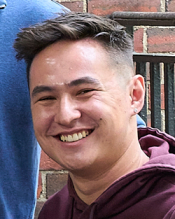
Student Spotlight: Denis McGrath ’27
Dean’s Scholarship
Space & Planetary Law Scholar
NYU Space Law Society, Founder
Student Bar Association, Accessibility Chair & Finance Committee
Manfred Lachs Space Law Moot Court, 2025 North American and World Champion
Which Law School class or experience has had the biggest impact on you?
Without a doubt, it was leading NYU Law’s team to the 2025 Manfred Lachs Space Law Moot Court. Winning both the North American and World Championships in a Grand Slam Moot for the first time in school history was a surreal experience. But the true impact came from the preparation and the time I spent with my teammates. Drafting 9,000-word memorials on complex international and space law issues that effectively had no precedent, and eventually arguing a case before three sitting justices of the International Court of Justice forced me to bridge the gap between abstract treaty interpretation and high-stakes advocacy. It confirmed for me that I didn’t just want to study international law—I wanted to practice it at the highest level. I’m also grateful to have played a small part in coaching this year’s Manfred Lachs team, a group of incredible individuals who just brought home the 2026 North American Championship and is now preparing for this year’s World Rounds in Antalya, Türkiye.
Additionally, Professors Benedict Kingsbury, Angelina Fisher and Katrina Wyman’s Space & Planetary Law Scholars Program has been foundational. It’s where I refined my ability to draw critical analogies between maritime, Antarctic, and environmental law and the “law of the frontier,” which is essential for any aspiring space lawyer. The program also provided me with the freedom to write a full-length research paper on the space law topic of my choice—supported by leading academics and my brilliant classmates—that connects my passion for space law with disability rights law. This program has helped put me in a position to—hopefully—publish this paper, something I wasn’t sure I would ever be capable of accomplishing.
You’re very involved in the field of space law, specifically. How did that interest develop?
If I’m being honest, my interest started while watching the Star Wars movies with my family growing up—please don’t ask my mom how many Star Wars action figures I still have stored back home! My interest grew during my time in the Boy Scouts, while studying stellar constellations to earn the Astronomy merit badge and navigating a high adventure trip where I fell asleep every night on the deck of a boat underneath the stars while sailing through the Caribbean.
I began translating my fascination with outer space into a more professional context at the intersection of technology and policy during my five years at Google. While working on Government Affairs and Public Policy projects involving AI-driven climate models, I began to see how rapidly technology was outpacing our current legal frameworks. I realized that the next great “frontier” for regulation and international cooperation wasn’t just digital—it was orbital. I actually wrote my law school personal statement on the intersection of space and disability rights law in the hope that I could pursue this passion in a structured academic way, and thanks to NYU’s unique Space & Planetary Law Scholars program, I was blessed to receive that opportunity. The cohort is pursuing research papers and hosting fascinating discussions on issues ranging from the management of nuclear energy in outer space, space insurance, the militarization of space, space debris mitigation, resource extraction, and satellite security. It feels like the Wild West of law, and that’s incredibly exciting.
What’s your advice for students interested in the field of space law?
My biggest piece of advice is to be brave. If you don’t believe in yourself, no one else will. One of my favorite mantras is a famous African proverb that states, “If you want to go fast, go alone. If you want to go far, go together.” When I showed up on NYU’s campus, I discovered NYU’s Space Law Society had folded during the COVID pandemic and I would not be able to take the Space & Planetary Law Colloquium until 2L at the earliest. But time in law school is limited and I didn’t want to wait that long. So, as a 1L, I decided to bring back the Space Law Society to campus, which led me to all the incredible opportunities I’ve mentioned previously. I had to get the ball rolling and bet on myself, but there’s no way I could have done it alone. I was able to find a group of absolutely incredible law students—primarily fellow 1Ls and LLMs—and thanks to their academic brilliance, unique perspectives and immense support, we created a community that has made school history and, I hope, will continue long after all of us depart from Washington Square.
From an academic perspective, study the analogies. Because space law is a relatively young field, much of our work is derived from the Law of the Sea, Antarctic Treaty System, and International Environmental Law. If you want to be a space lawyer, you first need to be a very good international lawyer. Space is interdisciplinary—reach out to engineers, policy analysts, and scientists. The more you understand the physics of the problem, the better your legal solution will be.
You’re also the co-chair of the Disability Allied Law Students Association (DALSA). Tell us about that experience.
Serving as co-chair of DALSA and the Accessibility Chair for the SBA since 1L has been one of my most rewarding roles at NYU Law. As someone with a physical disability who has competed in numerous Paralympic sports at an international level, I’ve always viewed resilience as a personal asset. However, DALSA has taught me the importance of institutional advocacy and tapping into our allied community of students who may not necessarily identify as having a disability, but are immensely passionate about accessibility and disability rights. Our goal is to ensure that law school is not just “accessible” in the sense of ramps and elevators, but inclusive in a way that allows students with disabilities to thrive professionally. Moreover, we seek to create “curb-cut effects” that benefit not only students with disabilities but all NYU Law students to ensure every student can fully engage with our school and community. Whether we are hosting panels on navigating Big Law with a disability or advocating for better accommodations, I want to ensure that the next generation of NYU lawyers feels that their identity is a source of strength, not a barrier.
What do you most like to do outside of class? Have you read any books or heard any podcasts lately that you would recommend?
Outside of Vanderbilt Hall, you’ll usually find me training. I’m a competitive cyclist and triathlete with dreams of competing at the highest level of Paralympic sport, so I spend a lot of time in the gym, on the bike, or in the water. It’s the best way I’ve found to clear my head after a long day of classes. I’m a massive proponent of balancing out the mental and academic strain of law school with physical exercise. When I’m not training or studying, I love playing the piano; reading non-law books; playing pickup soccer—shoutout to Learned Foot and FCDM; alpine skiing; and spending time with my friends. I’m also a PADI-certified scuba diver, which is probably the closest I’ll get to experiencing zero-gravity for now!
As for recommendations, I recently finished Leviathan Wakes by James S.A. Corey and Golden Son by Pierce Brown, which I highly recommend for my fellow space nerds. For something a bit different, I also highly recommend Meditations by Marcus Aurelius and “Invictus”, a poem by William Ernest Henley. On the podcast front, I’m a devoted listener of Arseblog’s Arsecast and the Arsenal Vision Podcast—yes, I am a diehard Arsenal fan. And no, I will not be commenting on our Premier League or Champions League chances at this time.