Ron Stubblefield ’17 leads projects to create affordable housing in Cincinnati region
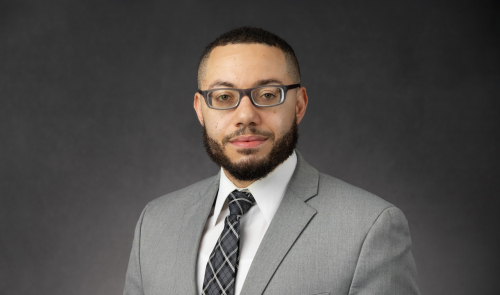
Ron Stubblefield ’17 once planned to become an engineer. Then a graduate school project sparked his interest in economic development strategy—and he redirected his path to NYU Law. In 2025, Stubblefield became the first-ever director of Housing & Place-Based Initiatives at the Greater Cincinnati Foundation (GCF), which manages more than $1 billion in charitable and impact-investing assets and supports large-scale, community-based initiatives across the region. In that capacity, Stubblefield helps to craft and administer innovative housing initiatives, including the multimillion-dollar Northern Kentucky Housing Fund, focused on increasing supply in Kentucky’s Boone, Kenton, and Campbell Counties.
For Stubblefield, his job fulfills a deep commitment to urban and rural improvement on a grassroots level. In a Q&A, he discusses how the current political environment impacts housing policy, recalls how NYU Law helped center his career ambitions, and makes the case for why housing will ultimately serve as a defining issue for the nation.
Tell us about your responsibilities at GCF.
In recent years, regional reports from community development leaders and the local Chamber of Commerce identified a housing shortage of approximately 40,000 units across Greater Cincinnati, contributing to rising cost burdens for working families. As part of a strategic plan, [GCF] wanted to get involved. At the time, the foundation did not have dedicated housing expertise on staff. That led to the decision to bring me on as the director of Housing and Place-Based Initiatives.
My role is to architect and implement a comprehensive regional housing strategy that integrates philanthropic grantmaking, impact investment vehicles, and partnerships with public-sector and financial institutions. The strategy includes structuring catalytic investments to strengthen local community development financial institutions through a tiered approach that combines recoverable grants, flexible debt capital, and mission-aligned fund investments; launching a regional housing lab designed to test and scale innovative development approaches; and designing grant programs that provide predevelopment and last-mile capital to move stalled housing projects into construction and completion.
The work has also expanded nationally; I now serve on the International Economic Development Council’s Reimagining Equitable Economic Development Committee, where practitioners from across the country are rethinking how capital flows, land use, and policy frameworks can better advance inclusive growth. I also contribute to broader public conversations on housing finance and equitable economic development.
Going in, I knew this was not going to be easy, based on prior work that I’ve done in the economic development space. Housing is a notoriously difficult problem. And I believe that it is at the core of the affordability crisis that’s going to define the next decade in America.
In your academic life, you initially pursued STEM-related degrees before switching to law. What led to the change?
When I went to Morehouse College, I studied physics, and then I received a master’s in engineering at Stanford University [in 2014]. While at Stanford, I worked on a capstone project that involved economic development strategies. And two things kind of clicked for me. I realized I wasn’t interested in advancing technology for its own sake; I was more interested in how systems distribute opportunity and shape economic outcomes. Second, I really enjoyed what those economic developers were doing. But I recognized that in order to do it, I was going to need one of three gateway degrees. I either had to get a planning degree, an MBA, or go to law school. Of the three, law school seemed to be the most interesting option.
Why did you choose to enroll at NYU Law?
After taking my LSATs, I started hearing from law schools. Since I had already been to grad school, I realized that when you go to a prestigious school, you get to brag about it. But did they necessarily invest in you? I wanted to find a school that could offer me programming and resources that I could lean into beyond scholarships. On the day that I received my acceptance letter from NYU Law, I also got an invitation to meet with Helen Scott [Professor of Law Emerita] and Gerald Rosenfeld Professor of Practice and Distinguished Scholar in Residence] to talk about the Mitchell Jacobson Leadership Program in Law and Business. That’s when I realized how serious the Law School was. It was offering a scholarship plus mentoring, additional coursework, and programming. All of that showed an institution willing to invest in me.
When you reflect on your time at NYU Law, which experiences stand out to you?
When protests over Eric Garner [an unarmed Black man who died after being put in a chokehold by an NYPD officer] happened, I was in law school during the day and protesting at night. When the incident first happened, I remember how the whole NYU community went, “Are you all okay? What resources do you need?” Everyone was just rallying around each other, which I think was just really helpful. But one of my professors, Stephen Schulhofer [Robert B. McKay Professor of Law Emeritus]—who I didn’t always appreciate at the time—offered some grounding perspective. He said, “I need you all to realize what the law is. The law is a tool. And it’s up to you to determine how you want to use that tool... but in many respects, you all have to go deeper.” It wasn’t a feel-good message, but it was honest. The thought of going deeper meant to start thinking about systems and their impact on society. That insight reinforced for me that the law is not just reactive—it is structural, and it shapes who has access to stability, safety, and ultimately housing and wealth.
I also really enjoyed Barry Adler [Lawrence King Professor of Law] in the contracts class. He brought out cases that shed light on fundamental unfairness.
And I was part of the national governing board of the National Black Law Students Association [now the Black Law Students Association]. One of my favorite memories was in working with NYU during my 3L year to bring a national pre-law diversity summit to the campus [in Fall 2016]. It was a wonderful event because we had hundreds of students from around the country and provided them with counsel: “Okay, you want to go to law school, so here are things that you need to think about.”
What did you do after you graduated from law school?
I came out of NYU Law wanting to support community development corporations. In 2017, I was a fellow with the New York City Department of Small Business Services. I was working in their legal department to help small community development organizations with governance issues. And then I got an offer from the South Baltimore Gateway Partnership [a nonprofit that supplies grants for community improvement efforts]. I was there as a fellow for a year, and it was so much fun—between designing budgets from scratch, learning bond financing, and testifying on bond bills, to drafting agreements with the city of Baltimore. It helped me to realize the gaps in my skill set and what was required to be an economic development leader. I have also served as a federal grant reviewer in the housing and economic development space, which provided additional insight into how large-scale public funding decisions are evaluated and structured.
After holding various positions [including special assistant to Baltimore’s deputy mayor], it was mentorship and hard work that propelled my career to the next level. I experienced this at JumpStart Inc. [an entrepreneur support organization], where I worked on business financing as an entrepreneur in residence and at Parallax Advanced Research [a nonprofit tech, scientific and discovery institute], where I was a senior program manager and worked to advance Ohio’s defense and aerospace industries.
On the housing front, how is the national economic and political climate playing out in the Midwest?
I also serve on the City of Cincinnati’s Housing Advisory Board. Through this experience, I can tell you that politics inevitably shapes housing policy and market outcomes. A lot of the groups that I work on impact investing projects with are what we call community development financial institutions (CDFIs). Recent federal debates over the future of the CDFI Fund and potential reductions in housing and community-development funding have created significant uncertainty for community lenders and the projects they support. Such instability threatens the viability of projects and small businesses that rely on community-based lending infrastructure.
But there’s a second piece. Many of our banks are subject to Community Reinvestment Act requirements. There’s a certain percentage of their money that has to go back into low-and moderate-income communities to be compliant. That becomes significantly more difficult if federal infrastructure that supports community lending is weakened.
And then there’s the reality of Housing and Urban Development cuts, the impact of tariffs on construction and property costs, and the homeless crises around the country. Politics is involved in all of that.
Housing is so intricately tied to every social issue—whether it’s education, LGBTQ+ discrimination, or homelessness—that we can’t talk about solving any of them without concurrently addressing our nation’s housing instability. The challenge over the next ten years is coming up with a better system that can stabilize housing and then make it easier for us to stabilize every other social issue that we are having to deal with.
Despite all the problems that you have outlined on the state of housing, you remain optimistic about the issue. Why?
I’m hopeful because there is a critical mass of people working seriously on these challenges. Progress has always required endurance. Durable reform typically follows sustained civic engagement and thoughtful policy refinement. While moments like this can feel uncertain, history reminds us that meaningful advances often emerge from periods of strain. The Civil Rights Act helped reshape housing and urban development policy across the country. That perspective gives me confidence that this moment, too, can become a catalyst for stronger and more equitable systems.
What piece of advice would you give to current NYU Law students?
It’s easy to get caught up on titles, roles, and tracks. But take the time to really understand: which causes do you care about? Determine what your calling is, and then build your life and career around that. It makes life so much easier. You can take your work seriously, but don’t take yourself too seriously. If you understand your calling and pace yourself accordingly, you can build a career that compounds impact over time. The work is demanding, but if you stay aligned with purpose, the long game becomes both sustainable and meaningful.