

NYU Law’s EVC hosts fourth annual fall showcase
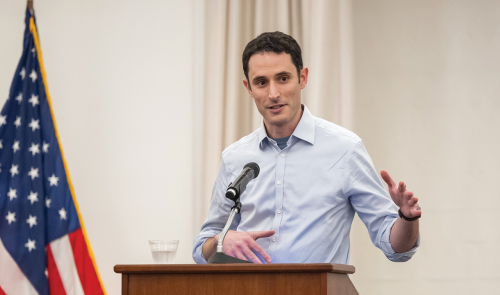
Nir Zicherman ’11
At NYU Law’s fourth annual Entrepreneurship and Venture Capital (EVC) Fall Showcase on October 14, Nir Zicherman ’11, founder of AI-powered learning company Oboe, started his keynote address by telling the audience how an elevator ride in D’Agostino Hall changed his life.
“I get in the elevator, and I get in at the same time as another woman who is standing there, holding a tray of coffees that are clearly intended for other people,” Zicherman recalled. “But for whatever reason, I turned to her and I said, ‘Wow, you must really like coffee.’ And she laughed. And then the doors open and we both get out. It turns out she’s the person who’s about to interview me for this internship. She gave me the job. She later told me that the only reason she gave me a job after meeting with 50 students was because I told her that joke,” he said. The internship, provided through the Law School’s public interest program, was in the legal department of the National Aeronautics and Space Administration (NASA) at the Kennedy Space Center in Florida. Inspired by the engineers he met there, Zicherman said, he taught himself to code and joined the tech industry after law school.
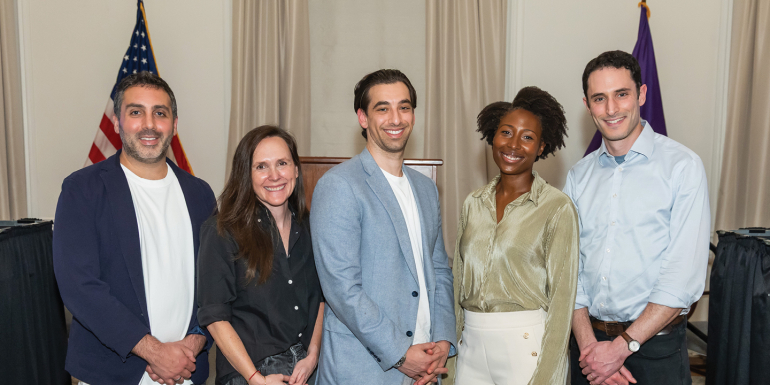
Zicherman was one of five Law School alumni who spoke at the EVC event about their entrepreneurial journeys. NYU Law’s EVC Program, which hosts this event each year, provides programming, student internship opportunities, and funding for students and alumni launching start-up companies. Each speaker described the companies they had created—which ranged from providers of AI-powered education and business tools to a successful Haitian cafe in Brooklyn—and shared lessons from their experiences.
Brandon Katz JD/MBA ’20 is the founder of DreamLever, an AI-powered management platform. Drawing on his experience at a rapidly growing startup, Katz explained that business leaders often struggle because information moves too slowly and teams fail to execute solutions efficiently. DreamLever uses data and AI agents to improve communication, accountability, and decision-making, he said. He attributed his legal education to some of his success as a founder: “In this age of entrepreneurship, I think that lawyers have a great advantage—that’s being able to sift through problems and solve them. And lawyers, I think, can be some of the best entrepreneurs in this age, even without the business background,” he said.
Cassandre Davilmar ’13, founder of Lakou Cafe, recounted how personal connection shaped her vision for a Haitian fusion café and community hub in Crown Heights, Brooklyn. In 2023, a team member asked her to sponsor a relative who was seeking safety during a period of crisis in Haiti. This request made Davilmar reflect on her own mother’s experience immigrating to the United States from Haiti with help from a family member. “Her opportunity made mine possible. … My answer had to be yes,” she said. That realization inspired the creation of Lakou Cafe, which combines food, cultural programming, catering, and community engagement.
Meagan Harmon ’14, founder of financial technology venture Sarraf, addressed the lack of affordable financing for small businesses in Pakistan. As an aid worker in Afghanistan for Welthungerhilfe in 2010, Harmon recalled, she discovered that conventional interest-bearing microloans failed to reflect borrowers’ needs. After the loan program was restructured according to Islamic finance principles—which include avoiding financial speculation, prohibiting interest, and barring investment in businesses engaged in activities forbidden in Islam—repayment rates rose to nearly 100 percent. The experience shaped her guiding belief when launching Sarraf: “When finance speaks the language of the people it serves, capital moves.”
For Danny Fein ’21, founder of Infinite Will, the mission is making estate planning more accessible to young families. A practicing attorney, Fein combines legal advice, mobile notaries, and custom software to help parents affordably create their own estate plans.
Zicherman’s path as an entrepreneur began in 2015, when he co-founded podcasting platform Anchor, which was acquired by Spotify four years later. After leading Spotify’s expansion into audiobooks, Zicherman launched Oboe to make personalized online education accessible worldwide. Zicherman said that his success in tech owes much to his legal education.
“Law degrees, in my opinion, based on my experience, are arguably actually the single most valuable degree that a person can have to prepare them for [the] uncertain future that we’re headed into right now,” he said. “And the reason is because it’s the only degree that actually teaches you how to critically think.”
While he has never had to cite a case in his career, Zicherman said, “the things that I’ve learned in school that stuck with me were the aspects of how to deeply analyze a tough situation, how to strategize about something, and how to reason about something—which is something that I think is exceptionally unique and powerful about a law degree.”