

NYU Law marks a decade in Buenos Aires with landmark conference
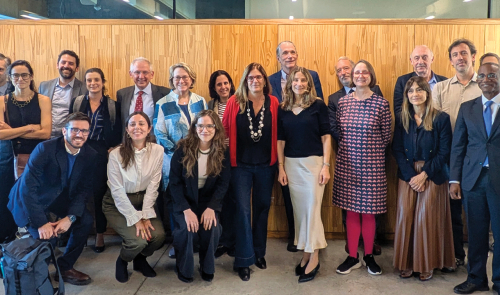
NYU Law celebrated the 10th anniversary of its Study Abroad program in Buenos Aires last month with a two-day conference that drew more than 90 attendees, including scholars, practitioners, students, and jurists from across the Americas and beyond.
The conference, Law, Institutions, and Contemporary Challenges: NYU Law–UBA at 10 | Di Tella Law at 30, was held April 23–24 at the Universidad Torcuato Di Tella (UTDT) and also marked the 30th anniversary of Di Tella Law School. The gathering brought together notable NYU Law faculty alongside scholars from Yale, Harvard, Tel Aviv University, Universidad de Buenos Aires, and Quinnipiac University. Carlos Rosenkrantz, a former NYU Global Faculty member who now serves as a justice on Argentina’s Supreme Court, also participated.
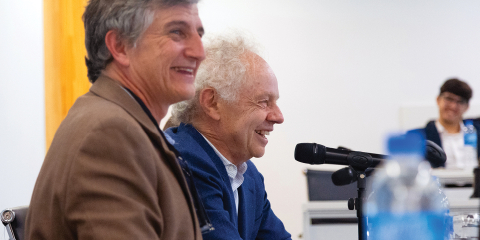
“The conference was a wonderful celebration of the intellectual vibrancy that our program fostered and of the impressive scholarship being undertaken by our Argentina colleagues,” said NYU Law Dean Emeritus Richard Revesz, AnBryce Professor of Law, who established the program as dean and who spoke on environmental regulation during the conference.
The conference program was broad in scope, spanning panels on democratic governance, environmental regulation, global governance, constitutional law, land use, legal education, and identity and discrimination in markets. Day one opened with a session on law and global governance, featuring Joseph Straus Professor of Law Joseph H. H. Weiler and Murry and Ida Becker Professor of Law Benedict Kingsbury addressing questions ranging from legal pedagogy to what Kingsbury described as pressing “planetary problems.” Samuel Issacharoff, Bonnie and Richard Reiss Professor of Constitutional Law, discussed the defense of democracy with scholars from UTDT and the Universidad de Buenos Aires. A subsequent panel on law and courts featured Rosenkrantz presenting on the topic of retroactive validation, with Frank Henry Sommer Professor of Law Lewis A. Kornhauser offering a foundational inquiry into what lawyers actually mean when they invoke the concept of law.
Day two broadened the lens further. A panel on legal education probed the profession’s future, with presentations examining the role of AI in due process, the formation of students’ professional identities, and what Martín Bohmer of the Universidad de Buenos Aires called a “missing theory of practice” in Latin American legal training. An afternoon session featuring Vicki Been ’83, Judge Edward Weinfeld Professor of Law, and Katrina Wyman, Wilf Family Professor of Property Law, tackled land use reform and local environmental governance. It was followed by a panel on identity and discrimination that examined, among other things, how large language models engage in price discrimination. The panel also included a discussion led by Tamar Kricheli-Katz, professor of law at Tel Aviv University, on how the Supreme Court’s ruling in 303 Creative v. Elenis—which supported a vendor’s right to refuse service to a gay couple on the grounds of religious beliefs—may ripple outward to affect protections for interracial couples.
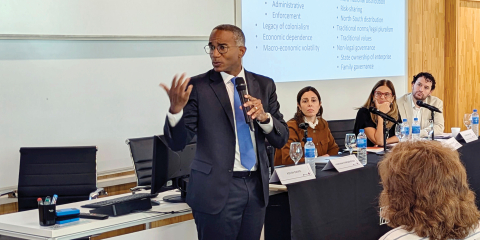
For Kevin Davis, Beller Family Professor of Business Law, the conference represented both intellectual breadth and personal continuity. “I was most impressed by the scale and scope of the conference,” said Davis, whose panel on international law and development drew on joint research with Harvard‘s Mariana Pargendler. “The sheer number of NYU Law colleagues who were willing to travel to engage with their counterparts in Argentina and the range of topics covered provided many points of connection and opportunities for further collaboration and dialogue.”
Davis noted that the visit carried special significance given the origins of his current research. “I was particularly pleased to be able to return to Buenos Aires to present my current thinking about comparative law and developing countries because the main ideas originated in a conference on ‘legal heterodoxy’ that my co-author and I organized in Buenos Aires in 2023.” That continuity—ideas taking root in one Buenos Aires gathering and returning, refined, to another—captured something essential about what the program has built over a decade, Davis said.
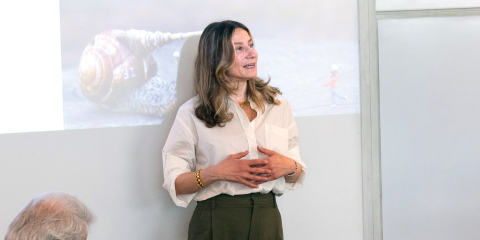
For Florencia Marotta-Wurgler ’01, Boxer Family Professor of Law and faculty director for NYU Law in Buenos Aires, the anniversary was an occasion to reflect on a decade of growth. “It has been incredibly rewarding to be part of NYU Law in Buenos Aires over the past decade and to watch cohorts of students spend a semester immersed in the laws, history, culture, language, and institutions of the region while learning from extraordinary faculty and practitioners,” said Marotta-Wurgler. As part of the program, she presented research on price discrimination by large language models, co-authored with John Edward Sexton Professor of Law and Economics Oren Bar-Gill and rising 3L Andrew Friedman ’27.
NYU students currently spending the spring semester in Buenos Aires attended the conference as well, experiencing a live demonstration of the program’s mission in action. According to Marotta-Wurgler, that mission is gaining momentum; the program received a record number of applications for next year and has already admitted 33 students for the coming spring.
“Like our students, the program is continuously evolving, and I am looking forward to the years ahead,” Marotta-Wurgler added.