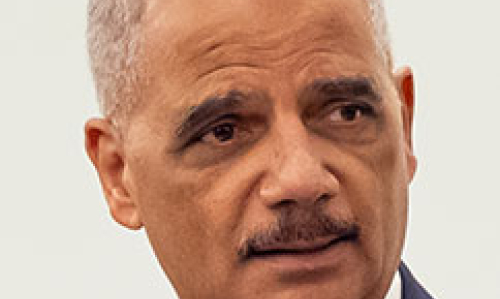
Annual Survey salutes Martin Guggenheim ’71 for pioneering work in family defense
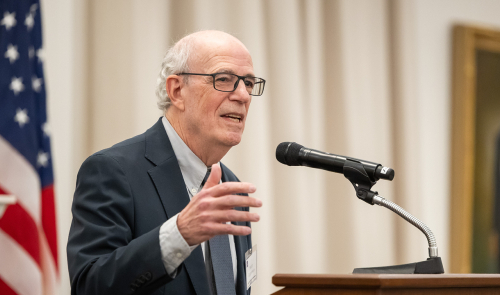
Martin Guggenheim ’71
On March 2, Martin Guggenheim ’71, Fiorello LaGuardia Professor of Clinical Law Emeritus, accepted the dedication of the 83rd volume of the New York University Annual Survey of American Law during a lively ceremony at NYU Law that offered poignant reflections, pointed commentary, and humorous observations.
The event honored Guggenheim, founder of the Family Defense Clinic, for his groundbreaking work—in both the courtroom and the classroom—to reshape how the law treats parents and guardians in child welfare cases. Throughout his career, Guggenheim has worked to ensure that their rights and interests are recognized and protected. In 1982, he successfully argued before the US Supreme Court in Santosky v. Kramer that “clear and convincing evidence” must be established before any state can terminate parental rights. The landmark ruling overturned the less restrictive “fair preponderance of the evidence” criterion that served as the standard of proof across 17 states.
Nearly a decade later, Guggenheim further transformed family law by implementing an interdisciplinary model of family defense that paired social workers and lawyers for the first time.
Each year, the student-run Annual Survey dedicates its new volume to an individual who has made outstanding contributions to American law. In introductory remarks to the audience, Dean Troy McKenzie ’00 applauded Guggenheim’s contributions as a “teacher, a scholar, an advocate, [and] a visionary,” who has brought lasting innovations to the field of family defense. “Marty is one of the nation’s foremost experts on the rights of children and families, but his influence extends far beyond any particular subfield. He has an extraordinary ability to think about problems from every angle, to begin not only with doctrine, but with the lived realities of families and children in crisis,” McKenzie said. “He believed, at a time when many did not, that parents in child welfare proceedings should have meaningful legal representation. That conviction led to the creation of the groundbreaking Family Defense Clinic.”

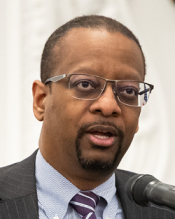
A succession of speakers described the impact of Guggenheim’s work, beginning with New Jersey Superior Court Judge Jeyanthi Rajaraman. She recalled the large volume of cases with due process violations that she encountered soon after becoming an attorney in the Office of Parental Representation in New Jersey in the early 2000s. Rajaraman was skeptical about the prospect of making a difference until she heard Guggenheim deliver an impassioned speech before the American Bar Association’s Parent Representation Conference.
“He said objecting matters, that making that record will matter, [that] filing appeals matter, that naming the injustice out loud will matter... That was oxygen. After hearing him speak, I changed,” she said. “I became relentless. I objected more [and] I filed emergent appeals. I even got to argue before the NJ Supreme Court. Because what he gave us was not just a critique. He gave us permission. Permission to be angry, permission to be bold, permission to fight in ways that match the stakes. This work is heavy, it’s filled with grief, but you taught us how to metabolize that grief into action, into advocacy that changes laws, that protected rights, that makes a record that the appellate courts cannot ignore.”

Bridget McCormack ’91, president and CEO of the American Arbitration Association and a former justice of the Michigan Supreme Court, served as a research assistant to Guggenheim when she was a student. Addressing the gathering, she underscored his wide-ranging influence as a mentor to generations of practitioners, whose efforts have produced legal changes nationwide. “Marty taught me that poverty is not a proxy for unfitness, that the state’s burden must be high and specific when it wants to separate families, that zealous advocacy for unpopular clients is the highest calling of our profession, that clinical legal education forms lawyers who will spend their careers seeking justice for people who need it most,” McCormack said.
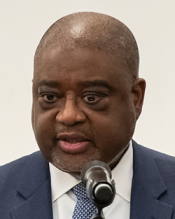
William Bell, president and CEO of Casey Family Programs, reflected on having observed the fledgling work of the Family Defense Clinic as deputy commissioner at the Administration of Children Services. “Marty understood in the mid-1990s that one of the greatest challenges facing children and parents involved in child abuse and neglect proceedings in New York City was the unequal legal representation structure impacting parents and their children. This unequal structure resulted in parents having the least effective legal representation in comparison to those representing the children or those representing the government when they appeared before the court on charges of abuse or neglect,” he said. “A fierce champion of family defense, Marty was an early proponent of families having adequate and effective legal representation and support that would give them the best opportunity to succeed when they were faced with responding to these charges.”
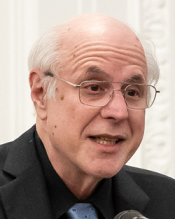
Richard Wexler, executive director of the National Coalition for Child Protection Reform, likened Guggenheim to the crusading journalist Edward R. Murrow and discussed his influence upon family defense attorneys and advocates. “But the bottom line is this,” he said, “virtually everything good that has happened in this field in family defense and family advocacy over the past 50 years has some connection to Professor Martin Guggenheim.”
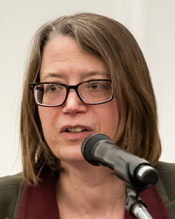
Professor Christine Gottlieb ’97, director of the Family Defense Clinic, highlighted Guggenheim's role as a scholar and teacher. She noted the continuing influence of his journal articles and “his game-changing” book, What’s Wrong With Children’s Rights. “His scholarship galvanized the largely ignored field of family regulation.… In child welfare and family regulation, it’s not an overstatement to say Marty shook the existing ground so hard that the columns have started to teeter and some are falling,” she said. “He pointed the way forward, not only for practitioners, as others have noted tonight, but also for the current generation of scholars who’ve been inspired by his theoretical insights and his amazing model of academic scholarship that serves the families—whom scholars, just like courts, have too often disregarded.”
Responding to the other speakers, Guggenheim described his career as “the best journey of my lifetime” and recalled his experiences in launching the Family Defense Clinic. “I never represented a parent before that. I started a clinic where I never worked in it. I didn’t know how to represent a parent. Not only was that insane, but the school let me do it. And even more, there was no field. What are we even talking about? I had to discover how to represent parents. It wasn’t a clinic to tell students how to do it,” he said. “It was a journey together to learn how to do it, with the full support of John Sexton as dean. And it was a clinic designed to serve the community. It wasn’t even a teaching clinic. It was a revolutionary idea of legal education of which the [NYU Law] is the national leader.”
Watch video of the Annual Survey dedication: