

Closing Statements: John C. P. Goldberg ’91
A Q&A with John C. P. Goldberg ’91, the dean of Harvard Law School
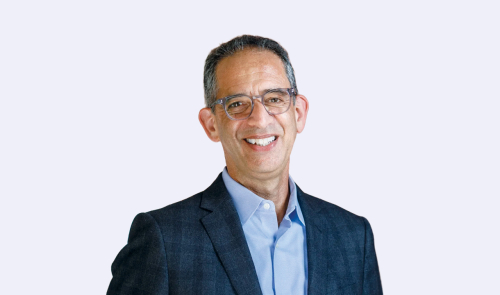
John C. P. Goldberg ’91, an expert in tort law, tort theory, and political philosophy, joined the Harvard Law School faculty in 2008, became interim dean in 2024, and was officially appointed Harvard Law’s dean in 2025—the first dean in the school’s history who did not attend Harvard University. This year, at his 35th NYU Law Reunion, Goldberg received the Legal Teaching Award. We spoke with him about his journey from NYU Law student to one of the highest-profile roles in legal academia.
What was your path to NYU Law?
As I was pursuing graduate studies in political theory at Princeton, I realized that law would be an important part of what I was studying. NYU Law had two great advantages. First, it had an incredibly strong faculty—people like Ronald Dworkin, Tom Nagel, and Larry Sager, all of whom were giants. Also, NYU was an hour from Princeton, where my then-girlfriend—and now wife of 35 years—was.
I had terrific professors my first year, including William Nelson ’65 for Property [see “In Memoriam”] and Sylvia Law ’68 for Torts. Sylvia was an early and leading scholar in law and feminism, and she taught a great Torts class. Obviously, it captivated me, because here I am still thinking about torts.
Why did torts capture your imagination, and how did you settle on an academic career?
My interest stemmed from having spent a lot of time thinking about moral and political philosophy. Tort law, as I see it, is about what we owe each other and how we have to be attentive to the interests and needs of other people as we go about our own lives. It’s also quintessentially American. The United States relies on tort law and invites litigation in ways that other nations don’t. Trying to get a sense of why we do things this way, what we think we’re accomplishing, and the pros and cons of this approach has always been very engaging for me.
As for academia, my suspicion is that most teachers are frustrated performers. Clearly, I like getting up in front of a group and holding forth. And being around really smart, really motivated young folks is rewarding on so many levels. For me, teaching has always been a joy. It is a dream job.
What are your thoughts on recent shifts in legal education and the legal profession?
We’re definitely in a period of ferment. The most obvious manifestation is AI and how it’s changing the legal profession. You ask 10 people and you’ll get 10 different opinions—but everyone is confident that things are going to be significantly different in terms of how law firms are structured and how legal services are provided. When a graduate goes out into the world to practice law, what new competencies will they need to have, not only to use AI, but to design or help build AI? That will be a basic question regarding how we educate and train our students going forward.
How have you stayed connected to the NYU Law community?
The people I’ve stayed most connected to are those I spent a lot of time with on the Law Review, especially my 1L section-mate, partner in torts, and co–award winner [of the Legal Teaching Award] this year, Ben Zipursky ’91. I have former classmates in academia and other parts of the legal profession with whom I talk pretty regularly. A few years ago, I had the privilege of coming back to NYU Law as a visiting professor. I taught a section of Torts and loved it, and got to reconnect with former professors. Looking back, my experience at NYU as a student was fantastic. I got a great legal education and made lifelong friends. I want every Harvard Law student to have the kind of experience I had, with great and engaged faculty, brilliant peers, and a setting where everybody is excited and can thrive.
My first semester at NYU Law was Harvard Law alumnus John Sexton’s first semester as NYU Law’s dean. I saw him a couple of years ago at a Harvard event—my former dean seeing me in the role of interim dean was a life moment for me. Although he refrained from giving me particular advice, he was hugely encouraging, and I certainly try to emulate his magical ability to make every person in the room feel attended to and special. I’m not sure I will succeed at his level, but I aspire to that.
This interview has been condensed and edited.
Photo credit: Harvard University/Veasey Conway