

Philosophers confront who is responsible for injustice
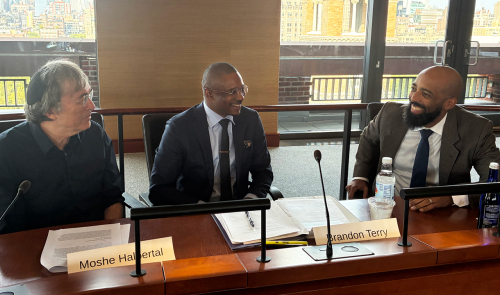
Moshe Halbertal, Brandon Terry, and Vincent Southerland
When elected officials break the law, who else shares the responsibility? What do citizens owe the victims of injustice, at home and abroad? And how should individuals act when the institutions around them fail? These questions were among those explored at “Obligations, Individual Responsibility, and Collective Responsibility Under Injustice,” a conference hosted by NYU Law’s Center for Law and Philosophy on October 2 and 3.
The conference gathered moral, political, and legal theorists in Furman Hall’s Lester Pollack Colloquium Room for the presentation of papers followed by open discussion. Sophia Moreau, Samuel Tilden Professor of Law and Professor of Philosophy, and Liam Murphy, Herbert Peterfreund Professor of Law and Professor of Philosophy, organized the event, together with Dr. Felix Lambrecht of LMU-Munich and the University of Southern Denmark.
“At NYU Law, we believe that philosophers have a responsibility to engage with real political and legal problems,” says Moreau, co-director of the center. “Some of the most pressing problems of our time concern who is responsible for the unlawful acts of politicians, how people should act in the face of such lawlessness, and what our collective responsibilities are towards the victims of injustice within and outside of our country.”
Moreau’s own paper, “Dirty Hands of the Governed: Collective Responsibility for Officials’ Unlawful Acts,” explored citizens’ broad duties of justice and argued that citizens often share in responsibility for their officials’ unlawful acts and must together compensate victims. University Professor Jeremy Waldron, in “Collective Responsibility in the Circumstances of Politics,” examined how individuals can understand their own responsibility in vast political communities that are deeply divided over what justice requires.
The conference drew leading scholars from around the world. Michele Moody-Adams, professor of philosophy at Columbia University, defended “civic grace,” a readiness to extend goodwill even to determined political opponents, as vital to democracy’s survival. Rainer Forst, professor at Goethe University Frankfurt, analyzed structural domination and offered a new account of class. Harvard Professor of African and African American Studies Brandon Terry revisited the discussion around “black-on-black crime” to recover its underlying concerns with responsibility. Rahel Jaeggi, a professor of practical and social philosophy at Humboldt University in Berlin, spoke on moral responsibility under authoritarian rule; Professor Lucas Stanczyk of Harvard addressed the ethical controversy around solar geoengineering—which advocates cooling the earth by reflecting a fraction of incoming sunlight back into space—in light of intergenerational injustice; and Cécile Fabre, professor at the University of Oxford, asked whether wrongdoers and victims alike bear a duty to vote.
NYU Law faculty served throughout as commentators, moderator, and chairs, including Murphy; Moshe Halbertal, Gruss Professor of Law; Richard Brooks, Emilie M. Bullowa Professor of Law; Lewis Kornhauser, Frank Henry Sommer Professor of Law; Professor of Law Vincent Southerland; and Katrina Wyman, Wilf Family Professor of Property Law.
The October meeting was the second of two gatherings on the theme. The first took place in June at Ludwig-Maximilians-Universität München, where Murphy presented “Official Lawlessness and the Responsibility of Individuals.” The papers presented at both conferences will be published together as an anthology.
The conferences are among several new initiatives undertaken by the Center for Law and Philosophy, Moreau notes. The center is also currently working on establishing a Postdoctoral Program in Law and Philosophy and an annual lecture in memory of Professor Ronald Dworkin, she says.