For its 30th anniversary, the Hauser Global Law School Program examines the future of international law
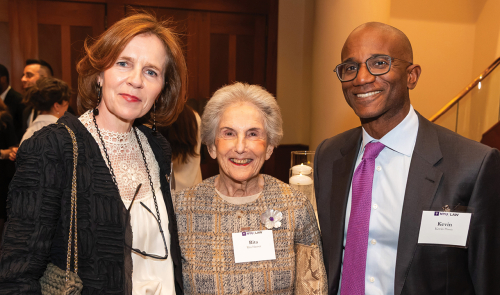
From left to right: Síofra O’Leary, Rita Hauser, and Kevin Davis
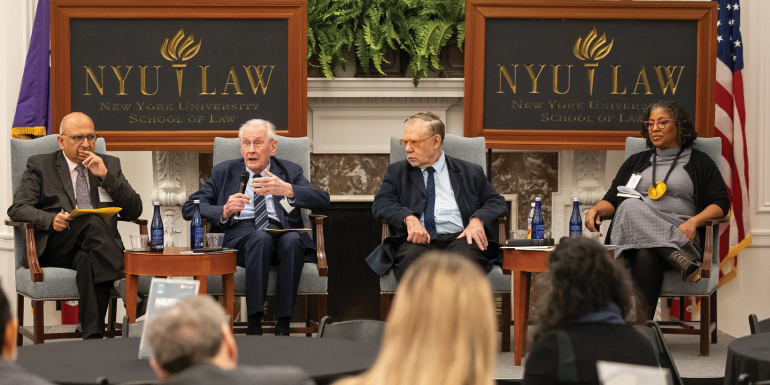
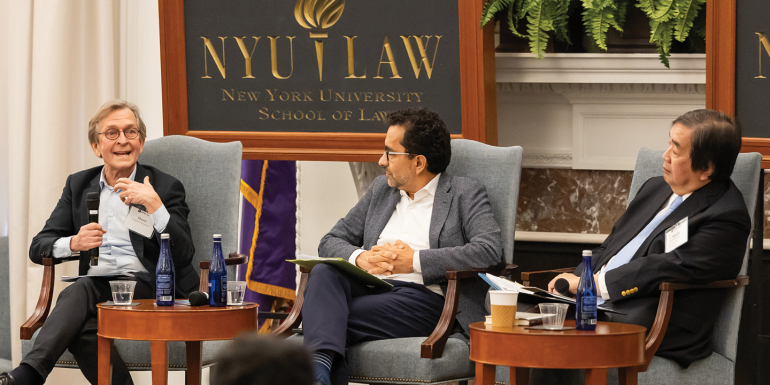
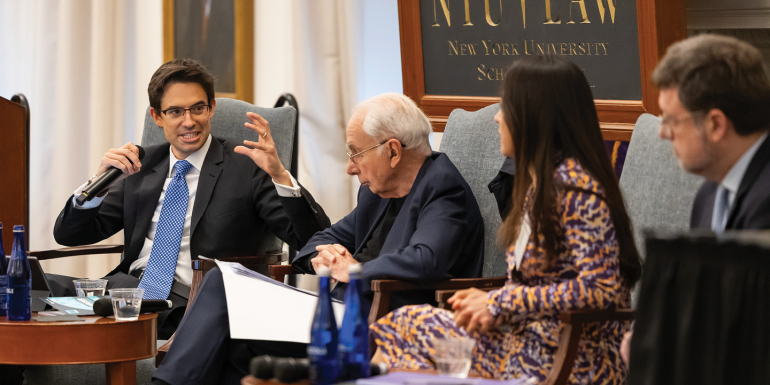
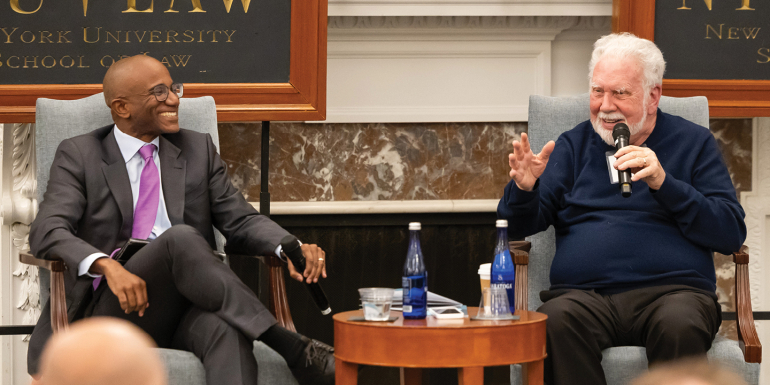
On March 12, the Hauser Global Law School Program celebrated its 30th anniversary with its annual dinner and a conference that examined the future of the legal profession globally in a rapidly changing geopolitical environment. “The Future of the Global Legal Order” featured scholars from across the world sharing perspectives on how the law is evolving in a range of countries. Experts evaluated the future of constitutionalism, of the international legal order, and of international competition policy and antitrust law. The conference closed with a conversation on global legal education between Kevin Davis, Beller Family Professor of Business Law and faculty director of the Hauser Program, and John Sexton, dean emeritus and Benjamin F. Butler Professor of Law.
The Hauser Program brings faculty, fellows, and students from around the world to teach, study, and collaborate at NYU Law. It was founded in 1995 with generous support from NYU Law Life Trustee Rita Hauser, an international lawyer and a senior partner for more than 20 years at Stroock & Stroock & Lavan, and by Gustave Hauser LLM ’57, a pioneer of the modern cable television industry.
“Over three decades, NYU’s Hauser Global Law School Program has become one of our defining features. It reflects an insight—a simple but powerful insight—that the study and practice of law today is not confined within national boundaries,” Dean Troy McKenzie ’00 said in opening remarks. “Ideas, institutions, and problems move across borders with extraordinary speed. And therefore, from the beginning, the program recognized that the best legal education and the best legal thinking had to keep pace with that reality."
In a discussion on “The Future of Constitutionalism: Between Globalism and Nationalism,” panelists agreed that around the world, constitutional government is becoming endangered, as more leaders disregard restraints imposed by their country’s constitution. Princeton University’s Pratap Bhanu Mehta, former president of India’s Centre for Policy Research, addressed the tension directly: “A constitution lives only so long as political actors behave as if it binds them, and there's some key shared understanding of what it is that binds them,” he said. “Like the Cheshire cat of Alice in Wonderland, where the smile remains, but the cat whose smile it was, has disappeared, the smile can still guide us to some illusive truths, but currently it seems that all that remains of constitutionalism is just that little faint enigmatic trace of that smile, even that of doubtful significance.”
During a panel titled “The Future of the International Legal Order: Beyond the Rupture,” moderator César Rodríguez-Garavito asked Global Professor of Law Martti Koskenniemi and Harold Hongju Koh, professor of international law at Yale Law School, to respond to a speech given by Mark Carney at the 2026 Davos conference. The Canadian prime minister had argued that world must recognize that the established international legal order faces a decisive rupture.
“Are we truly witnessing a rupture, a collapse of existing international legal architecture?” asked Rodriguez-Garavito. While public international institutions such as the United Nations have lost influence, commercial international law remains strong, Koskenniemi said. He also noted that ideas from international law—such as the concepts of war crimes, sovereignty, or human rights—have become integral to how people understand and talk about international affairs. “In this sense, I would say…it becomes more and more intensely a legal world, an international legal world,’” he said.
Koh rejected the idea that a break with the post-World War II international legal order was inevitable. “The short answer to your question, César, is that I think it's a cycle, not a rupture.… I think it’s easier and better to see this as a challenge, a tipping point perhaps that we have to resist.”
A third panel, “The Future of Competition Policy: Power, Politics, and Populism,” examined developments in antitrust regulation in Europe, China, and the United States. Angela Huyue Zhang, a professor at USC Gould School of Law, argued that China has reined in dominant market players more successfully than the US has. “I actually see the United States [as] governed by tech, whereas China is governed by law,” she said. “…China can afford to use its antitrust law in a split second and can discipline its big tech and try to use antitrust law to achieve common prosperity and redistribute wealth. But look at the United States. Despite all the intense scrutiny, all the litigations, all investigations and all the hype you have in the Congressional hearings, all these things, have we really moved the needle a little bit? Not really, right?”
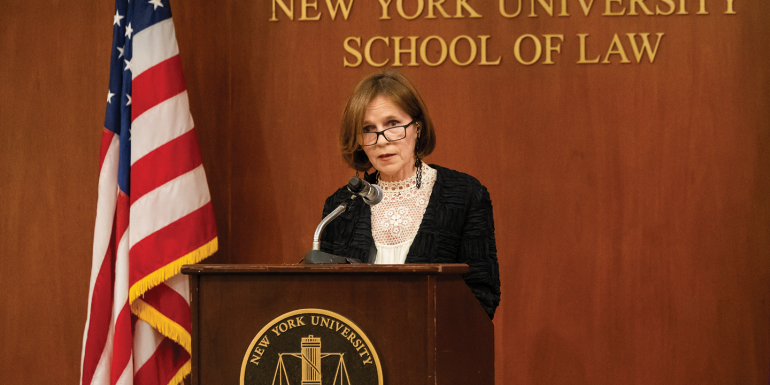
Síofra O’Leary, Hauser/Remarque Global Fellow and former president of the European Court of Human Rights, gave the keynote address during the Hauser Dinner. In her remarks, titled “Democracy and Freedom of Expression: Some European Judicial Perspectives,” she addressed the role of national and international courts in preserving freedom of expression and democracy in countries sliding into populist and autocratic regimes.
“It would be entirely disingenuous of me to stand before you in 2026 and to suggest that integration through law at the European level has been an outright success,” she said. “Many of the European scholars present are here in New York doing research to point out the legitimate criticism of when and how European systems have got some things wrong.... But when it comes to tools to protect democracy and freedom of expression, I think it would be foolish to dismiss the arsenal which has been built up in Europe for almost eight decades…. You cannot build back bigger, better, stronger and more just if the past is simply forgotten and its powerful, painful, and pragmatic lessons are set to one side.”
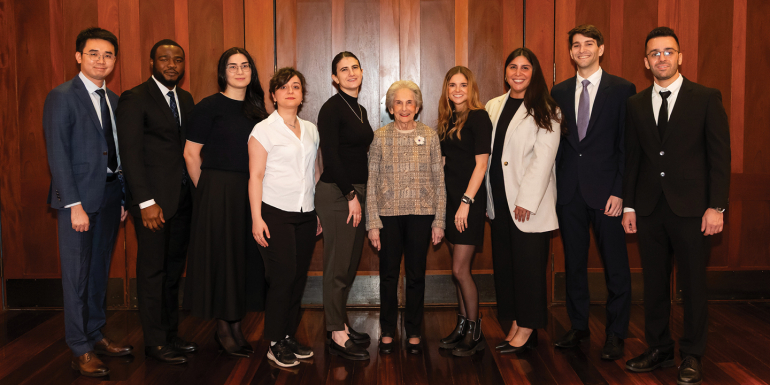
Selected photos from the Hauser Global Law School Program's 30th anniversary: