

Theodor Meron describes his extraordinary journey from Holocaust survivor to UN war crimes judge
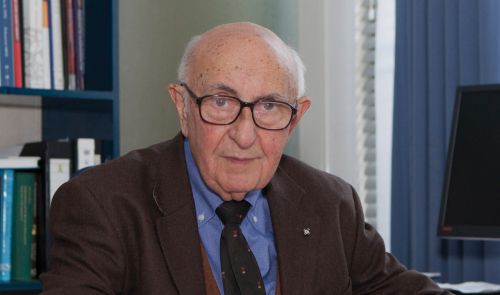
Theodor Meron
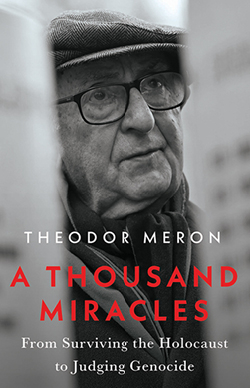
In his new memoir, A Thousand Miracles (Hurst, 2026), Theodor Meron, Charles L. Denison Professor of Law Emeritus and Judicial Fellow, looks back at a long and remarkable life. A survivor of the Holocaust, Meron is a leading scholar of international humanitarian law, human rights, and international criminal law who served as president of the International Criminal Tribunal for the former Yugoslavia (ICTY) and the International Criminal Tribunal for Rwanda. As a member of the Israeli Foreign Service, he was legal advisor to Israel’s Foreign Ministry, ambassador to Canada, and ambassador to the United Nations in Geneva. After immigrating to the United States, he began teaching at NYU Law in 1979.
In addition to numerous books and articles on human rights and international law, Meron has written extensively about the laws of chivalry and warfare in Shakespeare’s plays. He has also published two volumes of poetry, most recently Things I Dread (Saddlestone, 2026).
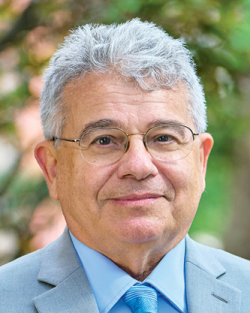
On April 10, Meron sat down with José Alvarez, Herbert and Rose Rubin Professor of International Law, for a public conversation about his childhood experiences in Nazi-occupied Poland, how they shaped his path, and what Shakespeare can teach us about the conduct—and the futility—of war.
José Alvarez: Your early life is not something that one associates with “a thousand miracles.” A peaceful childhood shattered by the Nazi invasion of Poland, flight from the invaders to southern Poland, and forced solitude from the age of 9 to 15, no access to school or boyhood friends in an authorized Jewish ghetto. The shock of September 21, 1942, which happened to be Yom Kippur, when that ghetto is destroyed and those deemed insufficiently strong, including your paternal grandparents, are sent to Treblinka. A hurried move to the small ghetto, until the day comes when you arrive home to discover that your mother and nearly all the other relatives have been taken out of the town and executed. A life with the knowledge that the person you were closest to, your 17-year-old brother, had probably died while taking part in a prisoner’s uprising in Treblinka, but never knowing for sure. More dislocations, ending in sanctuary in British Mandate Palestine at war’s end.
This is not a charmed life. Why do you see your life as so positive?
Theodor Meron: Just think of a person who between the ages of nine and 15 did not go to school, who became an academic at the age of 40, a judge at the age of 71, president of the UN tribunal on war crimes at the age of 73.
Who wrote the piece in Foreign Affairs urging the establishment of the ICTY, who wrote in 1993 a piece in the American Journal of International Law, lamenting the state of international humanitarian law with regard to the prosecution of rape. Who survived the Holocaust, as you have mentioned, by being 15 minutes late, and discovered that his family has been taken out for execution.
And whose position as a judge and president of the court was on the brink of collapse following his involvement [as presiding judge of the Appeals Chamber] in the reversal of the conviction of General [Ante] Gotovina. And it was only saved when the counsel for Serbia, in the Serbia-Croatia genocide case, complained against him and against the judgment, leading the court, the International Court of Justice, to focus on that case and to decide unanimously that our majority judgment reversing the conviction was right.
Who was about to fly on the doomed Swiss Air Flight 111, only to decide at the very last moment to postpone his flight to the following day.
Who, a survivor of Holocaust, as you mentioned, presided over the first genocide case on European soil. Who published a memoir and two books of poetry at the age of 95—a very precocious book. Who still teaches at NYU and at Oxford.
And if I may draw on Shakespeare, this is such stuff that the dreams are made of. So whether we call it miracles or something else, it comes down to the same.
Alvarez: So obviously you see islands of light where other people see the darkest of ones. I think many of us have known you for a good long time are only starting to learn all the details of your boyhood. And I suspect it may be that for so much of your life, you tried to forget—or as you write in the memoir—at least control your memories of the Holocaust, which is, I think, common with other survivors. But can you say more about what caused you to break that silence, especially at this particular time?
Meron: Well, my war years were so painful, so traumatic that I tried to forget them after the war. Actually, for years I suffered constant nightmares, and in the nightmares SS was chasing me, never capturing me, but never quite abandoning the chase. And I swore never ever to return to Poland. [Then] in 1986, the International Committee of the Red Cross (ICRC) asked me to go to Warsaw to lecture on international humanitarian law in their summer school. Altogether I’ve been working with the ICRC for some five decades, and I’ve never ever refused their requests. But it was a difficult choice. My wife felt that going to the places in which I lived the worst part of my life would help to exorcise my psyche from the ghosts that haunted my nights.
So we traveled to Poland a few weeks before the seminar and took the time to go to the city where I spent the war, to the city where I was born. We went to Auschwitz, we went to Treblinka. And psychiatrists always say that one of the ways to confront nightmares and traumas is to confront the events, to face them face to face. I never believed in that. My wife did. And actually, she and the psychiatrists were right. My nightmares disappeared practically overnight. And they never returned.
And since then, I’ve traveled to Warsaw many times to teach. In 2011, the University of Warsaw, surprisingly for me, invited me to come to Warsaw to receive an honorary doctorate. Ten years later, the university, the new established university and college, in the city where I was born, invited me to college to give their first-ever honorary doctorates. And since then, the president of Poland gave me the equivalent of the Legion d’Honneur. These are the gestures which I did not expect from Poland, which at the time of my childhood was extremely anti-Semitic.
And my relations with Poland returned to normality, which perhaps is explained by giving you one example. For years I would grieve for the heroes of the Jewish uprising in the ghetto of Warsaw. And after some years I began also, I started grieving for the Poles, for the Polish Catholics who died during the uprising of Warsaw.
Alvarez: So you may not have spoken of your personal experiences, but it seems that every fiber of your being has been affected by it, in terms of your career. I guess I want you to reflect a bit more about how not just the Holocaust, but genocides generally have affected what you write and what you’ve done.
Meron: The war years impressed me with enormous hunger for education, a desire to fill the gaps left by five years of not going to school, not having the companionship of children or teenagers my age, of simply trying to survive. Of simply trying to navigate the chaos of life in camps and in ghettos, of losing my closest family. And not surprisingly, this background led me to choose as focus of my education international human rights, humanitarian law, international criminal law.
I wanted to do something in which I could make even a small contribution to a world in which genocides, the Holocaust, would not be repeated, or at least not as frequently as before, and which would be ruled by rule of law and respect for human dignity. Where children would not lose their childhood, their education, their autonomy, their closest family.
As a judge and as an advisor to governments and as a scholar, I had the privilege of working for the rule of law, due process, and judging and advising without fear or favor. As a judge, I made it a point never, ever in my work and deliberations, in decisions, in writing judgments, to think about what happened to me during the Second World War. My mantra was always that the judge’s remit is strictly limited and that the interests of various stakeholders cannot influence the outcome, that no extraneous considerations can be included in a judge's agenda, however desirable they may be in themselves.
Alvarez: You’ve had many careers in both public and private sectors. It seems to me that each one of those changes took real courage.
After missing all those years of primary education, I think it takes some courage to leave Israel to complete an LLM and a PhD from Harvard. Courage to secure a diploma in law under Sir Hersh Lauterpacht [at the University of Cambridge], of all people. Courage quickly rise within the Israeli Foreign Service, so that at age 41 you were Israel’s ambassador to Canada. Courage to embark on yet another career change, to accept our then-dean’s invitation to come to NYU to become a professor. Courage to leave the comforts of academe for judicial robes, embarking on a career that makes you the longest serving international judge in the world. Courage to carry on after the loss of your wife after over 40 years of marriage and continue doing all the same things and more, and then becoming on top of all that, a published poet.
Given all that stuff, what’s been your greatest achievement?
Meron: Not my books. It was my opinion, written in 1967, right after the Six Days War, where the government of Israel asked for my opinion as to whether establishing Jewish civilian settlements on the West Bank and in other territories occupied by Israel and during the Six Days War, whether establishing those settlements was legal or illegal. It took me only a few days to write that opinion. It was three pages short.
My opinion stated simply after a short analysis that establishing civilian settlements on the West Bank would violate explicit provisions of Geneva Convention IV. Reflecting on that opinion many years later, I think that actually I did not consider at all the possibility of writing a sort of a cosmetic opinion which would make the legal question more fuzzy. It just did not occur to me. I gave no thought to possible repercussions on my career from an opinion which clashed frontally with what most of the cabinet expected at the time.
I think that in writing those opinions and whatever else I wrote, I tried to be faithful to the law. I tried to be faithful to my professional integrity. There was always a lot of hard work, a lot luck, on which I managed to jump before it quickly disappeared. Life requires seizing of opportunities. But the goddess Fortuna has a role to play in sending those opportunities your way, and she sent those opportunities to me in a plentiful number.
Alvarez: Those memos were leaked many years later, and that’s the first time you actually had public acknowledgement of your role. Can you speculate on what might have been the consequences if the Israeli government had accepted your advice and actually stopped building settlements in the occupied West Bank way back then?
Meron: Well, maybe I’m naive, maybe it is too optimistic to assume that, but I’ve always thought that if the government of Israel accepted my opinion at that time that we would have been much closer, if not to peace, to a real reconciliation between Jews and Arabs in Palestine. We would have a different Middle East. We would probably have a different world. And I’m very sorry that therefore they did not accept my opinion.
Alvarez: In the book you don’t say much explicitly about the professional code of conduct that you think government lawyers should abide by. So I can’t help but ask what advice you would now give to government lawyers and our secretary of war. What specifically would you want to say to, for example, those who would favor indiscriminate bombing that would not distinguish between civilians or disproportionately impact civilians, or say that what they’re intending to do is to destroy a civilization?
Meron: My advice to lawyers everywhere, not only those serving in the Trump administration, would be the same advice I try to follow myself: that we as legal advisors should call it the law as we see it. As legal advisors, we are in a way what the Brits have always called an officer of the law. Somebody with higher obligations. Your relationship with your clients is different from lawyer-client relationships in the private sector. Your integrity and professionalism require you to state the law, even if it clashes with the view of the administration and the government, of what the administration would hope to get from you. And it might even be in conflict with your career.
And I’ve always believed that professional integrity trumps career interests. This is my view, still, today.
Alvarez: Your book does not have footnotes—which is a shock to the system for those of us who write footnotes. Which means that it’s a bestseller.
You do manage to address your 14 books and other 100 works in a very minor way by talking about Shakespeare: the intersection of Shakespeare’s plays, the rules of chivalry, and modern international humanitarian law. And you cite a particular passage from Hamlet that I can’t resist, as a theater lover.
Captain: We go to gain a little patch of ground that has in it no profit but the name. To pay five ducats, five, I would not farm it.
Hamlet: To my shame I see the eminent death of twenty thousand men, that for a fantasy and a trick of fame go to their graves like beds, fight for a plot whereon the numbers cannot try the cause, which is not tomb enough, not continent enough, to hide the slain.
So what has Shakespeare meant to you, and what should he mean to us?
Meron: Well, let me start by saying that I owe my interest in Shakespeare and my love for Shakespeare to a visiting fellow at All Souls College and to the influence of my wife, for whom Shakespeare was—as he is now for me—the greatest poet in human history.
Shakespeare used the law of nations and the rules of chivalry, of course, for dramatic purposes. But Shakespeare’s involvement with the rules of war and the rules of chivalry went far beyond that. He sustained through his writing, through his histories, the [chivalric] customs of war in the Middle Ages and in the Renaissance. More than anything, chivalry meant the duty to act honorably, not only in war but also in peace, and implied an important code of behavior to give quarter, to protect non-combatants, to keep the chivalric oath. Its legacy continues to shape our law and our values.
And Shakespeare was an incredibly effective spokesman for humanity, for humanism. He understood that the words of a poet—don't count me among them yet—are more influential and more important, perhaps, than the words of politicians and statesmen. Sonnet 55: Not marble, not the gilded monuments of princes, shall outlive this powerful rhyme. It’s all there. He was a humanist whose characters attempted to discourage war frequently through irony and sarcasm, as in the famous soliloquy of the Archbishop of Canterbury in Henry V, where he lays bare the self-serving and hypocritical assertions of the church arguing and supporting the claim of the king that the war was just. He highlights the futility and the inevitable cost of war.
I am very grateful to you for citing that passage of the conversation between the captain and Hamlet, which really says it all.
This transcript has been condensed and edited.