

Friends For Life
NYU Law alumni recall how their relationships with their 1L classmates became the best thing they got out of law school.
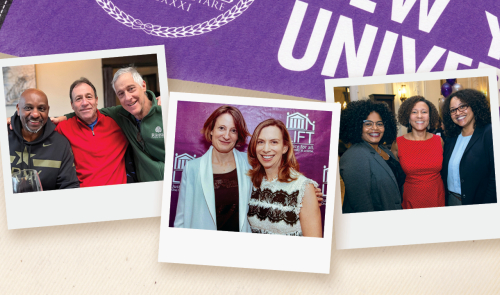
Left to right: Gary Way ’83, Charlie Chasin ’83, and Mitch Cohen ’83; Liberty Aldrich ’95 and Leslie Abbey ’95; Ayana Free Hardy ’07, Katrina James ’07, and Sienna Fontaine ’07
Gary Way ’83 still remembers what first drew his exceptionally durable and close group of NYU Law friends together back in their 1L year. It wasn’t a study group or a shared professor or any common hobbies or interests. It was a television set.
“Charlie [Chasin ’83] had a Sony Trinitron color TV,” Way says. “And that kind of said a lot about all of us.”
In the fall of 1980, the dorm room that Way shared with Charles Chasin and Mitch Cohen ’83 became the unofficial social center of their 1L class. After long days of class and study, a rotating cast of classmates from various sections would drift in to watch Sunday NFL games, stay up until three in the morning trading legal concepts and wisecracks, and simply be, as Way puts it, “nonproductive in our precious little discretionary time.” What grew from those late nights was a friendship among eight men, and a loose orbit of several others, that has now run without interruption for 46 years—connections so important to Way that he is now working on a memoir about his friend group.
Way, Chasin, and Cohen are not unusual among NYU Law alumni in forming bonds at the Law School that may have eclipsed the degree itself in terms of both personal and professional value. Across generations and graduating classes, a striking number of alumni describe their closest friendships—the ones that held through career pivots, cross-country moves, marriages, deaths, and the various challenges of adult life—as forming during that first year at Washington Square.
Alumni from three groups—Way, Chasin, and Cohen; Leslie Abbey ’95 and Liberty Aldrich ’95; and Ayana Free Hardy ’07, Sienna Fontaine ’07, and Katrina James ’07—offer a window into how those bonds are made, what sustains them, and what it is about law school that fosters friendships that last. Though separated by decades, career paths, and different generational pressures, each group agreed to one truth—that law school for them was a crucible. The pressure, the stakes, and the daily confrontation with one’s own capabilities and limitations were not incidental to the friendships formed there. They were the conditions that made the friendships possible.
According to Cohen, the Law School was a place where highlevel conversation was ubiquitous and thought-provoking and naturally led to the formation of strong ties—“the kinds of bonds that you make in summer camp,” he says. For Aldrich, it was the shared experience of clinic work that both enhanced self-knowledge and solidified friendships. “You did so much introspection—you think you’re presenting this way, but how is your client taking it? You learn about your position of power vis-à-vis your clients, and that’s also an amazing position from which to build a friendship,” she says.
The advice these alumni offered to current 1Ls is notable for its overlap. Beyond studying hard, taking interesting classes, and engaging with the best and the brightest, what they recommended, almost uniformly, was vulnerability—letting people in, showing up, saying yes to the brunch, the road trip, the dumb television show at midnight.
“Take advantage—not thinking of it as networking, thinking of it as creating a safety net,” Aldrich says. “[Law school] is hard. You are going to have moments of difficulty. So take advantage, and meet people.”
“Take the time and effort to develop and maintain your friendships,” says Chasin, who has hired and mentored hundreds of NYU Law and NYU alumni during his nearly 40 years at Morgan Stanley. “It is so unbelievably rewarding, both professionally and personally. We’ll be there for each other until we die.”
“If you hold yourself, and you stay true to your own values, and you honor the people that you’re around,” says Free Hardy, “you’ll have this incredible feeling of looking back and walking through the orchard of your friendships, and being like—‘Wow.’”
Shared Silliness
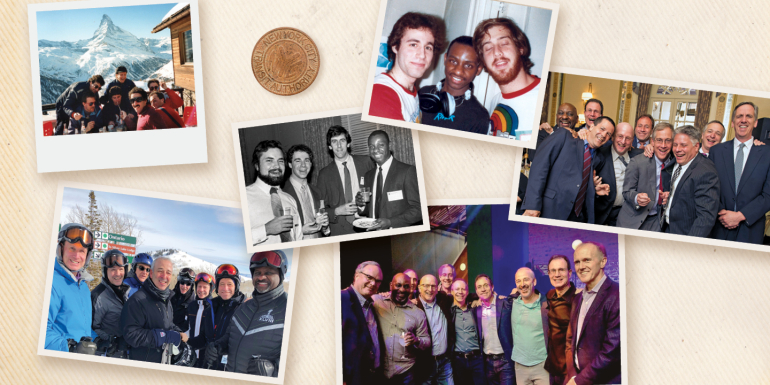
The group of friends that started off watching Charlie Chasin’s television came together in a way that had less to do with shared ambition than shared temperament. Way, Chasin, and Cohen were working-class kids in a law school that in 1980, according to Way, was thickly populated by graduates of the Ivies. Most of the group were first-generation college graduates—sons of secretaries, carpenters, diner owners, printers, and car salesmen.
What they found in each other was a shared refusal to mistake seriousness about the law for seriousness about themselves. “We were all trying to succeed, on the one hand,” says Cohen, who after two years in practice left law for rabbinic school and eventually spent two decades running Camp Ramah, a national network of Jewish summer camps. “And on the other hand, trying to show that we’re not taking it too seriously. We all shared that.”
The friendships deepened through proximity and silliness—intramural sports; a wildly popular Law School Family Feud game show invented, hosted, and cast by Cohen and Steve Brostoff ’83 (and running for at least 20 years after their graduation); and long nights in the East Village at McSorley’s before heading back to the dorm to watch Mary Tyler Moore Show reruns until dawn.
“We kept each other very sane in law school,” Chasin says. “We could go back and forth between talking about some concept we learned in class that day, and then be jumping on top of each other and messing around like idiots.” Their overall vibe led some of their classmates to write them off as slackers, he says. But academics—and career prospects—remained a top priority, and several members of the group ended up on prestigious journals, including NYU Law Review.
“These guys see a much deeper level of immaturity [in me]. One might call it lightheartedness. I would call it silliness. That’s a side of me that comes out with these guys that doesn’t really show up anywhere else. And it’s very, very therapeutic.”
Mitch Cohen ’83
What the group didn’t fully know at the time was that the road to post–law school employment was radically different for Way, the only Black member, than it was for the others. During his 2L job search, Way received not a single callback from 43 first-round interviews. “That doesn’t happen,” says Way, who ultimately went on to become general counsel at Nike’s Jordan
Brand division and who for 20 years headed the company’s sports marketing law practice group. “I was a good student, I was on a journal—and I could not even get a callback,” Way says. He eventually secured a position during his 3L year and became one of the first Black attorneys ever hired by the then-150-year-old firm Haight, Gardner, Poor & Havens. For months after graduation, with no savings and nowhere to live, Way quietly rotated sleeping on the couches of friends Chasin, Jeff Aronson ’83, Bob McLaughlin ’83, and Steve Connoni ’83. “That group subsidized me while I was getting on my feet,” he says.
Chasin recalls witnessing discrimination firsthand when Way went to a nearby SoHo club to meet up with another member of the group, Mark Shelnitz ’83. The doorman turned Way away on the pretense that the club was closed to the public for a private party. After Way returned to the dorm and told Chasin what had happened, Chasin went to the club himself and was admitted without question. He walked straight in to confront the manager. “When Gary first would tell me stuff, I would sometimes think, ‘Maybe he’s overreacting.’ But then I saw all of these things with my own eyes,” Chasin says.
The group is now in its 41st year of annual ski trips to the Alps and the Rockies, with the Rockies trip now permanently hosted by Steve Kaplan ’83 at his Park City, Utah, home. When a group member suffered a catastrophic stroke roughly a decade ago, every member dropped everything and traveled in from around the country within a day and a half to sit at his bedside for days. It was the first time in nearly a generation the entire group had been in the same room. The moment, Way says, moved him to begin the memoir.
“We hug each other and kiss each other on the cheeks in ways that a lot of men don’t do,” Chasin says, who also notes that half of the group—himself, Aronson, Kaplan, and Way—all currently serve on the NYU Law Board of Trustees. “The trust and the caring makes it feel very, very special.”
From a career perspective, Way says that his friends were a great resource in the early days of practice. “[If] I got stuck on something, and I didn’t want to ask an associate, I just had to pick up the phone,” he recalls. Cohen, whose career took him furthest from conventional law practice, credits the group with something he couldn’t have anticipated: “I’ve learned about corporate leadership from Shelnitz, prosecutorial work from Brostoff and [Steve] Goldstein [’83]. It’s given us expertise in all these areas whenever we need it.” But what the group really gave him, he says, was permission to be himself—completely. “These guys see a much deeper level of immaturity [in me],” he says. “One might call it lightheartedness. I would call it silliness. That’s a side of me that comes out with these guys that doesn’t really show up anywhere else. And it’s very, very therapeutic.”
Partners in Public Interest
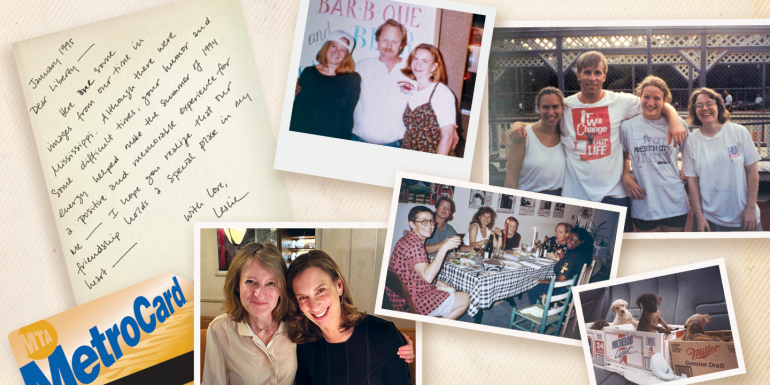
A little over a decade later, a friendship took shape in the corridors of NYU Law that eventually produced an organization serving thousands of New York families, as well as a bond that has spanned career building, marriages, children, and empty nests.
Liberty Aldrich and Leslie Abbey both noticed each other in class first. “I remember this moment of looking over and thinking, who is that woman? She’s got really cool things to say,” Abbey recalls. Aldrich uses almost the exact same words to describe the same moment. What followed was the ordinary machinery of law school friendship—shared classes, mutual friends, and the hothouse pressure that Aldrich describes as “trying to figure out what you’re doing with your life, trying to make your own way.”
The decisive moment in their relationship came just prior to their 2L summer, when they both simultaneously decided their futures were in public interest law. Unlike many of their classmates, instead of spending that summer working at a law firm, they traveled to Mississippi together as part of a summer legal program. It was an experience that both describe with particular warmth, including the moment they pulled over to rescue a box of abandoned puppies. Their job responsibilities included running a wills clinic where, according to Abbey, nearly every client listed a gun as one of their most valuable assets.
“One hundred percent, I believe…that second summer—when both of us decided we wanted to continue in public interest work—that was the pivotal point that cemented our connection,” says Aldrich. Both had been drawn to NYU Law precisely because of what she calls “the vibe—that level of commitment and interest and excitement around public interest practice.”
Their 3L year found them both in the Family Defense Clinic taught by Martin Guggenheim ’71—the undisputed highlight of their law school careers. “We were in that clinic office every spare moment,” Abbey says, “because we just loved our cases, loved the work, loved hanging out with Marty. He was such a mentor to us.”
“As lawyers, you really can do a lot of different things in your life. You can be successful and happy. You can have a family, and you can do what you want. That’s the kind of safety and support I mean—to know that you’re not alone in this.”
Liberty Aldrich ’95
Immediately after graduation, their friendship evolved into a literal partnership when they co-founded what became Family Legal Care, which offers unrepresented parents and caregivers the legal support and guidance they need to navigate New York State Family Court, and which currently serves more than 32,000 families per year. They came up with the idea after many sessions of sitting in Manhattan Family Court in their suits and being “besieged,” as Abbey puts it, by confused, unrepresented litigants asking for help: “‘Where can I find this? How do I fill out this form? What should I do between court dates?’ We thought,‘Everyone’s asking us anyway, why don’t we set up a table in the lobby?’”
Aldrich brought her knowledge of the court system, the players, and what was needed. Abbey incorporated the nonprofit, learned fundraising, and built the governance structure. “She knew Family Court so well,” Abbey says of Aldrich. “I was busy incorporating nonprofits, figuring out governance structures, learning how to fundraise. We were just a great combination.”
Both women took this mix of legal expertise, social service ethic, and entrepreneurial spirit to build exceptional careers. Aldrich went on to become general counsel of the Center for Court Innovation and then a judge in Bronx Family Court, before assuming her present job as executive director of the Children’s Justice Center. She is also an adjunct professor of law at Brooklyn Law School. Abbey was an attorney in the juvenile rights practice of the Legal Aid Society and served in leadership roles at New York City’s Administration for Child Services, Lantern Community Services, and Covenant House. In 2022, she returned to social entrepreneurship by co-founding Anthos|Home, a nonprofit that combats homelessness by moving families and individuals into permanent housing in New York City. Now she is CEO of Hot Bread Kitchen, which creates economic opportunities for individuals in the food industry through job skills training and placement, and also serves on the NYU Law Board of Trustees.
Aldrich and Abbey were part of a broader circle of women friends at NYU Law. (All, as it happened, had first names that begin with the letter L, including a Laura and a Lauren.) The group eventually spanned a wide range of legal careers, from a partner at a major firm who went on to become general counsel of a large investment fund, to a member who stepped back from practice entirely to raise her children.
“We had the whole spectrum, and we’re all still friends,” Aldrich says, characterizing their friendship as an important scaffolding for the construction of their lives. “I think about it as a safety net, a support group of folks whom you can interact with.” An NYU law degree offers a considerable amount of flexibility—and friendship supports that freedom, she suggests. “As lawyers, you really can do a lot of different things in your life. You can be successful and happy. You can have a family, and you can do what you want. That’s the kind of safety and support I mean—to know that you’re not alone in this.”
“I just look back and think—we were so brave to jump into social entrepreneurship,” Abbey recalls. “We just did it. I’m really, really grateful. I’m so glad we found each other.”
Bonding at Brunch
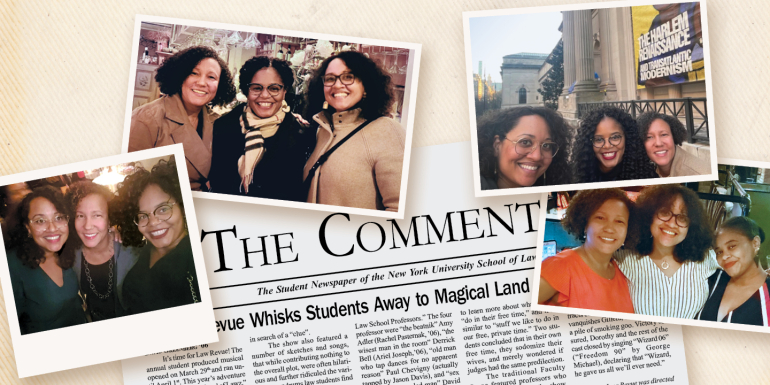
In the fall of 2004, three women arrived at NYU Law from very different starting points and found each other almost immediately. Katrina James had come from social work and higher education, enrolling at 29 with a solid awareness of exactly what law school could be expected to give her. Ayana Free Hardy had arrived via a PhD program in comparative literature at Duke University, drawn to NYU by an international law fellowship. Sienna Fontaine had moved from California knowing almost no one on the East Coast, “rolling solo,” having left all of her family and friends on the West Coast.
They found each other through BALSA (now BLSA)—the Black Allied Law Students Association—which Fontaine describes as a vital community hub for their class, a place where students from different 1L sections could meet on shared ground. James began organizing a Saturday brunch during 2L year, a practical response to the scheduling divergence that scattered close friends across different classes. The brunches became a ritual, and the ritual became a lifeline for them and several other women in their class with whom they became close friends.
“It was like those friend spaces were where you could ask the question that maybe you were nervous to ask in another setting, because you had that trust and you didn’t necessarily fear being judged,” Fontaine says.
“You’re not coming in for an inquisition,” Free Hardy says of the gatherings. “You’re coming in for brunch, for a sister circle—to be loved, to be affirmed, and for a lot of laughter.”
“It’s like anything else. If it’s worthwhile, you will commit to it. And that’s what we’ve decided: that this friendship, and the way that we show up for each other, is worthwhile.”
Sienna Fontaine ’07
Their careers after graduation could hardly have diverged more. James went to Skadden, Arps, Slate, Meagher & Flom and spent years in white-collar defense, left to recharge for 15 months, completed a residency in urban education, and worked as an executive in educational nonprofits. She’s now deputy executive director and general counsel at Lawyers for Children. Free Hardy went from Cleary Gottlieb Steen & Hamilton to a federal clerkship, back to Cleary, then to the US Attorney’s Office, then to ZocDoc. Now she is deputy general counsel at Via, a public transit tech company, and serves as president of the NYU Law Alumni Association. Fontaine became co-executive director of Make the Road New York, one of the nation’s largest immigrant rights organizations, itself founded by NYU Law alumni.
Across all of it, the friendships held—not passively, but through what all three describe as active, intentional commitment. Fontaine is the group’s organizer: She maintains a spreadsheet tracking every apple orchard they’ve visited together, hosts an annual cookies-and-cocktails gathering, and treats the rituals of friendship as, in her word, sacred. “It’s like anything else,” she says. “If it’s worthwhile, you will commit to it. And that’s what we’ve decided: that this friendship, and the way that we show up for each other, is worthwhile.”
When James’s mother fell gravely ill, Fontaine called within five minutes of learning the news. When she passed, Fontaine called again within five minutes. “They’re always the constant, the constant, the constant,” James says. “When something happens in my life, be it related to work, or personal, or anything—those ladies are going to be the first people that I share it with. They’re my family.”
Asked about what makes a friendship like theirs last so long, Free Hardy says she sees it as the difference between bonds built on proximity—shared schedules, shared housing, shared circumstance—and bonds built on something more durable. “If your friendship is based on caring about each other and the values that you share,” she says, “then whatever you do—whether you practice law, whether you don’t, whether you’re at a firm, whether you’re in public interest—it grows much more organically.”