Expert panelists delve into the issue of ICE in American cities

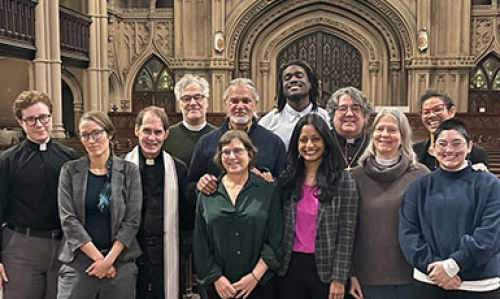
A panel moderated by Samuel Issacharoff, Bonnie and Richard Reiss Professor of Constitutional Law, discussed the domestic deployment of federal immigration officers and its impact on urban policing and constitutional rights during an NYU Law Forum in March.
Brandon del Pozo, former chief of police in Burlington, Vermont, discussed the recent influx of Immigration and Customs Enforcement (ICE) and Customs and Border Protection (CBP) agents into cities such as Minneapolis and Portland, Oregon. He identified what he saw as several major problems with these operations. The Trump administration’s surge tactics required rapid, large-scale hiring with lower standards and less thorough vetting of applicants, he said. In addition, del Pozo added, the new hires have received fewer training hours than many local police officers or earlier federal hires, especially in the area of core constitutional law training. Observers have also noted a lack of field supervision of agents, rigid arrest quotas, and the use of tactical gear and masks, creating the appearance of an “occupying force.”
Watch the video of the NYU Law Forum on ICE in American cities:
Distinguished Scholar in Residence Vanita Gupta ’01, director of the Center for Law and Public Trust, queried whether the federal immigration agents being deployed have been trained in interior enforcement, which involves “a very different set of laws and protections than what people get at the border,” she said. Gupta also mentioned the use of administrative rather than judicial warrants; the damage done to the trust that local law enforcement has worked to build in communities; and the limited remedies available in federal court to address alleged abuses by immigration agents.
Barry Friedman, Jacob D. Fuchsberg Professor of Law and faculty director of the Policing Project, also spoke to the difficulty of pursuing justice in federal court. He argued for the importance of state and local prosecutions of federal officials. Friedman also invoked concerns about the federal government’s collection of personal data, which can be used to label protesters as domestic terrorists.
Among the reforms proposed by the panelists were nationally standardized policing practices and restrictions on the harvesting of private information. “There’s actually a huge framework to work from,” said Gupta. “The question is always political will and whether, in these very polarized times, people [in Congress] will come together on these solutions. But until then, we are relying on police chiefs and leaders…to protect people in our cities and in our towns.”
Selected remarks from the NYU Law Forum:
Brandon del Pozo: “It’s basically like the worst instance of the New York City stop-and-frisk regime, applied not to carrying guns but applied to citizenship, where you’re stopping droves and droves of people based on stereotypes and hunches and the slimmest pretext of justification in order to find the few of them that are not citizens or not here lawfully.” (video 10:29)
Vanita Gupta ’01: “These ICE agents and [Department of Homeland Security] agents don’t live in [these] communities. They don’t have the same connections that state and local law enforcement do. A lot of chiefs are working day in and day out to build trust…where they live, and to have ICE agents surge in…using these tactics that are quite horrifying to the American public…has been a setback for law enforcement writ large.” (video 13:57)
Barry Friedman: “What I’ve seen is a lot of uses of force and property destruction and entering people’s homes and hauling people off in ways that look…wildly unconstitutional…. [The immigration agents] have all been told that they are immune from any kind of reaction by state and local officials. And that just isn't true.” (video 34:46)