Five Years Out: Chanel Thomas ’21
Associate, Troutman Pepper Locke
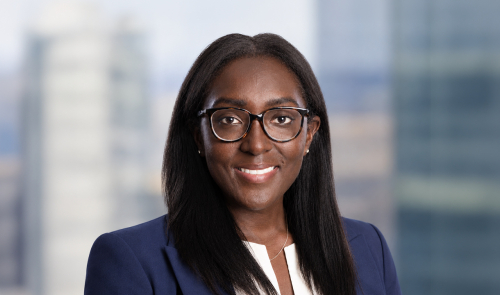
Four months after arriving at Troutman Pepper Locke, Chanel Thomas is advising clients during high-stakes regulatory investigations and enforcement actions. In this Q&A, she talks about why she loves working in a fast-evolving area where litigation helps shape policy.
You arrived at Troutman Pepper Locke earlier this year. Tell us about your role.
I’m in the Regulatory Investigation Strategies and Enforcement group, but it also goes by the acronym RISE. We deal with cases where regulators—whether it’s federal government agencies or a state attorney general’s office—bring enforcement actions relating to issues that affect a range of industries from healthcare to technology. Right now, I work with a lot of tech clients. It’s a pretty emergent space. There are all sorts of issues that our clients might not have even thought of when they were first creating their products and services. We’re navigating a whole new landscape where policies are being shaped by these litigation matters. And regulators are relying on laws that you wouldn’t traditionally associate with these issues.
A lot of these cases have high dollar values and reputational risk associated with them. So you’re dealing with legal and business professionals during a very stressful time. But I enjoy working on such high-impact issues and guiding clients through the legal process. At any given time, I can be involved in motion practice, witness preparation, fact discovery, or negotiating settlements. And it’s exposed me to so many different industries because a lot of these cases are interdisciplinary. One challenge is that with many of these cases, you’re having to balance many different parties, laws, and interests. If 50 states investigate or sue a client, then you’ll have a large amount of parties to engage with on these matters.
What led you to pursue law?
I didn’t grow up thinking that I would be a lawyer. I was exposed to a lot of teachers who I thought were amazing, and I always thought that I would be one myself one day. But when I was coming up on graduating from [Columbia University], and looking for employment, I saw that there were many law firms recruiting for legal assistants. I ended up accepting an offer to be a legal assistant at a large law firm. When I started working and observed the lawyers around me, I thought that with the proper training I could do that work as well. What was stopping me from doing it too? When I decided that I was going to go to law school, I received a lot of support from the lawyers I was working with as I studied for the LSAT and went through the application process.
I knew that I wanted to attend a New York institution, so NYU Law was a top choice. NYU Law had a reputation as an institution with forward-thinking people. It seemed like a place where you had access to great faculty, rigorous academic development, and the [chance] to develop professionally because of the vast amounts of opportunity available when you’re in a city like New York. I also noticed that NYU Law had the AnBryce Scholarship, which is a scholarship that seeks to build a community of high-achieving students who have overcome adversity. It seemed like the perfect opportunity for someone like me who really values having community. When I got the AnBryce Scholarship, coming to NYU Law was a given.
What memory from your law school days stands out most?
During my second year, I took Complex Litigation with Dean Troy McKenzie ’00. I was very intimidated by the cold-calling system. In my first year, I absolutely hated it. When I was a 2L, I got used to it—but I still didn’t like it. During one of Dean McKenzie’s classes, we were discussing the settlement process in multi-district litigation matters. I remember it being my turn to answer his question and feeling very confident in my response, but it was the way that he engaged with me that was truly memorable. He made me feel like I was saying something of value and that my thoughts mattered. That was the moment when I felt less intimidated about the cold call.
I was also involved with the Black Law Students Association, which was a core part of my experience at NYU Law as I served on the board for this group. I’ve made lifelong friends out of the people I’ve met and I am grateful to have [experienced] such a tight-knit Black community here at the law school.
How did you come to work on government investigations and regulatory enforcement cases?
When I was at NYU Law, I knew that I wanted to work in litigation. Beyond that, I was very much open to exploring different paths. After graduation I went to a large law firm, where I spent almost two years gaining a good amount of substantive experience working on securities litigation matters. Recognizing that I wanted a more government-facing practice, I ended up moving to a boutique firm that specialized in government investigations and white collar defense. I got to work on some interesting cases, including a white collar criminal matter that went to trial, but soon had to accept the fact that I’m better suited for civil matters. In my current role in the RISE group, I get to focus on civil investigations and litigation matters brought by regulators that have real-world impact.
What advice would you give to current students at the Law School?
I would say that there isn’t one path to success, and that there are so many areas of law that you wouldn’t know what interests you until you’re exposed to them. Being a lawyer is demanding, regardless of your practice area, and it helps when you enjoy what you’re doing. It’s important to find the practice area that truly satisfies you. Also, hold tightly to the friendships and the connections that you make in law school and as you enter into the workforce, because you really do end up leaning on them—both professionally and personally. Those relationships have certainly made a difference for me.
This interview has been condensed and edited.