

No longer on the fringe, 12-year-old “crypto class” adapts to new realities

In March, at a recent session of Digital Currency, Blockchains and the Future of Financial Services—a joint NYU Law-NYU Stern class, now in its 12th year—more than 100 students listened as investor and adjunct professor Max Raskin ’16 talked about the Bahamas test.
It’s an idea that Raskin and University of Chicago law professor Todd Henderson introduced in a 2019 article in the Columbia Business Law Review: a digital asset is too decentralized to be regulated as a security if it could survive its creators fleeing to the Bahamas. The concept filled a void in scholarship around the categorization of digital assets, helping shape the law. “Because we came up with this funny little test, we’re now the experts in crypto securities law,” Raskin told the class. “And now we have something to build off of.”
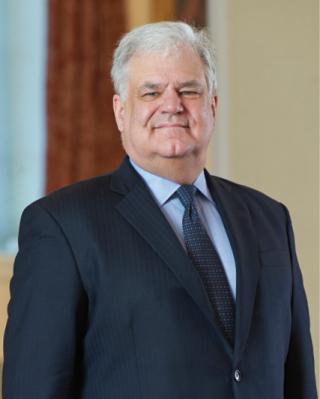
Sitting in the classroom and occasionally commenting were the class’s two founders, Stuyvesant P. Comfort Professor of Law Geoffrey Miller and David Yermack, Albert Fingerhut Professor of Finance and Business Transformation at NYU Stern. When they launched the course, it was the first of its kind at a leading law school. (Raskin was among the first students to take it.) Back in 2014, “crypto” was the domain of libertarian idealists and the dark web, but Miller and Yermack—who were colleagues at the NYU Law/NYU Stern Pollock Center for Law and Business—were intrigued by the technology’s potential.
“Satoshi Nakamoto is probably the most important contributor to the future of finance of the 21st century,” Miller says of Bitcoin’s alleged and elusive creator. Nakamoto’s celebrated 2008 whitepaper, “Bitcoin: A Peer-to-Peer Electronic Cash System,” laid the foundation for a monetary system where transactions are validated by network participants rather than a bank. Undergirding this system was a distributed and immutable digital ledger that came to be known as the blockchain—which Yermack believes to be the most revolutionary development in finance since double-entry bookkeeping in the 16th century.
“Bitcoin has never been hacked, and never will be hacked without an effort that’s well beyond anybody’s capacity right now,” Miller says, though he and Yermack remained mindful that cryptocurrencies could fail. “We were never sure in the early years that there would even be a course to teach next year,” he says.
Nakamoto, whose identity has never been confirmed, disappeared in 2010, leaving behind what is now worth approximately $75 billion in inaccessible Bitcoin holdings. But Bitcoin continued—passing the Bahamas test—and its secure transactional technology went on to foster a flood of digital currency products, from Ethereum, which can now be held in tax-deferred retirement accounts, to Dogecoin. Today digital currencies like Bitcoin have been adopted by nations such as El Salvador and the Central African Republic.
Most recently, President Trump signed the GENIUS Act in July 2025, the first US law designed to regulate asset-backed cryptocurrency, known as stablecoin. The world’s largest banks then piled on, including Bank of America, Goldman Sachs and UBS, all of which have committed to creating blockchain-based assets pegged to G7 currencies.
The drama around digital currency since the course’s inception has made for a topical, constantly-morphing curriculum. Bitcoin’s valuation alone has been a wild ride, climbing from roughly $900 in 2014 to just under $70,000 as of March 2026. To avoid the appearance of a conflict of interest, neither Miller nor Yermack has ever traded in Bitcoin nor any other cryptocurrency. For them, its value lies in how students can learn from the issues surrounding it.
“Cryptocurrency is a new type of money, issued by computer algorithms instead of a political authority,” says Yermack. “This leads to a lot of interesting questions about money, banking, and regulation, and in my opinion those questions are almost exactly the same today as when we started the course in 2014.”
The course includes varied readings that provide a rich and textured history of digital currency, such as the Nakamoto White Paper; the sentencing transcript for Silk Road founder Ross Ulbricht after his conviction for Bitcoin-enabled narcotics trafficking (Ulbricht was later pardoned by President Donald Trump); studies on Bitcoin’s electricity consumption; the evolution of non-fungible tokens (NFTs); Trump’s speech at the Libertarian Party convention in 2024; and an April 2025 Department of Justice memo, “Ending Regulation by Prosecution,” which shut down the DOJ’s cryptocurrency enforcement team.
According to Miller, an understanding of the legal and technical issues around digital currency is now essential for students wishing to enter banking and securities law: “Lawyers need to be ‘teched up.’ The ABA already recognizes competence in technology as essential to effective legal practice.”
Yermack observes that the biggest change he’s seen in a dozen years of teaching the class has been in students’ motivations for taking it. While early followers of cryptocurrencies may have been intrigued by speculative fortunes or the promise of global banking revolution, today’s students have much more focused career goals related to cryptocurrency. “There are a lot of job opportunities now in areas such as stablecoins and crypto asset management that didn't really exist when we began in 2014,” he says.
Expanded opportunities appear to have driven this spring’s strong enrollment, which featured an approximately equal split of law and business students, as well as a few from NYU’s Tandon School of Engineering.
"I came to law school to study financial regulation, and the regulation of digital assets is an incredibly timely subject,” says Nicole Beckman, a 2L enrolled in the class this spring who is also externing at the Securities and Exchange Commission. She says she was particularly drawn to Miller’s established reputation as a scholar in the nascent space, viewing him as “prophetic in recognizing the impact crypto would one day have.”
As crypto is increasingly embraced by the establishment, its future path is likely to be significantly more staid than its history, according to Raskin. “Stablecoins are called coins, but they’re just a novel payment mechanism,” he says. “They don’t have the qualities that really undergirded what I think of as the revolution in crypto.”
Miller, Yermack, and Raskin all predict a future where digital currency becomes so much a part of the financial system that their course materials will work their way into the mainstream law and business curricula. In the meantime, the class still holds allure for those drawn to the speculative nature of crypto investing.
“The enrollment is in direct proportion to the price of Bitcoin, so we have very good enrollment this semester,” says Miller, who notes that Bitcoin reached its highest-ever price of $126,198 in October 2025. “But next semester, we’ll have to see.”