Now part of BWLC, the Marcy Syms Equality Initiative works to advance the Equal Rights Amendment

Marcy Syms
A five-year-old initiative focused on the proposed Equal Rights Amendment (ERA) to the US Constitution has found both a new name and a new home. On February 27, during the Birnbaum Women’s Leadership Center’s (BWLC) Dechert Symposium, faculty director Melissa Murray announced that the Marcy Syms Equality Initiative, formerly the ERA Project, will be a permanent part of the BWLC. Its new name honors a generous gift from philanthropist and business executive Marcy Syms, president of the Sy Syms Foundation, a founder and supporter of the project since its launch at Columbia Law School in 2021. The initiative joined NYU Law in May 2025.
The mission of the Syms Equality Initiative is to develop policy, strategy, and research aimed at advancing the ERA and the values it codifies. “We could not be more grateful and delighted for the rich vision, wisdom, and generosity that [Syms] brings to this work,” said Murray, who is Frederick I. and Grace Stokes Professor of Law. NYU Law is a natural home for the Syms Equality Initiative, she said, noting that the Law School produced its first women graduates in 1892: “[NYU Law] has long been, and it continues to this day, to be a catalyst for gender justice.”
The ERA states in its entirety: “Equality of rights under the law shall not be denied or abridged by the United States or by any State on account of sex.” It has satisfied the requirements for constitutional amendments under Article V of the Constitution, says Ting Ting Cheng, director of the Syms Equality Initiative: passage by Congress, achieved in 1972, and ratification by 38 state legislatures, achieved in 2020. As a political matter, procedural hurdles stand in the way of its finalization and perceived legitimacy, but Congress has, and can again, pass joint resolutions to remove these hurdles, Cheng says.
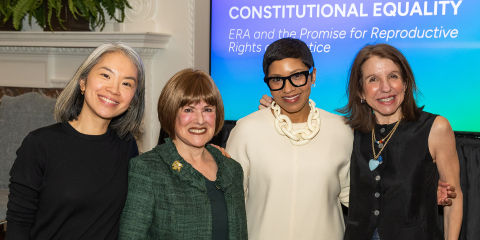
In her remarks at the Dechert Symposium, Syms, former CEO and president of the Syms Corp., reflected on her career and her hopes for the future of gender and sex equality in American law. “I learned what it meant to lead, and I learned over and over again what it meant to be a woman in spaces where women were an afterthought at best and invisible at worst. My years in business fueled both my feminism and my philanthropy,” Syms said. “I make this gift because I believe, with every fiber in my being, that women deserve to be in the Constitution. We must be in the Constitution. I made it because I have spent my life watching women be left out: left out of boardrooms, left out of medical research, left out of history books, and left out of the founding document of this republic—which, if we want to save it, we must get women into the Constitution.”
“The ERA is not—contrary to popular belief, perhaps—a dead battle. It still poses really interesting questions of organizing, and politics, and the law. The ERA project really stands apart as the academically-grounded think tank that is so imperative to all of the organizing that needs to be done at the same time, in part because it’s always important to have that scholarly grounding, and also in part because it is complicated,” says Jennifer Weiss-Wolf, director of the BWLC. “So to have that kind of resource for the entire movement is extremely valuable.”
“[Marcy Syms] had the vision to create something that would go deeper into the question of what the ERA is beyond ‘Let’s get it across the finish line,’” said Cheng at the March 5 event. “[Her] commitment to have the work be durable, permanent, sustainable and also to bring it to NYU—which has the spirit of feminism all over it—is a really wonderful kind of partnership,” Cheng added. “….We’re just at the tip of the iceberg here, and at the beginning of the work that we are doing to chart long-term change and gender justice. And we owe it to Marcy's leadership and vision and her support.”
Syms says that she hopes that the new partnership will present new opportunities to NYU Law students. “I’m optimistic that this initiative will ignite students in the Law School to want to do, to volunteer around this work, to get involved with this work to be part of this future. And that's one of the really exciting things to me about being associated with NYU Law.”
Discussions at the Dechert Symposium brought together experts on equality and reproductive justice to examine the path forward for the ERA and efforts to build gender equality. Panels focused on the potential impact of the ERA on American social and political life; on state ERAs as laboratories for gender justice; and on international models for charting the ERA’s future.
Kimberly Mutcherson of Rutgers Law School, who moderated the first panel, called for a new era of advocacy following the US Supreme Court’s revocation of constitutional abortion rights in Dobbs v. Jackson Women’s Health Organization. “We are in a very serious and very important rebuilding project [for equality and reproductive rights], which gives us an opportunity to build back in a way that seeks to fix some of the mistakes of the past,” said Mutcherson. “In a world in which abortion is no longer a protected federal constitutional right and the entire existence of substantive due process, including the fundamental right to privacy, is at risk,…there’s great opportunity to ask for more of our Constitution, more of our courts, and certainly more of our legislatures.”
A lunchtime discussion, moderated by Cheng, featured Murray; Jennifer Klein of Columbia University’s School of International and Public Affairs, and Jamia Wilson, executive editor at Random House and co-host of the podcast Ordinary Equality. They discussed the unique importance of adding the ERA to the Constitution and why existing law—like the 14th Amendment—is important but not sufficient for ensuring sex and gender-based equality.
“One thing that does bring us together is the law, and that’s a story, too,” said Murray. “That is a story that we have to tell, and perhaps tell in a different way, so that we can shape the way other stories are received.”